Locations:





CLE Cares symposium explores the condition like nothing before
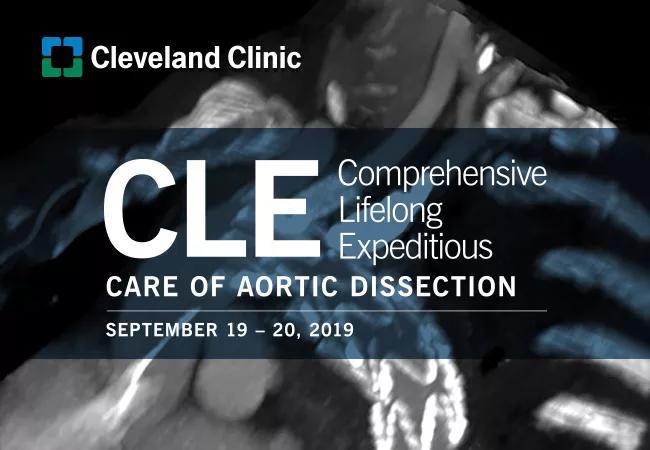
Image content: This image is available to view online.
View image online (https://assets.clevelandclinic.org/transform/1fb44a1d-9e78-4daf-9af2-c6ea7428228c/19-HRT-332-Aortic-Dissection-CQD-2_jpg)
19-HRT-332-Aortic-Dissection-CQD-2
You may have completed continuing education on aortic dissection before, but there’s little chance you’ve encountered a CME activity that delves into the topic quite the way the CLE Cares Aortic Dissection Symposium will.
Advertisement
Cleveland Clinic is a non-profit academic medical center. Advertising on our site helps support our mission. We do not endorse non-Cleveland Clinic products or services. Policy
The two-day CME event, subtitled “Comprehensive Lifelong Expeditious Care of Aortic Dissection,” will be held in Cleveland Thursday, Sept. 19, and Friday, Sept. 20, 2019, at the InterContinental Hotel & Conference Center on Cleveland Clinic’s main campus.
“This symposium promises one of the most intensive and dynamic explorations of aortic dissection care ever offered anywhere, based on extraordinary efforts to merge the latest evidence with practical insights from real-world practice,” says course co-chair Eric Roselli, MD, Director of Cleveland Clinic’s Aorta Center.
Below are six specific reasons the symposium is not be missed by clinicians who encounter aortic disease on a fairly frequent basis.
From choice of optimal imaging modality to treatment of acute ascending and distal dissection, and from aortic embryology to the chronic care of dissection survivors, the symposium covers nearly every conceivable issue and subtopic in aortic dissection management. And it does so with an explicitly practical orientation across 11 sessions with the following titles: Inside the Aorta; What Happened Before?; The Moment of Reckoning; When the Patient Arrives; Seeing Is Believing — Confirming the Diagnosis; Prepping the Field: Insights from the Ground Crew; Treating Acute Ascending Dissection; Treating Acute Distal Dissection; We Survived — Now What?; Treatment in the Chronic Phase; and Point-Counterpoint.
Whether you’re a cardiothoracic surgeon, cardiologist, interventionalist or vascular surgeon (or an advanced practice provider in one of these areas), the symposium has plenty for you — and, importantly, offers guidance on how best to collaborate with care team members from other disciplines. This multidisciplinary take was ensured by the symposium’s multidisciplinary leadership team: In addition to Dr. Roselli, who is a cardiothoracic surgeon, course co-chairs include cardiologists Milind Desai, MD, and Venu Menon, MD, as well as Sean Lyden, MD, Chair of Vascular Surgery. In addition to these specialties, faculty also include specialists from disciplines such as genetics, pathology, radiology, anesthesiology, nursing, pharmacy and more.
Advertisement
The agenda covers so much ground thanks to efficient programming in which all presentations are 10 minutes long, with faculty instructed to thoughtfully focus their specific expertise into accessible segments emphasizing key takeaways and essential evidence. Frequent breaks allow for follow-up with faculty for more in-depth discussion if desired.
More than half of the 11 sessions conclude with case presentations and panel discussions that include audience response questions. This allows for synthesis of the focused subspecialist perspectives from earlier in the session and further carries out the symposium’s mission of practicality. In addition to these abundant case presentations, the program features a live case of TEVAR for subacute dissection and a live OR case involving frozen elephant trunk repair. The format mix is further diversified through use of point/counterpoint presentations to explore multiple issues. In fact, point/counterpoints make up the entirety of the final session, in which various experts use video case presentations to advocate for differing management approaches to challenging clinical scenarios.
All these discussions and debates feature expert speakers and panelists from across Cleveland Clinic, which has long run the world’s busiest and most acclaimed program for aortic disease, as well as celebrated clinical experts from leading centers in the U.S. and Europe. “Attendees will be privy to the clinical decision-making insights of some of the premier aortic disease clinicians in the world,” Dr. Roselli notes.
Advertisement
If the above substantive reasons aren’t enough, keep in mind that Northeast Ohio is typically one of the most pleasant locales in the nation in mid-to-late September. Before and after sessions, enjoy the mild daytime temperatures and the first hints of autumn in the crisp evening air.
For a detailed agenda and registration information, visit ccfcme.org/aorticdissection19.
This activity has been approved for AMA-PRA Category 1 Credit™.
Advertisement
Advertisement
A sampling of outcome and volume data from our Heart & Vascular Institute
Concomitant AF ablation and LAA occlusion strongly endorsed during elective heart surgery
Large retrospective study supports its addition to BAV repair toolbox at expert centers
Young age, solid tumor, high uptake on PET and KRAS mutation signal risk, suggest need for lobectomy
Surprise findings argue for caution about testosterone use in men at risk for fracture
Residual AR related to severe preoperative AR increases risk of progression, need for reoperation

Findings support emphasis on markers of frailty related to, but not dependent on, age
Provides option for patients previously deemed anatomically unsuitable
 Search