Locations:





26th annual offering will mix the tried and true with emerging developments
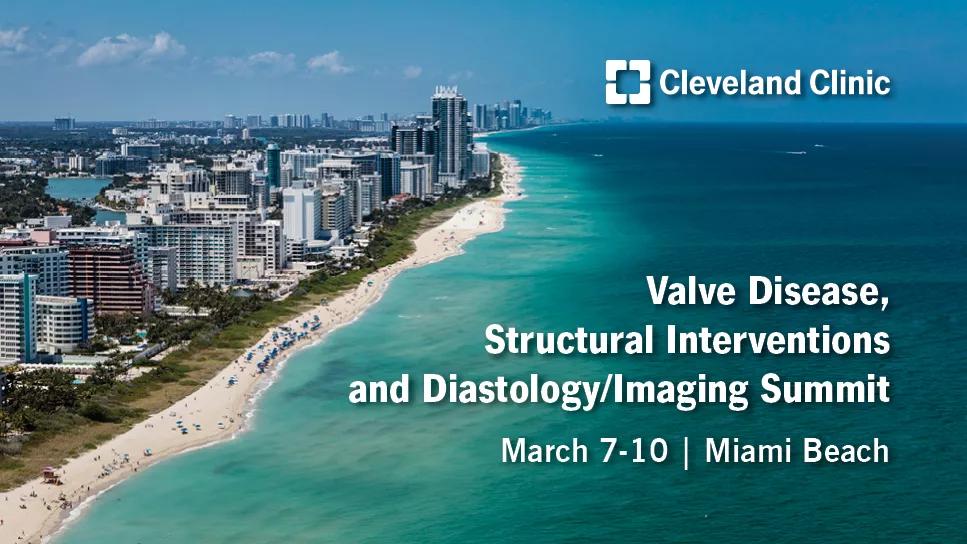
Image content: This image is available to view online.
View image online (https://assets.clevelandclinic.org/transform/eaf8443b-f202-46cf-a9f4-6653b1ffa543/23-HVI-4310410-CQD-967x544-1_jpg)
photo of miami beach with text about a CME course
Cleveland Clinic’s Valve Disease, Structural Interventions and Diastology/Imaging Summit ― which was offered for the 25th time in early 2023 ― will begin its second quarter century in March 2024 by combining its established strengths with explorations of emerging practice developments. The popular annual CME course is being held at Fontainebleau Miami Beach in Miami Beach, Florida, from Thursday to Sunday, March 7-10, 2024.
Advertisement
Cleveland Clinic is a non-profit academic medical center. Advertising on our site helps support our mission. We do not endorse non-Cleveland Clinic products or services. Policy
“This year, in addition to addressing the latest in valvular heart disease, structural interventions and new advances in imaging, we will explore the role of artificial intelligence as well as timely controversies in clinical practice,” says summit director Allan Klein, MD, a cardiologist who directs the Pericardial Diseases Center in Cleveland Clinic’s Section of Cardiovascular Imaging. “Many presentations will be case-based, featuring a practical approach to management. These will be complemented by debates, hands-on workshops and panel discussions.”
Topically, the focus will be on mitral, aortic and tricuspid valve disease as well as developments in structural interventions, including transcatheter aortic valve replacement (TAVR), transcatheter edge-to-edge repair (TEER), valve-in-valve procedures and left atrial appendage occlusion. Additional sessions are devoted to diastology and myocardial and pericardial diseases, as well as sarcoid disease, congenital heart disease, mechanical support in heart failure and contrast echocardiography.
The faculty of over 20 expert clinicians from Cleveland Clinic and other top U.S. centers includes leaders in cardiovascular imaging, interventional cardiology, electrophysiology and other cardiology subspecialties as well as cardiothoracic surgeons, sonographers and researchers. “We will be tapping the expertise of leaders in intervention, interventional echocardiography, CT, CMR and more,” notes Dr. Klein.
A focus throughout will be practical application of the latest relevant practice guidelines and consensus statements on valves, structural interventions, pericarditis, hypertrophic cardiomyopathy and amyloid disease. “This course offers attendees the best opportunity to get up to date on issues in cardiovascular imaging and structural heart disease,” says summit co-director Leonardo Rodriguez, MD, Program Director of Cleveland Clinic’s Advanced Imaging Fellowship.
Advertisement
The summit’s pace will be brisk, featuring presentations five to 12 minutes in length and often organized around illustrative cases. These focused talks will be integrated into interactive panel discussions at the end of each of the seven broad topical sessions.
The agenda is punctuated by a series of case workshops and a pair of hands-on “how to” sessions — one on 3D reconstruction and cropping in valve disease, and one on strain imaging and diastology.
The format will be further diversified by a series of pro/con debates — on TEER versus surgery for primary mitral regurgitation, on TAVR versus surgical AVR for an active 65-year-old, and on whether artificial intelligence will replace echocardiographers in the future. Artificial intelligence will also figure into one of the case workshops.
“Our program is updated every year to provide state-of-the-art reviews across all areas of valve disease, structural interventions and diastology,” says summit co-director Christine Jellis, MD, PhD, of Cleveland Clinic’s Section of Cardiovascular Imaging. “With a focus on innovation and drawing on Cleveland Clinic’s vast experience, we are able to showcase new technologies, provide practical clinical pearls and give hands-on technical training through interactive workshops.”
Another opportunity for hands-on instruction is offered in a bonus two-hour “Learning Lab for Interventional Echo” on Thursday evening, March 7, before the start of the summit the next morning. This lab — limited to 25 attendees and subject to an additional registration fee — provides hands-on practice in 3D transesophageal echo and multiplanar reconstruction to inform structural heart interventions.
Advertisement
The meeting itself takes place Friday through Sunday, with early starts each day and adjournment by 1:00 p.m. to allow attendees to enjoy the Miami Beach sunshine. Attendees will have abundant opportunities to interact directly with expert faculty at breaks and meals throughout the summit.
“Structural intervention and cardiovascular imaging are evolving at an unprecedented pace,” says summit co-director Samir Kapadia, MD, Chair of Cardiovascular Medicine at Cleveland Clinic. “This course will feature thought leaders’ takes on many of these innovations and provide ideal opportunities for interaction at a great venue.”
For more information and to register, visit ccfcme.org/echo.
This activity has been approved for AMA PRA Category 1 Credit™.
Advertisement
Advertisement

A sampling of outcome and volume data from our Heart & Vascular Institute

Concomitant AF ablation and LAA occlusion strongly endorsed during elective heart surgery

Large retrospective study supports its addition to BAV repair toolbox at expert centers

Young age, solid tumor, high uptake on PET and KRAS mutation signal risk, suggest need for lobectomy

Surprise findings argue for caution about testosterone use in men at risk for fracture

Residual AR related to severe preoperative AR increases risk of progression, need for reoperation

Findings support emphasis on markers of frailty related to, but not dependent on, age

Provides option for patients previously deemed anatomically unsuitable
 Search