Locations:





Clinical trial aims to determine whether candidacy should be redefined
Image content: This image is available to view online.
View image online (https://assets.clevelandclinic.org/transform/019e8e8e-c305-44c2-8f3b-7b481e17a81c/14-ENT-2027-Woodson-Hero-Image-690x380pxl1_jpg)
14-ENT-2027-Woodson-Hero-Image-690x380pxl
By Erika Woodson, MD, FACS
Advertisement
Cleveland Clinic is a non-profit academic medical center. Advertising on our site helps support our mission. We do not endorse non-Cleveland Clinic products or services. Policy
The Hearing Implant Program at Cleveland Clinic, which has long been at the forefront of technology for the rehabilitation of advanced hearing loss, is pleased to announce that we will be participating in the latest FDA trial of cochlear implants (CIs) in adults.
The CI422 study will determine whether we can use newer, more challenging test methods to demonstrate that patients benefit from CIs under expanded eligibility criteria (Figure). This study is sponsored by Cochlear Americas, a manufacturer of hearing implant devices.
Traditional CI candidacy has been determined by measuring a patient’s sentence comprehension when listening binaurally with optimized hearing aids in both ears. Over time, candidacy tests have evolved from the easier hearing-in-noise tests (HINTs) to the more difficult AzBio test. However, the AzBio test still falls short of measuring hearing handicap in real-world conditions.
The aim of the CI422 study is to determine if additional, more challenging testing is necessary, and if patients who perform “too well” on HINT and AzBio testing may still obtain a greater benefit with a CI than with hearing aids alone. Our findings may ultimately pave the way for patients with significant but not profound hearing loss to qualify for cochlear implantation.
The Hearing Implant Program has robust experience with patients whose hearing has traditionally been considered too good for a CI. Many of these patients have a sharply sloping sensorineural hearing loss, with good low-tone thresholds and profound high-frequency deafness. They can hear speech, but they must rely on contextual clues to differentiate words. A CI in these cases restores hearing at the high frequencies, which allows patients to hear much better in a variety of listening situations.
Advertisement
Moreover, we can often save low-frequency hearing in the implanted ear, which allows for better sound localization and music appreciation and even greater listening abilities in the presence of background noise.
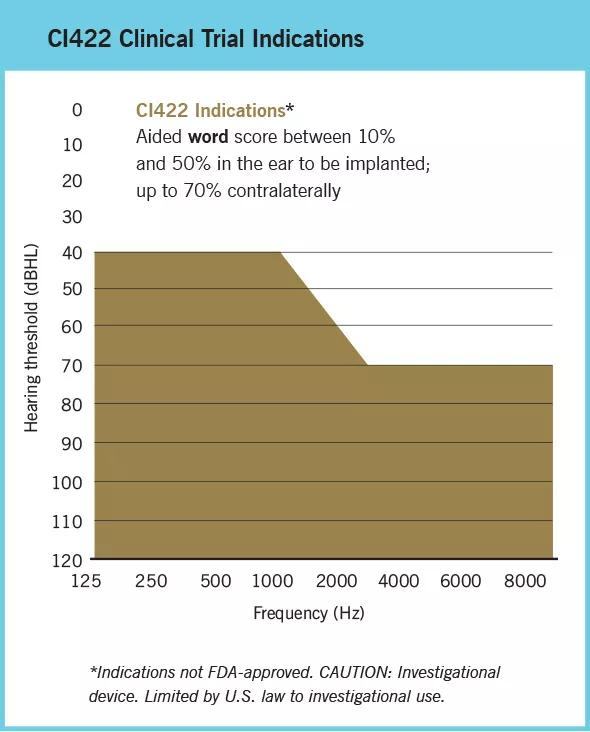
Image content: This image is available to view online.
View image online (https://assets.clevelandclinic.org/transform/b2ae28ea-e093-42e7-af9d-f84dfab2b190/14-ENT-2027-Woodson-Inset-Image-Graph-590pxl-width_jpg)
Figure. Audiometric parameters of the CI422 study. Graph adapted, with permission, from Cochlear Americas.
Advertisement
Advertisement
With a wide scope of skills, comprehensive otolaryngologists care for patients of all ages in the community
Research on children with UHL explores the quality-of-life benefits and outcomes of cochlear implants
A look at how custom-fitted oral appliances work and when they’re a good fit for patients
Subtle information gleaned from clinical examinations prompted concern
A new single-port system well-suited for oropharyngeal cancer treatment
Challenging case requires outside-the-box approach
Collaborative and multidisciplinary approach necessary for treatment
The tri-vector gracilis procedure uses a thin muscle from the thigh to help create a natural mimetic smile
 Search