Locations:





A look at Cleveland Clinic’s future 377,000-square-foot cancer building
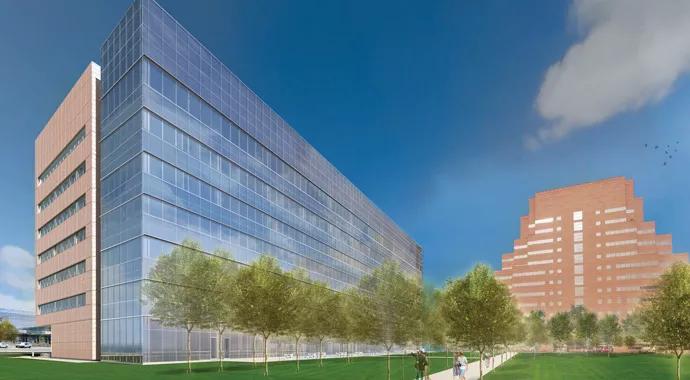
Image content: This image is available to view online.
View image online (https://assets.clevelandclinic.org/transform/0458144f-cebe-4a31-8f1c-7d9708a7fe9f/Cancer-east-690-x-380_jpg)
Cancer-east-690-x-380
When Cleveland Clinic’s 377,000-square-foot cancer building opens in 2017, several things will be apparent on the surface: the flow of patients, the abundance of natural light, the presence of support services mixed in with clinical care.
Advertisement
Cleveland Clinic is a non-profit academic medical center. Advertising on our site helps support our mission. We do not endorse non-Cleveland Clinic products or services. Policy
If physicians and patients look deeper, though, they will find a facility designed expressly to improve patient outcomes through a collaborative, disease site-specific approach to cancer care.
The idea: Patients benefit from their oncologists, surgeons, radiation oncologists, social workers and other team members working together in close proximity. They also benefit from having an infusion suite close to their doctor’s clinic, negating the need for multiple appointments and — along with many other such efficiencies — ultimately bringing healthcare costs down.
Such cancer care is already the norm in practice at Cleveland Clinic, but being scattered in multiple locations across campus presents challenges, both for practitioners and for patients. The new multidisciplinary cancer building aims to bring it under one roof.
“The new cancer building will allow us to centralize the cancer care we provide, creating a seamless, personalized experience for patients,” says Brian J. Bolwell, chairman of Cleveland Clinic’s Taussig Cancer Institute. Improving outcomes and designing clear care paths — customized by specific disease states — are both major goals.
Multidisciplinary work has existed for years, but the focus of organizing multidisciplinary groups by disease — teams focused around breast cancer, head and neck cancer, and other specific cancer types — will receive new emphasis in the facility.
Each disease group will have its own dedicated clinical practice area on a floor of the new facility, where a patient’s physician is mere steps away from a private or semi-private treatment room. Likewise, each practice area will space for sub-specialized nurses, social workers and other key team members, plus exam and procedure rooms. For example, even though this will be an outpatient facility with surgeries performed elsewhere, surgeons will have the space and equipment needed to perform consults with patients on-site.
Advertisement
Growth in patient care
Patient volume has increased in all disease groups, with growth as high as 35 percent for some groups in 2013. However, increased patient demand is far from the only reason behind the need for such a facility
In addition to the clinical focus on disease groups, the new facility will expand existing patient services and improve the way they are delivered. For example, because genetic counseling improves patient outcomes, the facility will offer space dedicated to this practice, as well as genetics and genomics testing.
The facility will offer a new, centralized home for existing high-level treatment technology, including 6 linear accelerators and a Gamma Knife suite. It also will include additional space to expand tumor boards, and link community locations into these discussions.
Beyond clinical services, the facility also will house critical support needs such as registered dietitians, prosthetics, wig services and a spiritual center.
“Cancer patients are uniformly scared,” Dr. Bolwell, said in a recent interview with Crain’s Cleveland Business. “We have to provide many different ways to help patients and their families deal with the medical aspect of their disease but also the psychological aspect.”
Accelerating Phase 1 research
Enhanced space matters as much for researchers as it does for care teams, Dr. Bolwell notes. The new building will have space dedicated to Phase I, II and III clinical trials — with a special emphasis on supporting Phase 1 trials.
Advertisement
Patients enrolled in a Phase I trial will have access to a full clinical care team. Hosting such trials on-site not only provides added support for patients but also eliminates unnecessary travel to other locations, especially for those whose doctors are located at the facility. The goal, at least partly, is to ease the process for people who are willing to participate in this crucial undertaking.
As with clinical care, another goal is to bring full teams — including researchers, clinicians, technicians, pharmacists and others involved in any given trial — into a common space to ease access issues and help trials run more efficiently. Doing so ultimately will aid the goal of clinical trials and move treatments that prove effective forward, to the benefit of more patients.
Advertisement
Advertisement
First-of-its-kind research investigates the viability of standard screening to reduce the burden of late-stage cancer diagnoses

Global R&D efforts expanding first-line and relapse therapy options for patients
Study demonstrates ability to reduce patients’ reliance on phlebotomies to stabilize hematocrit levels
A case study on the value of access to novel therapies through clinical trials

Findings highlight an association between obesity and an increased incidence of moderate-severe disease
Cleveland Clinic Cancer Institute takes multi-faceted approach to increasing clinical trial access 23456
Key learnings from DESTINY trials

Overall survival in patients treated since 2008 is nearly 20% higher than in earlier patients
 Search