Locations:





An exacting emphasis on precision approaches
Because of their relative rarity, sarcomas, including those in the retroperitoneum, require a high level of expertise to treat and manage. In addition, these cancers can be locally aggressive, so expediency remains essential when providing each patient with radiation therapy, systemic chemotherapy and/or surgery.
Advertisement
Cleveland Clinic is a non-profit academic medical center. Advertising on our site helps support our mission. We do not endorse non-Cleveland Clinic products or services. Policy
Not content to treat patients with currently available therapies, staff at centers like Cleveland Clinic are developing innovative approaches and conducting leading-edge research on retroperitoneal sarcomas.
One goal of radiation therapy is to shrink the tumor before surgery; this neoadjuvant approach generally increases chances for complete tumor removal. In some cases, radiation treatment after surgery is used to target and kill any residual cancer cells.
Radiation oncologists at Cleveland Clinic generally target retroperitoneal sarcomas in one of two ways:
Brachytherapy. In this strategy, physicians place one or more catheters in the area surrounding the tumor or its resection bed to deliver radiation therapy directly to the sarcoma. Brachytherapy can often deliver a higher dose of radiation faster and in a more conformal/targeted way as compared to standard external beam radiation. Radioactive implants in these cases are temporary.
Interstitial brachytherapy is one of the unique treatments for retroperitoneal sarcoma offered by Chirag Shah, MD, and Jacob Scott, MD, radiation oncologists at Cleveland Clinic. Very few centers in the U.S. offer this treatment, and Drs. Shah and Scott were recently co-authors on national guidelines regarding this technique.
External beam radiation therapy. In external beam radiation, a linear accelerator device directs beams of high-energy radiation at the tumor from outside the body.
An advantage of this external delivery is flexibility; physicians can target the tumor from any angle. Most people receive a series of treatments, typically five days a week for five to six weeks.
Advertisement
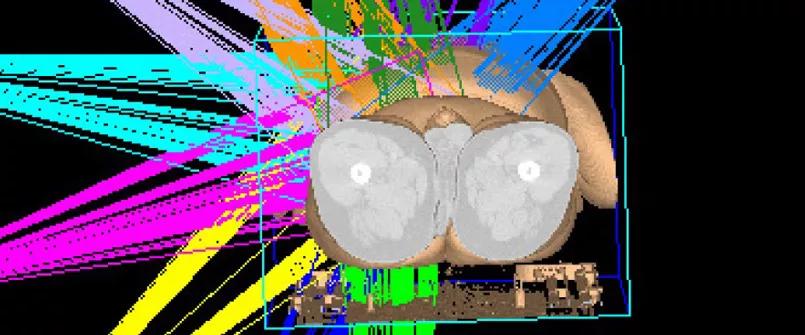
Image content: This image is available to view online.
View image online (https://assets.clevelandclinic.org/transform/c7c3e6dc-4f10-4083-b879-35033ef63d5c/RP-Sarcoma_805x335_jpg)
A 3-D surface representation showing external beam radiation therapy to treat retroperitoneal sarcoma.
“We also perform image-guided radiation therapy where we can perform daily tracking of the patient’s tumor with a CT scanner attached to a linear accelerator during external beam radiation therapy,” Dr. Shah says. This helps ensure radiation accurately targets the changing tumor throughout the series of treatments.
In conjunction with external beam, Cleveland Clinic is one of the few centers that also offers patients an intraoperative radiation therapy boost following external beam radiation therapy for cases that require additional treatment.
Retroperitoneal sarcomas often arise very close to healthy, vital tissue and organs. Radiation oncologists strive to effectively target the tumor while sparing surrounding structures, which often requires a high level of expertise and experience.
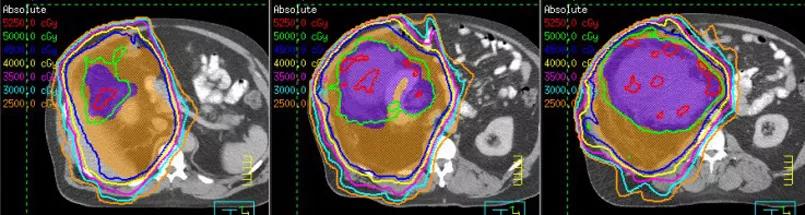
Image content: This image is available to view online.
View image online (https://assets.clevelandclinic.org/transform/e8c319c3-4608-4023-88c8-ba629fb18913/RP-inset-2_805x215_jpg)
Images of radiation treatment plan for retroperitoneal sarcoma sparing normal tissue structures.
Dr. Shah and colleagues are evaluating new radiation therapy strategies for retroperitoneal sarcomas that further refine the ability to minimize risk to nearby organs. In so doing, they also hope to minimize some of the side effects patients experience. For example, they are utilizing techniques such as simultaneous integrated boost and differential dose per fractions that deliver higher doses to areas away from tissues at risk while at the same time rapidly reducing doses near critical structures.
To maximize the likelihood of a successful outcome, international guidelines recommend referral of patients to a high-volume center with a collaborative, multidisciplinary team of physicians adept at addressing retroperitoneal sarcomas.
Advertisement
The European Society for Medical Oncology (ESMO) and the European Network for Rare Adult Solid Cancer (EURACAN), for example, support coordinated, expert care for retroperitoneal sarcomas in new guidelines released on May 28, 2018.
Historically, at many cancer centers, a patient would complete treatment from radiation oncologists, then be passed along to surgeons for resection and later to medical oncologists to plan for systemic therapy. Treatment coordination starts right away at Cleveland Clinic.
“The minute the patient is brought in, the radiology team that will be reviewing imaging and coordinating biopsies discusses the case in conjunction with the surgeon, medical oncologist and radiation oncologist,” Dr. Shah says. “We also incorporate genetics, psycho-oncology and supportive care services from day one.”
Dr. Shah and colleagues see more than 175 newly diagnosed sarcoma patients each year. They receive requests for their expertise on more than 2,000 pathology consults annually from clinicians across the country.
“We also offer a wide spectrum of clinical trials, including surgery, radiation and chemotherapy studies,” Dr. Shah says. Examples include trials led by Lukas Nystrom, MD, Orthopedic Surgery, who is studying wound healing in radiated soft tissue sarcoma using transcutaneous oxygen; several clinical trials from Peter Anderson, MD, Pediatric Hematology Oncology and Blood and Marrow Transplantation, who specializes in pediatric sarcoma; and sarcoma chemotherapy trials led by Dale Shepard, MD, PhD, Hematology and Medical Oncology.
Advertisement
Ultimately, each patient and each retroperitoneal sarcoma presentation is unique. “The most important things to know are that these sarcomas can be quite aggressive locally, and they can recur.” When a physician sees a mass in the retroperitoneum, he or she should refer the patient to a high-volume sarcoma team right away, Dr. Shah adds.
Advertisement
Advertisement
First-of-its-kind research investigates the viability of standard screening to reduce the burden of late-stage cancer diagnoses

Global R&D efforts expanding first-line and relapse therapy options for patients
Study demonstrates ability to reduce patients’ reliance on phlebotomies to stabilize hematocrit levels
A case study on the value of access to novel therapies through clinical trials

Findings highlight an association between obesity and an increased incidence of moderate-severe disease

Cleveland Clinic Cancer Institute takes multi-faceted approach to increasing clinical trial access 23456
Key learnings from DESTINY trials

Overall survival in patients treated since 2008 is nearly 20% higher than in earlier patients
 Search