Locations:





Immunotherapy, PARP inhibitors and a targeted therapy
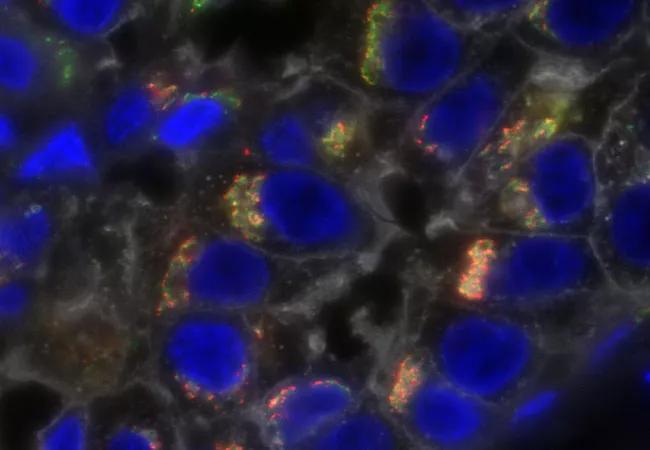
Image content: This image is available to view online.
View image online (https://assets.clevelandclinic.org/transform/11ed86bb-43c7-4712-b040-af3da9e9171f/nci-vol-10502_650x450_jpg)
nci-vol-10502_650x450
Breakthroughs have emerged in the treatment of triple-negative breast cancer (TNBC), an aggressive type of breast cancer that often strikes younger women and metastasizes. Researchers are testing immunotherapy, antibody-targeted chemotherapy and poly ADP ribose polymerase (PARP) inhibitors to see if patients with TNBC respond better when such treatments are given with chemotherapy.
Advertisement
Cleveland Clinic is a non-profit academic medical center. Advertising on our site helps support our mission. We do not endorse non-Cleveland Clinic products or services. Policy
In the recent phase 3 clinical trial, IMpassion130, researchers found that patients with metastatic TNBC had both a longer progression-free survival (PFS) (7.2 versus 5 months) and overall survival (OS) rate (21.3 versus 17.6 months) when they were treated with chemotherapy plus the anti-PD-L1 monoclonal antibody atezolizumab, compared with patients treated with chemotherapy and a placebo.
The trial also showed that patients whose tumors were programmed death-ligand 1 (PD-L1) positive, and who received atezolizumab plus chemotherapy, had longer PFS (7.5 versus 5 months) and OS (25 versus 15.5 months) than those who received chemotherapy and a placebo.
“I think this pretty strongly supports that TNBC patients with PD-L1 positive tumors should receive this in combination with chemotherapy as a frontline treatment,” says Alberto Montero, MD, staff in the Department of Solid Tumor Oncology. “However, one of the problems with all PD-L1 immune checkpoint antibodies is the absence of any reliable predictive markers.
“When we’re considering a medication like atezolizumab, we ask the pathology lab to stain the tumor for PD-L1, in the same way that it was measured in this study, since patients with PD-L1 positive tumors were reported to have derived more benefit from the addition of atezolizumab to chemotherapy.”
The FDA approved atezolizumab combined with chemotherapy for the treatment of PD-L1-positive, unresectable, locally advanced or metastatic TNBC in March 2019.
PARP inhibitors are among the most promising treatments for TNBC patients who carry the BRCA1 or BRCA2 mutation. PARP inhibitors may be particularly effective against cancers in people with BRCA mutations. The mutated cells use the base excision repair pathway for DNA repair. PARP proteins are an integral part of this pathway, and inhibiting that function can selectively targeted BRCA cells. Several PARP inhibitors, including olaparib and talazoparib, were recently approved by the FDA for use with chemotherapy in breast cancer patients.
Advertisement
“Talazoparib seems to be better than standard chemotherapy alone and less toxic, and it seems to be a more potent inhibitor than olaparib,” says Dr. Montero. “To my knowledge, they haven’t been compared head to head, but it’s another option for TNBC patients who have a BRCA mutation.”
One of the first targeted options for TNBC may soon be available. The FDA is performing a priority review on the antibody-drug conjugate sacituzumab govitecan, which binds to the TROP-2 protein — which is found in TNBC tumors — and releases a chemotherapy drug into the cancer cells.
In a recent phase 2 trial, metastatic TNBC patients who had failed prior therapies and received sacituzumab govitecan had a PFS of six months compared with 3.5 months in historical controls, and had an OS of 16.6 months compared with 10 to 13 months for historical controls. Investigators started recruiting for a phase 3 trial in January.
“There’s an unmet need here because there aren’t any targeted treatments yet for TNBC,” says Dr. Montero. “This one was studied in patients who’d had a lot of different treatments — so a pretty resistant disease setting. It would give a novel option for patients in a disease where we don’t have many.”
“Over the years, we’ve been looking for targeted treatments that can give triple-negative breast cancer patients better options,” he adds. “These new approaches are absolutely needed, and hopefully there will be even more in the near future.”
Image: Heterogeneity in triple-negative breast cancer. Source: National Cancer Institute. Creator: Kevin Janes.\
Advertisement
Advertisement

First-of-its-kind research investigates the viability of standard screening to reduce the burden of late-stage cancer diagnoses

Global R&D efforts expanding first-line and relapse therapy options for patients

Study demonstrates ability to reduce patients’ reliance on phlebotomies to stabilize hematocrit levels

A case study on the value of access to novel therapies through clinical trials

Findings highlight an association between obesity and an increased incidence of moderate-severe disease

Cleveland Clinic Cancer Institute takes multi-faceted approach to increasing clinical trial access 23456
Key learnings from DESTINY trials

Overall survival in patients treated since 2008 is nearly 20% higher than in earlier patients
 Search