Locations:





New models hope to advance understanding and treatment of these auditory disorders
Image content: This image is available to view online.
View image online (https://assets.clevelandclinic.org/transform/83cdbe57-9521-4bf3-b0c8-e0bb2ea3fbce/14-ENT-2033-Kaltenbach-Hero-Image-690x380pxl_jpg)
14-ENT-2033-Kaltenbach-Hero-Image-690x380pxl
Advertisement
Cleveland Clinic is a non-profit academic medical center. Advertising on our site helps support our mission. We do not endorse non-Cleveland Clinic products or services. Policy
Cleveland Clinic’s Auditory Neurobiology Laboratory has been on the cutting edge of hearing research ever since it was established in 2008. We were among the first to investigate the role of the cholinergic system in the modulation of tinnitus, and we continue to be pioneers in pharmacologic approaches aimed at treating this condition.
For example, we have succeeded in abolishing tinnitus-related hyperactivity in the dorsal cochlear nucleus, a component of the central auditory pathway that is key to tinnitus generation. We accomplished this by using a variety of cholinergic agonists in our in vivo tinnitus animal model. We are now moving toward the use of more selective molecules that will allow us to translate our therapeutic findings to the clinic. Preliminary results have been promising.
To further understand the effects of drug application on tinnitus-related neural activity, we are using innovative microscopic techniques to explore the anatomy and ultrastructural properties of tinnitus-generating neurons — the fusiform cells. By combining scanning electron microscopy with powerful computer software, we are able to accurately reconstruct the different layers and cellular components of the dorsal cochlear nucleus, where these neurons are located. Then we identify and trace individual neuronal elements, which allows us to generate 3-D renditions of the desired structures (Figure).
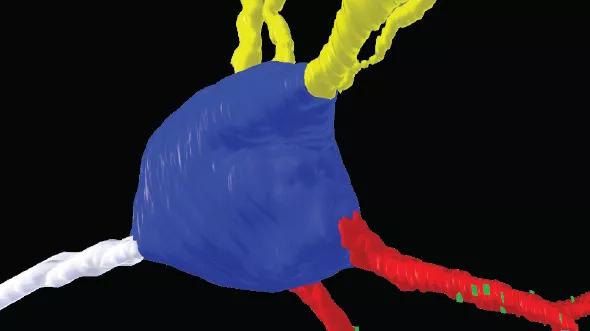
Image content: This image is available to view online.
View image online (https://assets.clevelandclinic.org/transform/e477e553-ccbb-45af-99e2-ab389616acd7/14-ENT-2033-Kaltenbach-Inset-Image-Fig-1-590pxl-width_jpg)
Figure. 3-D reconstruction of a fusiform cell neuron (blue: cell body; yellow: apical dendrites; red: basal dendrites; white: axon).
Advertisement
This approach is unprecedented. It has allowed us to accurately map the fusiform cells, as well as the synapses on the different compartments of these neurons. Then we can examine the various features that provide measures of synaptic strengths (i.e., the sizes of synaptic terminals, the number of active zones within a synapse and the size of active zones).
The value of this information lies in its ability to define synaptic mechanisms that contribute to tinnitus and hyperacusis. It also provides us with a better understanding of the neuronal disequilibrium that occurs in the setting of tinnitus, as well as the mechanism of action of the drugs we use to abolish tinnitus-related hyperactivity.
In addition to its long-standing history with tinnitus research, our lab has recently expanded its scope to cover yet another hearing condition: hyperacusis. Hyperacusis is a disorder of loudness perception in which sound intensities that are considered to be comfortable by most people are perceived as being unbearably loud, even painful, by affected patients.
We have recently established a first-of-its-kind animal model that exhibits chronic noise-induced hyperacusis and tinnitus simultaneously. Upcoming efforts are centered on establishing the first pure animal model of hyperacusis, which will allow us to accurately study the behavioral and neural correlates of hyperacusis. We expect this effort to pave the way for future research aimed at uncovering the neural signature of hyperacusis, which is essential if we hope to ever effectively treat or cure this condition.
Advertisement
Dr. Kaltenbach (kaltenj@ccf.org) is Director of Otology Research and Head of the Auditory Neurobiology Laboratory in the Head & Neck Institute. He is also a staff member in the Department of Neurosciences in the Lerner Research Institute.
Advertisement
Advertisement

With a wide scope of skills, comprehensive otolaryngologists care for patients of all ages in the community
Research on children with UHL explores the quality-of-life benefits and outcomes of cochlear implants
A look at how custom-fitted oral appliances work and when they’re a good fit for patients
Subtle information gleaned from clinical examinations prompted concern
A new single-port system well-suited for oropharyngeal cancer treatment
Challenging case requires outside-the-box approach
Collaborative and multidisciplinary approach necessary for treatment

The tri-vector gracilis procedure uses a thin muscle from the thigh to help create a natural mimetic smile
 Search