Locations:





Reflecting on our progress and potential
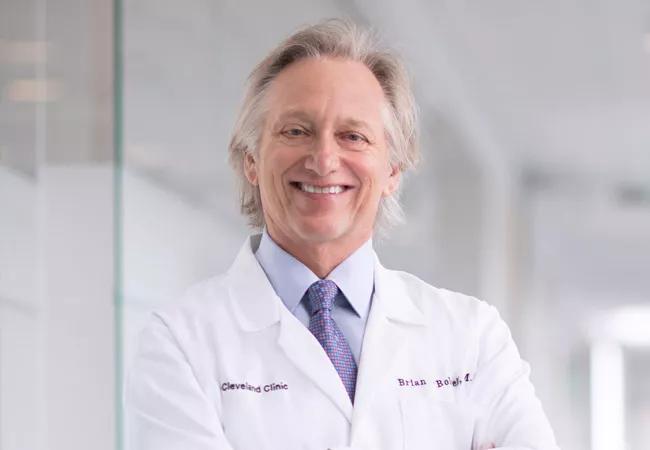
Image content: This image is available to view online.
View image online (https://assets.clevelandclinic.org/transform/591ea9b1-5501-40df-80a1-e5d4c8c6c8f3/bolwell50_650x450_jpg)
bolwell50_650x450
By Brian Bolwell, MD
Advertisement
Cleveland Clinic is a non-profit academic medical center. Advertising on our site helps support our mission. We do not endorse non-Cleveland Clinic products or services. Policy
As Cleveland Clinic celebrates 100 years of medical innovation and leadership in 2021, I can’t help but reflect on the immense changes that have occurred in cancer care in just the last decade or so. Cleveland Clinic Cancer Center has changed in two fundamental ways over the past 10 years.
First, we changed how we are organized to focus on cancer programming. Each cancer program is a disease-based team comprised of physicians from different specialties as well as nurses and other support staff. Team-based care for each cancer diagnosis is critical. Programming allows us to prioritize and structure different aspects of team-based care, including multidisciplinary clinics, tumor boards, care paths and reduction in time to treat. It’s a natural evolution of the group practice model Cleveland Clinic pioneered in 1921.
Secondly, cancer care in general has experienced major clinical shifts in both how we classify and treat cancers. Now instead of naming a cancer based solely on how it looks under a microscope, almost all cancer diagnoses these days are based on genomic or immunological abnormalities. This is a substantial change that has contributed to a paradigm shift in cancer therapeutics.
In recent years, immunological and genomic therapies have increasingly become standard of care. Ten years ago, these therapies were standard in a few cancers, and now they are part of care paths in a majority of cancers. The successes we’re seeing with this approach are heartening to those of us who treated patients in a time before they were available. The outcomes of immunologic therapies for diseases like melanoma and renal and lung cancers, among many others, are a springboard for more optimism about where the next ten years could take us. Our recently founded Center for Immunotherapy and Precision Immuno-Oncology will transform that optimism into action.
Advertisement
The other form of immunologic therapy that is generating major clinical improvement is cellular therapy, especially for hematological malignancies. Cleveland Clinic Cancer Center was part of a phase 2 trial of chimeric antigen-receptor T-cell therapies for large B-cell lymphoma and continues to engage in both clinical and basic research about this therapy. While it remains to be seen where successes will be found in the multitude of studies looking at cellular therapy for solid tumors, there will be exciting successes for our patients.
Finally, the innovations of the past few years have presented us with a new but welcome problem: survivorship. The advent of immunologic and, to some extent, genomic therapies have allowed people to live with cancer as a chronic disease. The implications of an increasingly large number of people living with cancer are wide ranging, from the development of additional abnormalities due to the interplay between immunologic drugs and genomic abnormalities, to the unknowns of long-term use of immunologic agents. Our researchers and clinicians are on the forefront of addressing these issues as they evolve over the coming years.
The world of cancer care is indeed very different than when many of us joined the field years ago, and the possibilities are striking and extraordinarily promising for our patients. That statement is not based solely in hope, but in the factual outcomes of the scientific advances of the past 20 or so years. We all have many years of discovery to look forward to as we build on a 100-year tradition of leadership in scientific innovation at Cleveland Clinic.
Advertisement
Dr. Bolwell is Chair of Physician Leadership and Development and former Chair of Taussig Cancer Institute
Advertisement
Advertisement
First-of-its-kind research investigates the viability of standard screening to reduce the burden of late-stage cancer diagnoses

Global R&D efforts expanding first-line and relapse therapy options for patients
Study demonstrates ability to reduce patients’ reliance on phlebotomies to stabilize hematocrit levels
A case study on the value of access to novel therapies through clinical trials

Findings highlight an association between obesity and an increased incidence of moderate-severe disease
Cleveland Clinic Cancer Institute takes multi-faceted approach to increasing clinical trial access 23456
Key learnings from DESTINY trials

Overall survival in patients treated since 2008 is nearly 20% higher than in earlier patients
 Search