Locations:





International effort allows experts to confer on complex cases
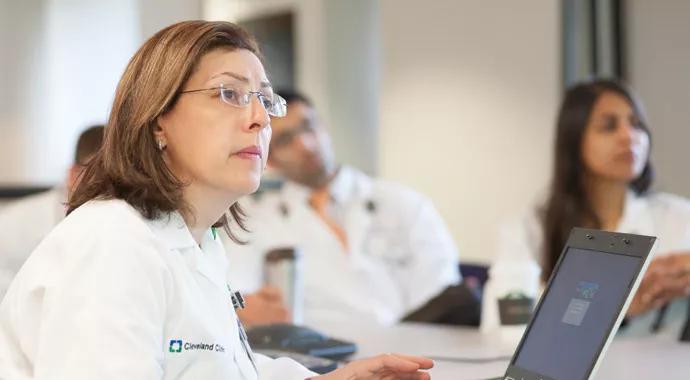
Image content: This image is available to view online.
View image online (https://assets.clevelandclinic.org/transform/06271510-e3c8-45b3-94d2-ae401fb1bbf8/Telemedicine-690_jpg)
Telemedicine-690
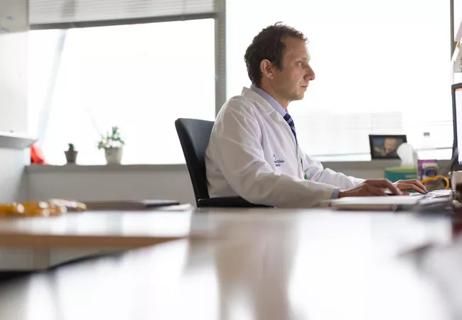
A new telemedicine program is bringing collaboration and international expertise to people fighting cancer across Africa, while providing global health training for Cleveland Clinic residents.
Advertisement
Cleveland Clinic is a non-profit academic medical center. Advertising on our site helps support our mission. We do not endorse non-Cleveland Clinic products or services. Policy
The African Radiation Oncology Network (Afro-NET) program strives to overcome inequalities in access to radiation therapy care and equipment across Africa’s varied geography and national borders. During the first two telemedicine collaborations in 2013, clinicians from Cleveland Clinic, Canada and Africa successfully came together online to confer on complicated cases. This approach is the vision of the International Atomic Energy Agency (IAEA) of Vienna, Austria.
An ‘international tumor board’
“This is an exciting collaborative effort that has far-reaching benefits for all involved,” says May Abdel-Wahab, MD, PhD, Section Head of Gastrointestinal Radiation Oncology at Cleveland Clinic. “We share cases, scans and patient histories and discuss ways to treat the patients.”
Dr. Abdel-Wahab is a consultant on the project, was a speaker at the IAEA meeting that launched the initiative, and now participates in the monthly telemedicine outreach.
“The first two collaborations generated great feedback, insight and even some lessons learned,” she says. “This is a truly international tumor board.”
Evidence-based medicine backs the specific expert recommendations made during the teleconference. Collaborators protect patient confidentiality at all times; a patient code replaces names on all clinical records, scans and management plans.
Treatment centers in nine of 54 African countries participate in AfroNET: Egypt, Ethiopia, Ghana, Namibia, Nigeria, South Africa (three sites), Sudan, Uganda and Zimbabwe.
Advertisement
Nimble approach required
Radiation oncology resources vary greatly among the centers. Therefore, Dr. Abdel-Wahab says the participants must be creative, flexible and innovative in their approach to each case.
“Not only do we discuss patient management, but the technical considerations for radiation therapy at the local level,” she says.
A training opportunity
Recognizing the educational component, Cleveland Clinic requires that radiation oncology trainees participate in the AfroNET program. “This is good experience for a radiation oncology resident,” Dr. Abdel-Wahab says. “So far, they are impressed with the types of cases presented. They see a wide spectrum of cancer diagnoses, medical confounding factors and, in some cases, advanced-stage cancers.”
Adobe® Connect™ software facilitates the online collaboration and allows participants to see and hear each other. Dr. Abdel-Wahab says the ease of communication and the coordination among colleagues from different countries and across multiple time zones is impressive
The program holds much potential. “There is always more to learn from challenging cases and difficult scenarios,” Dr. Abdel-Wahab says. In the future, radiation oncology subspecialists at Cleveland Clinic and elsewhere may be called to share expertise on specific cancer types. In addition, the unique expertise that African colleagues bring in terms of interesting patient cases and alternative treatment approaches is valuable to the residents’ global health experience.
The IAEA is not only assessing the radiation oncology capabilities in centers worldwide (Egypt and South Africa, for example, already feature advanced training, treatments and equipment), but is devising solutions to aid clinicians and patients where the need remains greatest. Future plans include providing expertise and training to developing programs, adding radiotherapy machines and brachytherapy devices, and supplying aid to establish new centers.
Advertisement
The AfroNET project is slated to last three years. A database will be maintained and outcomes evaluated to determine the project’s effectiveness.
Advertisement
Advertisement
First-of-its-kind research investigates the viability of standard screening to reduce the burden of late-stage cancer diagnoses
Global R&D efforts expanding first-line and relapse therapy options for patients
Study demonstrates ability to reduce patients’ reliance on phlebotomies to stabilize hematocrit levels
A case study on the value of access to novel therapies through clinical trials
Findings highlight an association between obesity and an increased incidence of moderate-severe disease
Cleveland Clinic Cancer Institute takes multi-faceted approach to increasing clinical trial access 23456
Key learnings from DESTINY trials
Overall survival in patients treated since 2008 is nearly 20% higher than in earlier patients
 Search