Locations:





Surprising outcome differs from previous results
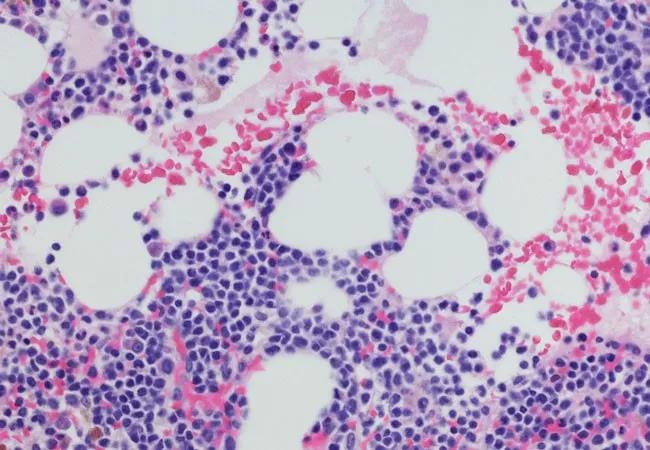
Image content: This image is available to view online.
View image online (https://assets.clevelandclinic.org/transform/80817bfb-1968-439b-ad50-4e12b1c77bf3/multiple-myeloma_jpg)
multiple myeloma
High rates of acute and chronic graft-versus-host disease (GVHD) during the course of a small phase I clinical trial to evaluate the drug bortezomib as a possible GVHD prophylaxis in high-risk multiple myeloma patients forced discontinuation of the study. Four of the study’s seven participants developed GVHD and died due to complications.
Advertisement
Cleveland Clinic is a non-profit academic medical center. Advertising on our site helps support our mission. We do not endorse non-Cleveland Clinic products or services. Policy
The unexpected results have prompted the investigators to reconsider how to reduce the risk of GVHD and relapse in multiple myeloma patients who undergo nonmyeloablative allogeneic hematopoietic cell transplantation (allo HCT).
“We wanted to publish the results to emphasize the safety issue of this therapy,” says Cleveland Clinic Cancer Center hematologist/oncologist Jack Khouri, MD, the study’s lead author. The findings were published in 2019 in the journal Clinical Lymphoma, Myeloma & Leukemia. The study was conducted between 2013 and 2017 at Cleveland Clinic.
The study involved administering the proteasome inhibitor bortezomib for GVHD prevention, followed by maintenance low-dose lenalidomide therapy in multiple myeloma patients at high risk of relapse.
Both drugs are established as effective frontline chemotherapy treatments for multiple myeloma when administered prior to allo HCT. After allo HCT, bortezomib has been shown to be effective at maintaining disease control without increasing the risk of GVHD, and actually reduced GVHD risk in mouse transplant models. Conversely, after allo HCT, maintenance low-dose lenalidomide is associated with a significant risk for acute GVHD.
The Cleveland Clinic Cancer Center study intended to assess the safety and effectiveness of the combination of bortezomib and low-dose lenalidomide in maintaining remission and preventing GVHD post-transplant.
Allo HCT with reduced-intensity conditioning is still considered an experimental therapy for multiple myeloma, and poor outcomes with GVHD and a high rate of mortality are common, notes Dr. Khouri.
Advertisement
“We set out to study the safety of bortezomib, which is a proteasome inhibitor that we use to treat myeloma and has been shown to have some anti-GVHD effects as well,” he says. “We wanted to study this drug both as a prophylaxis for GVHD and for maintaining myeloma remission after transplant.” The study called for adding lenalidomide, an immunomodulator, after 100 days to help maintain remission. Three dosage levels were to be tested.
All seven patients who participated in the study showed an improved disease response after allo HCT. But six developed acute GVHD after starting the course of bortezomib, with four later developing chronic GVHD.
Only two patients were able to complete the lenalidomide regimen. While those two went on to have a good response, and one patient remains in remission today, the four patients with chronic GVHD ultimately died.
“It was surprising, because there was a previous trial that showed that bortezomib could actually help mitigate graft-versus-host-disease after transplant,” Dr. Khouri says, “so the high rate of graft-versus-host-disease that we saw in this study was unexpected.”
The poor outcomes could be related to the timing of the start of therapy after transplantation, or the duration of the regimen, he notes, and physicians who look further at the treatment should consider starting bortezomib later after transplant, or trying a shorter course. But no follow-up study is currently planned, as interest in allogeneic transplantation is waning in favor of more promising therapies, such as monoclonal antibodies, bispecific T-cell engager therapy and chimeric antigen receptor T-cell therapy, Dr. Khouri says.
Advertisement
“Currently, the enthusiasm has decreased because we have so many good and effective treatments, and the pipeline of new treatments is so rich that clinicians have steered away from this approach,” he says.
While the study’s utility was limited, Dr. Khouri says it still has some important implications for cancer care teams.
“We can’t say much about the role of lenalidomide after transplant because we had just two patients on maintenance,” he says. “But I think we can say that there is some safety signal — a toxicity signal with bortezomib — that people should be aware of.”
Advertisement
Advertisement
First-of-its-kind research investigates the viability of standard screening to reduce the burden of late-stage cancer diagnoses

Global R&D efforts expanding first-line and relapse therapy options for patients
Study demonstrates ability to reduce patients’ reliance on phlebotomies to stabilize hematocrit levels
A case study on the value of access to novel therapies through clinical trials

Findings highlight an association between obesity and an increased incidence of moderate-severe disease
Cleveland Clinic Cancer Institute takes multi-faceted approach to increasing clinical trial access 23456
Key learnings from DESTINY trials

Overall survival in patients treated since 2008 is nearly 20% higher than in earlier patients
 Search