Locations:





Optimizing a procedure to reduce the use of general anesthesia in very young patients
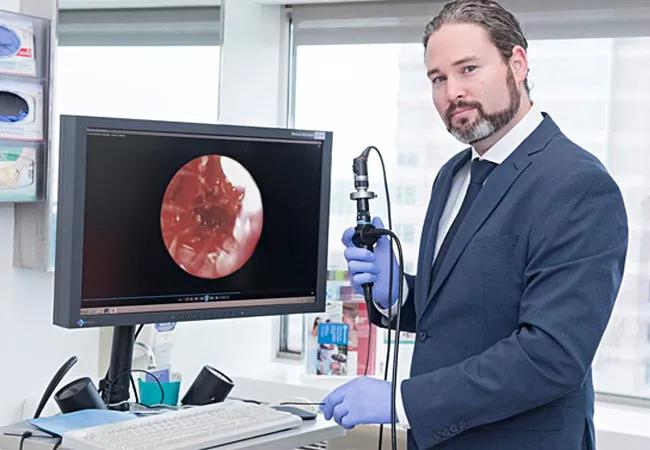
Image content: This image is available to view online.
View image online (https://assets.clevelandclinic.org/transform/34d3160c-315c-4741-95cb-984f207f131b/19-ENT-585-BrandonHopkins-InfantNaselStent-650x450_jpg)
19-ENT-585-BrandonHopkins-InfantNaselStent-650×450
Pediatric otolaryngologists report successful outcomes using these drug-eluting stents in one-stage surgical correction of choanal atresia (CA), negating the need for children to undergo multiple surgeries under general anesthesia.
Advertisement
Cleveland Clinic is a non-profit academic medical center. Advertising on our site helps support our mission. We do not endorse non-Cleveland Clinic products or services. Policy
Choanal atresia (CA), a rare pediatric congenital disorder causing upper airway obstruction, occurs in about one in 5,000-8,000 live births. Bilateral CA requires immediate intervention, as infants present with respiratory distress. In unilateral CA, common presenting symptoms include unilateral nasal congestion and mucoid rhinorrhea.
Surgical repair is generally accomplished through a transnasal approach, with or without stenting. In the past, follow-up surgical procedures were required for 89 percent of children undergoing CA repair. In fact, on average, 2.7 procedures were required for the repair of unilateral CA, and 4.9 procedures were required for the repair of bilateral CA.
“Things that are closed tend to want to stay closed,” says Cleveland Clinic otolaryngologist Brandon Hopkins, MD. “Creating an opening where one does not exist is always difficult, whether it be choanal stenosis or narrowing in the trachea or esophagus. This is why, traditionally, repeat procedures have been necessary.”
These secondary procedures were also conducted under general anesthesia, and included evaluation, removal of nasal stents, dilation and debridement. These follow-up surgeries pose increased risk for morbidity and mortality in infants and young children.
A promising new technique, reported for the first time in 2016, involved the use of mometasone furoate drug-eluting stents at the conclusion of CA repair. The first case report discussed three cases, all of which were successful with no complications. While not necessarily a complication, two out of the three young patients involved in the first report required a second surgery for evaluation and debridement.
Advertisement
In an effort to reduce trips to the operating room for these fragile young patients, a group of surgeons from Cleveland Clinic’s Head and Neck Institute conducted their own trial using the mometasone furoate drug-eluting stents.
Three patients, ranging in age from 8 days to 38 months, underwent surgery for CA repair. Two had right-sided CA and the third had bilateral CA. All surgeries were without complication. A dissolvable, bio-compatible steroid-eluting stent was successfully placed in patients intraoperatively. Each patient was followed for 6-17 months with serial flexible nasoendoscopy in a clinical setting.
One patient had restenosis two months out; this showed partial improvement after two weeks on intranasal ciprodex drops. The patient was and well-healed and patent at the six-month follow-up visit.
Importantly, in all patients, general anesthesia was required only for the initial operation.
“Keeping the patients out of the operating room as much as possible was clearly a goal of ours,” Dr. Hopkins states. “We were able to determine that this was feasible by using nasal endoscopy in clinic to determine repair patency at the post-op visit. If it was patent, we elected not to go back to the operating room. I think the next steps for this technique is to follow children long term to determine if future reversions are necessary.”
Recent studies confirm that there is an association with multiple exposures to general anesthesia before age three and increased frequency of learning disabilities and attention-deficit/hyperactivity disorder.
Advertisement
“We are moving toward avoiding elective procedures until after age three in order to lower the potential neurocognitive risks of anesthesia. While not yet completely understood, age at anesthesia, length of anesthesia, and repeat anesthesia all likely play a role in terms of possible detrimental effects,” notes Dr. Hopkins.
“I think we need to continue to look at ways to avoid repeat OR trips or delay OR trips until children are older. Techniques, technologies, and approaches that can assist with this will continue to be explored.”
Dr. Brandon Hopkins was the senior author on this study, which was published in the International Journal of Pediatric Otorhinolaryngology. Joseph Meleca, MD, and Samantha Anne, MD, both of Cleveland Clinic’s Head and Neck Institute, also contributed to this paper.
Note: Image republished with permission from Elsevier.
Advertisement
Advertisement

With a wide scope of skills, comprehensive otolaryngologists care for patients of all ages in the community
Research on children with UHL explores the quality-of-life benefits and outcomes of cochlear implants
A look at how custom-fitted oral appliances work and when they’re a good fit for patients
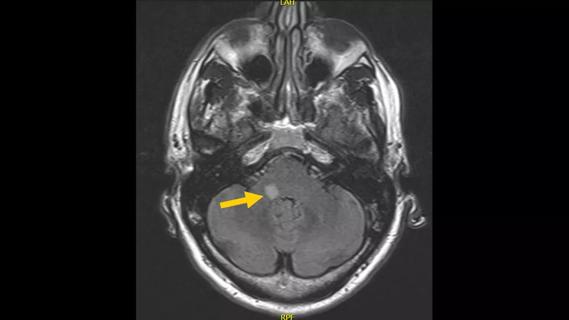
Subtle information gleaned from clinical examinations prompted concern
A new single-port system well-suited for oropharyngeal cancer treatment
Challenging case requires outside-the-box approach
Collaborative and multidisciplinary approach necessary for treatment
The tri-vector gracilis procedure uses a thin muscle from the thigh to help create a natural mimetic smile
 Search