Locations:





Largest retrospective study to date confirms randomized trials
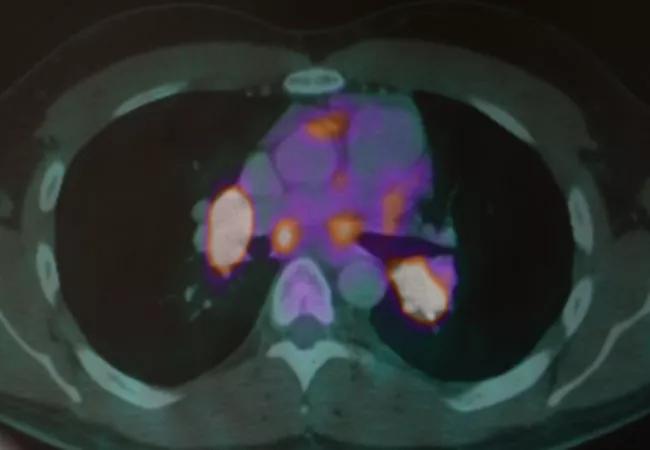
Image content: This image is available to view online.
View image online (https://assets.clevelandclinic.org/transform/bce4f5a5-93c6-4f0d-8eb6-0b99c95492fa/lung-cancer_650x450_jpg)
lung-cancer_650x450
Single-fraction stereotactic body radiation therapy (SBRT) is safe and effective in treating early stage, medically inoperable non-small cell lung cancer (NSCLC), according to Cleveland Clinic’s ten-year retrospective study of 229 patients, the largest single-institution report to date in this specific component of lung SBRT. It confirms the findings of two smaller, randomized phase 2 trials comparing varying dose/fractionations of SBRT in this patient population.
Advertisement
Cleveland Clinic is a non-profit academic medical center. Advertising on our site helps support our mission. We do not endorse non-Cleveland Clinic products or services. Policy
“It’s reassuring to validate previous prospective studies in a large population and know that one fraction remains both safe and effective in the long term,” says Gregory M. Videtic, MD, Department of Radiation Oncology, Cleveland Clinic Cancer Center. The findings were presented at the American Society for Radiation Oncology (ASTRO) annual meeting held virtually in late October.
Although the use of SBRT for inoperable early stage lung cancer began about two decades ago, the study of single-fraction (SF)-SBRT only began about 12 years ago in patients with inoperable NSCLC. These medically fragile patients, who are usually former or current smokers, have abnormal pulmonary functions or other comorbidities that make surgery not feasible. They represent only about 5% of all newly diagnosed lung cancer patients but “we knew they were potentially curable if we could find a way to treat them without harming them with the treatment,” says Dr. Videtic.
At Cleveland Clinic, the SBRT program began in 2004 to address this clinical need, and the radiation oncology group began by using a five-fraction schedule for SBRT based on earlier work done in Japan.
But “in the beginning, we were learning ‘on the go.’ No one knew which SBRT dose schedule or approach was best,” says Dr. Videtic. That was why he and his colleagues were very active in taking part in clinical trials over the years where a range of SBRT schedules were tested, including those with four, three and one fractions.
In two multicenter randomized trials, with one comparing four fractions to one and the other three fractions to one, and published in 2018 and 2019, respectively, one fraction proved to be as effective as a multiple number of fractions and just as safe.
Advertisement
“When we think about it, we are amazed that we can pack an enormous amount of radiation into a single shot that is so focused that it doesn’t harm the body around it,” Dr. Videtic says.
For routine patients who meet the criteria of the trials, especially having a tumor that is distanced from the central structures of the chest, one fraction SBRT has become the standard of care at Cleveland Clinic. At other centers, however, “some radiation oncologists still have a bit of a psychological hurdle to overcome about using only one fraction, mainly around the safety issue, even though safety and effectiveness were demonstrated in randomized trials. Because Cleveland Clinic is known for its experience in this area, we are frequently contacted by these colleagues at other institutions, seeking guidance and reassurance,” says Dr. Videtic.
The study evaluated 229 patients treated between December 2009 and December 2019 from a Cleveland Clinic prospective data registry. Fifty-five percent of patients were female, with a median age of 74.6 years and median KPS of 80. Over 23% were active smokers. The median pretreatment forced expiratory volume (FEV1) was 1.38L, 58% of predicted, and the diffusing capacity for carbon monoxide (DLCO) was 50% of predicted, with inoperability due to abnormal pulmonary functions in 52.4% of cases. Median tumor diameter was 1.6 cm, and median PET SUV max was 6.1.
The SF-SBRT dose was 34 Gy in 72.1% of cases and 30 Gy in 27.9%, with patient and tumor characteristics balanced between cohorts. At the time of the analysis, 55.9% of patients were alive; the median overall survival time was 44.1 months, with two-year overall survival (OS) at 73.8%. No significant differences in outcomes were identified by dose.
Advertisement
These results were comparable to the two randomized clinical trials. In the one vs. four fractions trial, the median two-year OS was 61.3% and 77.7%, respectively; in the one vs. three fractions trial, the two-year OS was 73% and 62%, respectively.
Clinic radiation oncologists using SBRT still need to build on their experience and document their outcomes to understand the optimum treatment for these patients. “Lung SBRT is still a relatively young practice to be involved in, so analysis of its results has to be ongoing. One of the privileges of working at Cleveland Clinic is access to a large patient population who can benefit from SBRT and then following them closely for years so you can get a significant sense of how well they have done with time,” says Dr. Videtic.
Advertisement
Advertisement

First-of-its-kind research investigates the viability of standard screening to reduce the burden of late-stage cancer diagnoses

Global R&D efforts expanding first-line and relapse therapy options for patients
Study demonstrates ability to reduce patients’ reliance on phlebotomies to stabilize hematocrit levels
A case study on the value of access to novel therapies through clinical trials

Findings highlight an association between obesity and an increased incidence of moderate-severe disease

Cleveland Clinic Cancer Institute takes multi-faceted approach to increasing clinical trial access 23456
Key learnings from DESTINY trials

Overall survival in patients treated since 2008 is nearly 20% higher than in earlier patients
 Search