Locations:





Cytokine IL-17A may drive cancer stem cell growth
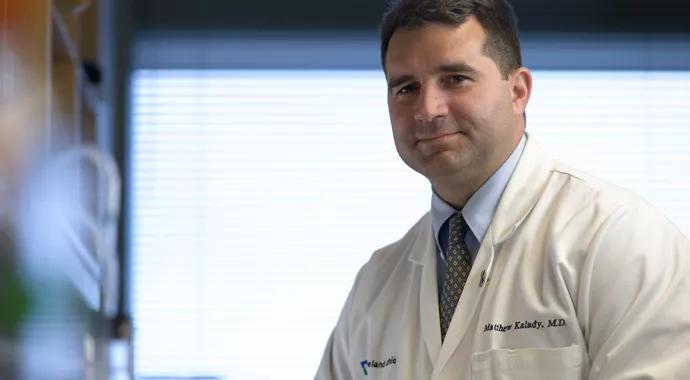
Image content: This image is available to view online.
View image online (https://assets.clevelandclinic.org/transform/896ccd11-e89f-47ca-aa4e-eaa3c0e5c000/DrKalady_690x380_jpg)
DrKalady_690x380
For many years, the holy grail in treating locally advanced rectal cancer has been to improve tumor response before surgery.
Advertisement
Cleveland Clinic is a non-profit academic medical center. Advertising on our site helps support our mission. We do not endorse non-Cleveland Clinic products or services. Policy
Now Cleveland Clinic researchers have discovered a biological mechanism that may make some colorectal tumors more resistant to chemotherapy and radiation.
If the finding proves translatable from in vitro and animal studies to human subjects, it may help make colorectal tumors more susceptible to neoadjuvant chemotherapy and radiation, paving the way for more effective pre-surgical treatments, according to Matthew Kalady, MD, a surgeon in Cleveland Clinic’s Department of Colorectal Surgery and Director of the Colorectal Cancer Translational Science Laboratory.
Dr. Kalady and his fellow researchers have found that a cytokine known as interleukin-17A (IL-17A), secreted by fibroblasts in the tumor microenvironment after treatment with chemotherapy or radiation, can cause cancer stem cells to become more resistant to therapies. As a result, the cancer-initiating stem cells can repopulate, causing tumors to grow and metastasize. “So the very therapies we are using to kill the cancer actually may have the negative effects of increasing cancer stem cells and tumor spread through secretion of IL-17A,” Dr. Kalady said.
Cancer stem cells receive critical support from the tumor microenvironment, where cancer-associated fibroblasts are located. When Dr. Kalady and colleagues at Cleveland Clinic studied the response of the tumor microenvironment to chemotherapy, they found that cancer-associated fibroblasts grew in number and size after treatment. These fibroblasts, in turn, released cytokines, including IL-17A, which caused cancer stem cells to proliferate and become more resistant to chemotherapy.
Advertisement
In addition to studying the biological response of colorectal cancer to chemotherapy in cell culture, Dr. Kalady and his collaborators analyzed chemotherapy’s effect on tumors and the tumor microenvironment in mouse models. In their work, published in December 2013 in the Journal of Experimental Medicine, they found that mice treated with chemotherapy exhibited growth of cancer-associated fibroblasts, which in turn produced IL-17A.
The cytokine IL-17A then drove cancer stem cell renewal and proliferation. As a result, the mouse tumors, which showed overexpression of IL-17A after chemotherapy, continued to grow and did not respond to treatment.
Butt if the mice were treated with chemotherapy along with an IL17A inhibitor, the tumors shrank dramatically. “There was a drastic tumor regression when the mice were treated with an IL-17A inhibitor and chemotherapy when compared to chemotherapy alone,” Dr. Kalady said.
Since the paper’s publication, Dr. Kalady’s research group has analyzed tumor samples from colorectal cancer patients and found that patients express varying levels of IL-17A after treatment with chemotherapy and radiation. “These different levels may partly explain why patients respond differently to standard therapies,” he said. “It may be one of the many biological mechanisms that differentiate tumors and patients’ variable responses to chemotherapy or radiation. Looking at IL-17A levels, and how to regulate those levels, might be one way to personalize colorectal cancer therapy.”
Advertisement
Dr. Kalady’s research group has approached pharmaceutical companies about testing existing IL-17A inhibitors in combination with standard therapy for treatment of rectal cancer in human clinical trials. In January 2015, Secukinumab became the first IL-17A inhibitor to be approved by the U.S. Food and Drug Administration for treatment of psoriasis. Other IL-17A inhibitors are in late-stage clinical trials.
If his research group is unable to garner pharmaceutical support for clinical trials, Dr. Kalady plans to go forward with a small study on human patients. “We might begin with a pilot study of as few as 10 rectal cancer patients, using standard chemoradiation treatment along with an IL-17A antibody,” he said.
In human studies, Dr. Kalady plans to measure levels of IL-17A before and after treatment — both in serum and in tumor samples. “We’d like to see if the IL-17A levels before and/or after treatment can be correlated with response,” he said. “Although IL-17A can be measured in serum blood tests, we don’t know yet if blood test levels might reflect therapy response.”
Dr. Kalady’s research is an example of how basic science can be leveraged to understand tumor biology and the influence of biological mechanisms on treatment response in colorectal cancer. The research may also open the door to future treatments that produce improved patient response and extend survival, he said. “We’re taking a scientific, translational approach, and moving discoveries made in the lab to human trials.”
Advertisement
Advertisement

First-of-its-kind research investigates the viability of standard screening to reduce the burden of late-stage cancer diagnoses

Global R&D efforts expanding first-line and relapse therapy options for patients

Study demonstrates ability to reduce patients’ reliance on phlebotomies to stabilize hematocrit levels
A case study on the value of access to novel therapies through clinical trials

Findings highlight an association between obesity and an increased incidence of moderate-severe disease

Cleveland Clinic Cancer Institute takes multi-faceted approach to increasing clinical trial access 23456
Key learnings from DESTINY trials

Overall survival in patients treated since 2008 is nearly 20% higher than in earlier patients
 Search