Locations:





Variety of drugs used in defined approach often helps

Image content: This image is available to view online.
View image online (https://assets.clevelandclinic.org/transform/c0de4b36-4e3a-414c-be12-4b132a2f632e/Dr_-Gupta-690-x-380_jpg)
Dr.-Gupta-690-x-380
An approach to managing nausea and vomiting in patients with advanced cancer that includes a systematic assessment — detailed history, physical examination and investigations for reversible causes – has proven useful in improving the quality of their lives.
Advertisement
Cleveland Clinic is a non-profit academic medical center. Advertising on our site helps support our mission. We do not endorse non-Cleveland Clinic products or services. Policy
“Nausea and vomiting in advanced cancer: the Cleveland Clinic protocol” stresses that cancer patients’ well-being can be improved by helping them retain food. The protocol used to reduce nausea and vomiting can also affect their mind-set.
“Patients dread nausea more than pain, while physicians focus more on emesis than nausea,” says a report led by palliative care expert Mona Gupta, MD. “I think this mind-set has developed since nausea is subjective,” she says. “So physicians underrate nausea. It is not visible. There are no complications. Patients also may have retching and dry heaves and nothing comes up. Patients fear nausea since they can’t eat anything and fear that this may affect their survival.
“The mechanisms underlying the symptom of nausea are not well understood,” Dr. Gupta says. “Nausea requires conscious awareness and is a cerebral sensation. Vomiting is a concrete, visible symptom that can be put into numbers. Physicians worry about complications of vomiting, e.g., dehydration. Patients actually feel better after throwing up. Vomiting is a brain-stem reflex and does not require input from the cortex.”
Dr. Gupta’s advice, therefore, is that physicians should conduct a comprehensive history and take it seriously. And, they should ask about nausea as a separate symptom from vomiting.
The multiple causes of nausea and vomiting include gastrointestinal symptoms such as obstruction, constipation, gastroparesis and inflammations; central nervous system symptoms such as increased intracranial pressure, hemorrhage and abscess; and certain medications that run the gamut from cytotoxic chemotherapy to opioids, NSAIDs, antidepressants and anticonvulsants.
Advertisement
In an assessment for treatment of nausea and vomiting, detailed history is important because it provides clues to the causes, which in turn will direct drug management. Nausea relieved by vomiting, for example, is likely to be generated by gastrointestinal pathology. Nausea and vomiting from bowel obstruction, gastric outlet obstruction or stasis is commonly accompanied by abdominal pain, bloating, colic, change in bowel habit, early satiety and/or stool consistency.
Treatment of nausea and vomiting at Cleveland Clinic consists of metoclopramide or haloperidol as first-line treatment, according to the protocol. Olanzapine or chlorpromazine are second-line treatment and ondansetron is third.
“Little is known about pathways that generate nausea, which tends to respond less well to anti-emetics,” the protocol paper says. “Some approach the management of nausea and vomiting based on ‘emetogenic receptor pathways’ to select agents. We have not used these etiologic-based guidelines, but have chosen to use sequential single-agent therapy. There is little evidence that an antiemetic choice based upon emetogenic receptor pathways is any better than empiric single-agent therapy.
“The Cleveland Clinic protocol is eminence-based, i.e., based on experience,” Dr. Gupta says. “There is no evidence to support our protocol and it is not common. Cleveland Clinic has developed a unique protocol that is effective in controlling nausea and vomiting.
“Within our protocol, the strongest evidence is for metoclopramide. (But), response assessment tools have not been uniform in palliative medicine as they have been with chemotherapy prophylaxis. I would say metoclopramide is effective in 50 to 70 percent of cases.”
Advertisement
Dr. Gupta adds that palliative assessment should include the possible use of over-the-counter drugs and complementary therapies that might actually cause nausea and vomiting.
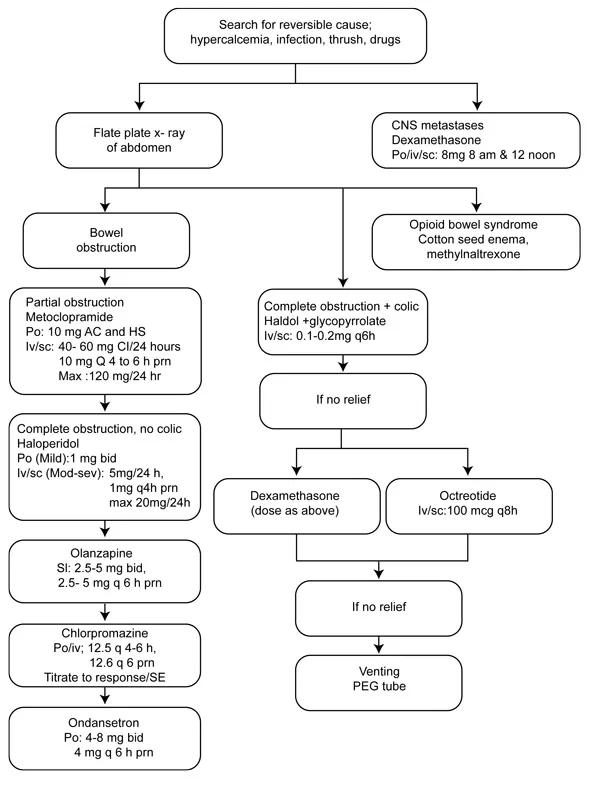
Image content: This image is available to view online.
View image online (https://assets.clevelandclinic.org/transform/0647d7d1-e1fb-4726-aa44-5885df3bc14c/nausea-cancer-chart_jpg)
Advertisement
Advertisement

First-of-its-kind research investigates the viability of standard screening to reduce the burden of late-stage cancer diagnoses

Global R&D efforts expanding first-line and relapse therapy options for patients

Study demonstrates ability to reduce patients’ reliance on phlebotomies to stabilize hematocrit levels

A case study on the value of access to novel therapies through clinical trials

Findings highlight an association between obesity and an increased incidence of moderate-severe disease

Cleveland Clinic Cancer Institute takes multi-faceted approach to increasing clinical trial access 23456
Key learnings from DESTINY trials

Overall survival in patients treated since 2008 is nearly 20% higher than in earlier patients
 Search