Locations:





New protocol lets patients ‘test drive’ hearing devices
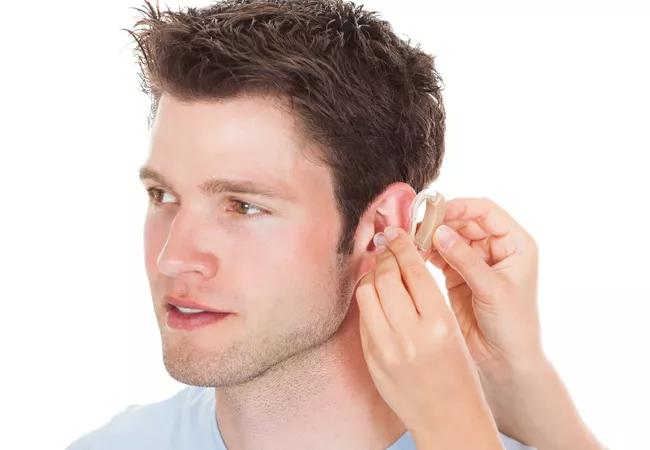
Image content: This image is available to view online.
View image online (https://assets.clevelandclinic.org/transform/7e002b4b-5305-4c76-aa44-f94a2b332842/15-ENT-2837-Sydlowski-Consult-QD-Image_jpg)
15-ENT-2837-Sydlowski-Consult-QD-Image
By Sarah A. Sydlowski, AuD, PhD, and Erika Woodson, MD
Advertisement
Cleveland Clinic is a non-profit academic medical center. Advertising on our site helps support our mission. We do not endorse non-Cleveland Clinic products or services. Policy
Unaidable unilateral sensorineural hearing loss, more commonly referred to as single-sided deafness (SSD), is a potentially disabling condition. Even with normal hearing contralaterally, patients with SSD have difficulty localizing sound, hearing sounds arising from the deafened side and understanding speech in background noise.
The Head & Neck Institute’s Hearing Implant Program has developed a comprehensive evaluation protocol for SSD patients that includes subjective questionnaires, demo devices and speech-in noise measures to identify appropriate candidates for the various SSD management options. This protocol allows us to make meaningful, objective comparisons among options, and it allows our patients to experience the benefit they can anticipate with each device in a controlled environment before they make a selection. In short, patients can “test drive” each device to see which works best for them.
The challenges of SSD are perhaps intensified by the fact that unilateral hearing loss is a nearly invisible disorder, so much so that many of the patient’s close contacts may be unaware of the patient’s disability. But affected patients are certainly aware of it. They frequently report a perceived hearing handicap that often approaches severe levels. These patients cite difficulty participating in group environments, an inability to converse in lateralized communication settings (e.g., when riding in a car) and general fatigue from increased listening effort, particularly in challenging hearing environments. Many patients also report social consequences that include feelings of embarrassment, frustration and isolation resulting from their inability to accurately follow conversations in a noisy environment.
Advertisement
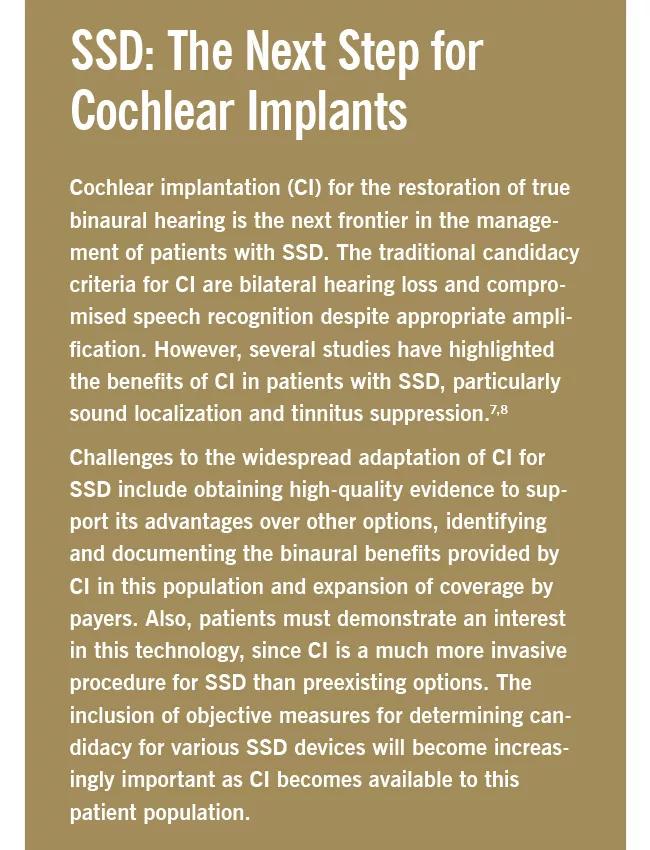
Image content: This image is available to view online.
View image online (https://assets.clevelandclinic.org/transform/40a3447c-cecf-4923-94d2-019a31e21988/15-ENT-2837-Sydlowski-Consult-QD-Inset-Sidebar_jpg)
A variety of management options exist for SSD, all of which route stimuli from the poorer hearing side to the normally functioning contralateral cochlea. Although research suggests that these devices are effective, there are three primary limitations that clinicians face when considering a potential candidate for SSD management options:
Frequently, determining audiologic candidacy for each of the various devices has been based on audiometric thresholds and patient feedback following an informal experience listening with a demo device. However, research has consistently demonstrated that audiometric data alone are not enough to predict how much benefit and satisfaction a patient will receive with an SSD device. Moreover, simply restoring awareness of sound on the deafened side cannot guarantee improved sound quality, speech-in- noise understanding or patient satisfaction.
Anecdotally, our SSD protocol has benefited both patients and clinicians. Patients tend to feel more comfortable choosing a device when they have had an opportunity to realistically evaluate its potential for success. Clinicians benefit by having reliable data upon which to base recommendations and to track outcomes. Our future clinical research will focus on refining test protocols to improve their validity. Further development of appropriate protocols will be particularly crucial as cochlear implant candidacy expands to include patients with unilateral hearing loss.
Advertisement
Dr. Sydlowski is Audiology Director and Dr. Woodson is Medical Director of the Head & Neck Institute’s Hearing Implant Program. They can be reached at 216.444.0354 or hipteam@ccf.org.
Advertisement
Advertisement
With a wide scope of skills, comprehensive otolaryngologists care for patients of all ages in the community
Research on children with UHL explores the quality-of-life benefits and outcomes of cochlear implants
A look at how custom-fitted oral appliances work and when they’re a good fit for patients
Subtle information gleaned from clinical examinations prompted concern
A new single-port system well-suited for oropharyngeal cancer treatment
Challenging case requires outside-the-box approach
Collaborative and multidisciplinary approach necessary for treatment
The tri-vector gracilis procedure uses a thin muscle from the thigh to help create a natural mimetic smile
 Search