Locations:





New evidence supports their use for initial evaluation
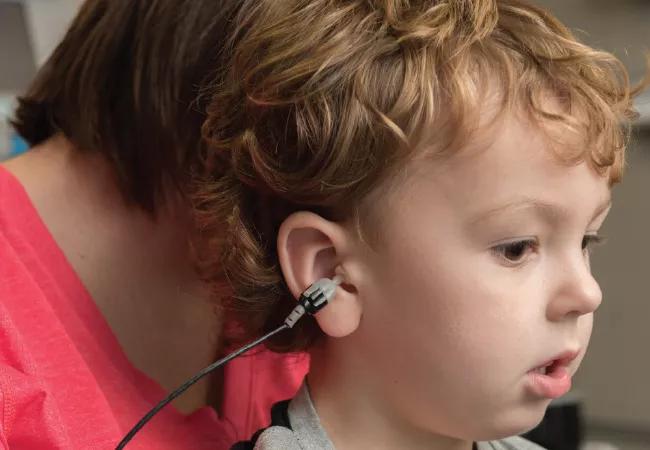
Image content: This image is available to view online.
View image online (https://assets.clevelandclinic.org/transform/07484012-1af8-4372-b705-0b4c3deab451/16-ENT-2726-Anne-Hero-Image-Option-02_jpg)
16-ENT-2726-Anne-Hero-Image-Option-02
Advertisement
Cleveland Clinic is a non-profit academic medical center. Advertising on our site helps support our mission. We do not endorse non-Cleveland Clinic products or services. Policy

Image content: This image is available to view online.
View image online (https://assets.clevelandclinic.org/transform/c77db15f-b895-4e65-9799-0c58c42869eb/16-ENT-2726-Doc-Portrait-Anne_jpg)
Samantha Anne, MD, MS
Hearing loss affects one to three neonates for every 1,000 births, and its prevalence increases to nearly 15 percent among those between ages of six and 19 years, according to the CDC’s Third National Health and Nutrition Examination Survey (NHANES III).1 This underscores the importance of having a reliable and accurate test for children with concerns for hearing loss.
In view of relatively high rates of incomplete or inaccurate testing in children younger than 3 years and in children with special needs, the American Academy of Audiology (AAA) prefers otoacoustic emissions (OAE) testing rather than pure-tone audiometry as an initial screening tool in these children. The AAA also recommends follow-up screening with tympanometry for children whose OAE test results are unsatisfactory, in order to evaluate middle ear status.
Two Studies Test the AAA’s Recommendation
The emphasis on cost containment in our healthcare system prompted evaluation of the cost and utility of AAA’s recommendation in clinical practice. With this in mind, our Department of Pediatric Otolaryngology undertook a study to compare the costs incurred with combined OAE testing and tympanometry with the costs of comprehensive audiometry. This study, the results of which were published in June,2 found that on average, OAE testing and tympanometry cost $70 less per patient than a full audiometric evaluation.
As a follow-up and adjunct to that study, we also evaluated the specificity of full audiometric testing in children. Our findings strongly demonstrated that audiometric testing was associated with significantly less specificity in children younger than 3 years than in older children—51 versus 93 percent (manuscript submitted for publication). This finding further supports the use of the AAA’s recommendation.
Advertisement
A Third Study Is on the Way
We are now in the process of designing a prospective trial of healthy children with no risk factors for hearing loss or concerns for speech or language delay. We intend to follow them and compare the results of OAE testing and tympanometry and comprehensive audiometry. Concurrent speech and language testing will be performed to ensure that patients do not develop delays if this testing protocol misses hearing loss diagnoses until these children are older.
Our goal is to determine whether OAE testing/tympanometry can be safely used for testing for hearing loss in very young children so that comprehensive audiometry can be reserved for children older than 3 years, along with careful monitoring of age-appropriate speech and language development.
References
Dr. Anne is Medical Director of Pediatric Ear & Hearing Disorders in Cleveland Clinic’s Department of Pediatric Otolaryngology.
Advertisement
Advertisement
With a wide scope of skills, comprehensive otolaryngologists care for patients of all ages in the community
Research on children with UHL explores the quality-of-life benefits and outcomes of cochlear implants
A look at how custom-fitted oral appliances work and when they’re a good fit for patients
Subtle information gleaned from clinical examinations prompted concern
A new single-port system well-suited for oropharyngeal cancer treatment
Challenging case requires outside-the-box approach
Collaborative and multidisciplinary approach necessary for treatment
The tri-vector gracilis procedure uses a thin muscle from the thigh to help create a natural mimetic smile
 Search