Locations:





New information poised to individualize patient care
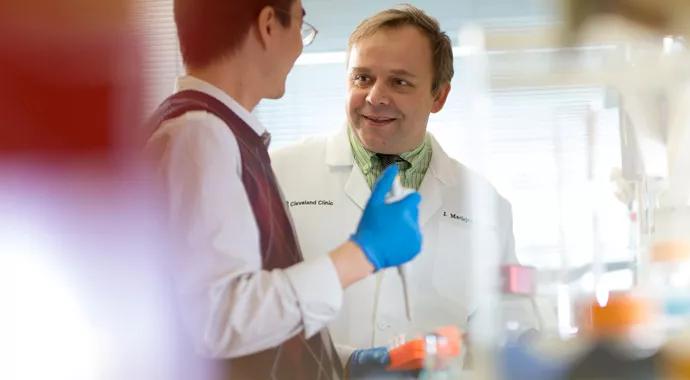
Image content: This image is available to view online.
View image online (https://assets.clevelandclinic.org/transform/266f1a08-018d-4d26-9fa0-66e072e3beab/maciejewski_690x380_jpg)
maciejewski_690x380
Cancer researchers now have a window into the incredible genetic diversity of cancers thanks to next generation sequencing technology. This advance is poised to provide cancer clinicians with insights that will help them individualize patient care, according to Jaroslaw Maciejewski, MD, PhD, Department Chair of Translational Hematology and Oncology Research at Cleveland Clinic’s Taussig Cancer Institute.
Advertisement
Cleveland Clinic is a non-profit academic medical center. Advertising on our site helps support our mission. We do not endorse non-Cleveland Clinic products or services. Policy
In a recent interview with Consult QD, Dr. Maciejewski discussed the research and clinical implications of next generation sequencing.
Dr. Maciejewski: This technology sequences DNA with the purpose of identifying mutations or alterations of sequence that may contribute to disease or variations in response to medical care. In our setting, the main advantage of next generation sequencing is to identify genetic alterations that are acquired or inherited.
Dr. Maciejewski: The main difference between traditional sequencing and next generation sequencing is that there has been an exponential increase in throughput and speed. What would have taken months or years can now be done in a day. This technology is not only revolutionizing the application of sequencing as a discovery tool, but also as a clinical diagnostic tool. This revolution is occurring in the cancer field, in microbiology, and many other areas of medicine.
Dr. Maciejewski: It allows unbiased screening of human genome to search for pathogenic changes in the DNA, whether they are inherited or acquired. With this technology, you can take on more ambitious tasks. In the old days, researchers were limited to conducting a rational, targeted study of a particular gene and its role in disease. Now, we can just sequence everything and look for medically relevant variations in an unbiased way.
Dr. Maciejewski: Here at Cleveland Clinic, the technology has been used to identify changes during malignant progression or the evolution of cancers, including leukemia.
This is in addition to using it to identify genetic variations that predispose an individual to developing cancer. For example, my colleagues and I recently used the technology to analyze the downstream genetic effects of a common mutation found in patients with myelodysplastic syndromes, which hamper the production of healthy blood cells and sometimes lead to the development of acute myeloid leukemia. In a study we published in the journal Nature, we found that mutations in the SF3B1 gene alter the expression of genes in blood cell producing stem cells in the bone marrow. It increases our ability to find new genes and alterations.
Advertisement
We also are applying it in clinical research. It has boosted our ability to search for mutations and identify changes in genes that are linked to clinical outcomes, such as treatment response or therapeutic outcomes. This may help us more precisely predict patient outcomes. It is also allowing us to study variations that may predict which drug is the best choice for a patient.
In drug discovery, identifying individual gene alterations that contribute to cancer or therapeutic outcomes allows for the development of novel therapies that are targeted to specifically address the consequence of a particular mutation. The use of next generation sequencing as a diagnostic tool is also being studied.
Dr. Maciejewski: We are almost there. The U.S. Food and Drug Administration approved the first next-generation device for clinical use in November 2013. There are many established tests that are already using next generation sequencing. It is already used to identify certain mutations in cancer and to predict treatment response and patient outcomes.
It’s unclear whether next generation diagnostic tools will be centralized in laboratories or whether every hospital or practice will have them. In the future, as more targeted cancer therapies are developed, it will be important to make more precise diagnoses using next generation sequencing.
Dr. Maciejewski: The platforms will continue to be refined. Next generation sequencing is going to revolutionize many areas of medicine and our understanding of many diseases. It also will help us understand the complex contributions of variations that were inherited and those caused by environmental exposures. It will help to reveal the diversity of similar-seeming cancers, and genetic diversity within a tumor or a patient.
Advertisement
Photo Credit © Russell Lee
Advertisement
Advertisement
First-of-its-kind research investigates the viability of standard screening to reduce the burden of late-stage cancer diagnoses

Global R&D efforts expanding first-line and relapse therapy options for patients

Study demonstrates ability to reduce patients’ reliance on phlebotomies to stabilize hematocrit levels
A case study on the value of access to novel therapies through clinical trials

Findings highlight an association between obesity and an increased incidence of moderate-severe disease

Cleveland Clinic Cancer Institute takes multi-faceted approach to increasing clinical trial access 23456
Key learnings from DESTINY trials

Overall survival in patients treated since 2008 is nearly 20% higher than in earlier patients
 Search