Locations:





Certain cases may benefit from second opinion
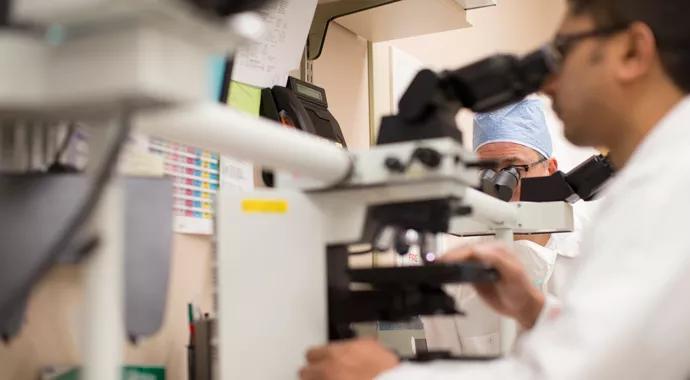
Image content: This image is available to view online.
View image online (https://assets.clevelandclinic.org/transform/96ffa46e-cced-41a9-9969-02d06d50b8e5/surgpath_690x380_jpg)
surg&path_690x380
A new study highlights the importance of breast cancer physicians and pathologists working closely together when evaluating breast biopsies.
Advertisement
Cleveland Clinic is a non-profit academic medical center. Advertising on our site helps support our mission. We do not endorse non-Cleveland Clinic products or services. Policy
The study, published in JAMA, investigated the accuracy of breast biopsy interpretation among pathologists. The pathologists who participated regularly interpret breast biopsies in clinical settings in eight U.S. states. The study compared those pathologists’ determinations with the consensus of a panel of three internationally recognized diagnostic breast pathologists.
Study investigators reported an overall agreement of 75.3 percent between the individual pathologists and the expert consensus-derived reference diagnoses. The highest level of agreement was for invasive carcinoma (96 percent). The study found substantially lower levels of concordance for atypia (48 percent) and ductal carcinoma in situ (DCIS, 84 percent).
The individual pathologists over-interpreted atypia in 17 percent of the study cases, the researchers found, while under-interpreting atypia and DCIS at rates of 35 percent and 13 percent, respectively. The authors conclude that breast atypia may warrant clinicians and patients seeking a formal second opinion before finalizing treatment or surveillance decisions.
Further evaluation of the study and its findings seem to point to pathologist experience as a key differential in accurate diagnosis of breast biopsies. Additionally, the investigators found that pathologists who weren’t in an academic environment, and who had less focus on breast disease, disagreed with the diagnosis more often.
“There’s some validity to the study’s findings in that a pathologist’s experience and focus on a specialty area do matter. And I think it matters particularly when the biopsy involves atypia or small foci ductal carcinoma,” says Cleveland Clinic pathologist Benjamin Calhoun, MD, PhD, “However, it’s important to note that even for the study’s experts, overall concordance rate was lowest for the atypia category, at 80 percent.“
Advertisement
In selected cases of borderline breast lesions, Dr. Calhoun says it may be helpful for a breast pathology specialist to review and confirm diagnoses, especially when the interpretation involves atypical ductal hyperplasia or ductal carcinoma in situ (DCIS). He notes that cases of small foci (<5mm) of low-grade ductal carcinoma in situ and cases in which the pathologic findings are not fully concordant with the clinical and radiologic impression may benefit from expert review.
“This allows them to collaborate and generate a consensus diagnosis,” notes Dr. Calhoun.
“Prior studies demonstrated inter-observer variability in the diagnosis of atypia and small foci of low-grade ductal carcinoma in the past and it remains an area for quality improvement,” Dr. Calhoun explains. “More recent studies have shown that the clarification of diagnostic criteria with tutorials and illustrations has brought improvement to the area of inter-observer variability in the diagnosis of atypical lesions.”
Correlation of the pathologist’s findings with the clinician’s and radiologist’s impressions is essential for an accurate diagnosis. “Further, the study clearly shows that pathologists in the practices with a higher volume of breast biopsies and in academic settings were more likely to agree with the reference diagnosis,” says Dr. Calhoun. “It’s not surprising that discordance was higher in cases that the pathologists regarded as borderline or for which they would have sought a second opinion.”
At least in some major academic medical centers, like the Cleveland Clinic, pathologists do tend to focus on only one or two organs or disease sites, and they work within a team of pathologists. “This allows them to collaborate and generate a consensus diagnosis among people who are dedicated to that one disease site, such as the breast. For example, I work with a large group of other specialized breast pathologists. In other, smaller, practice settings, you don’t have that resource when evaluating biopsy slides,” Dr. Calhoun explains.
Advertisement
Larger institutions, including Cleveland Clinic, have multidisciplinary conferences — tumor boards — to review and discuss the diagnosis and treatment planning for patients with breast cancer, says Dr. Calhoun. However, few medical centers have comparable multidisciplinary conferences for those patients with atypia and other risk-associated lesions.
“The diagnoses associated with the highest levels of discordance, atypia and DCIS, are not the same as invasive carcinoma. Patients should not feel as if they are jeopardizing their care by taking a couple of weeks to talk things over with their care team and get a second opinion on the pathology,” Dr. Calhoun adds.
Future research will clarify the relationship of the study’s findings with breast cancer patient management.
Learn about Cleveland Clinic’s breast cancer services at our Comprehensive Breast Cancer Program.
Photo credit: ©Russell Lee
Advertisement
Advertisement

First-of-its-kind research investigates the viability of standard screening to reduce the burden of late-stage cancer diagnoses

Global R&D efforts expanding first-line and relapse therapy options for patients

Study demonstrates ability to reduce patients’ reliance on phlebotomies to stabilize hematocrit levels
A case study on the value of access to novel therapies through clinical trials

Findings highlight an association between obesity and an increased incidence of moderate-severe disease

Cleveland Clinic Cancer Institute takes multi-faceted approach to increasing clinical trial access 23456
Key learnings from DESTINY trials

Overall survival in patients treated since 2008 is nearly 20% higher than in earlier patients
 Search