Locations:





Comprehensive treatment and trial access show promise
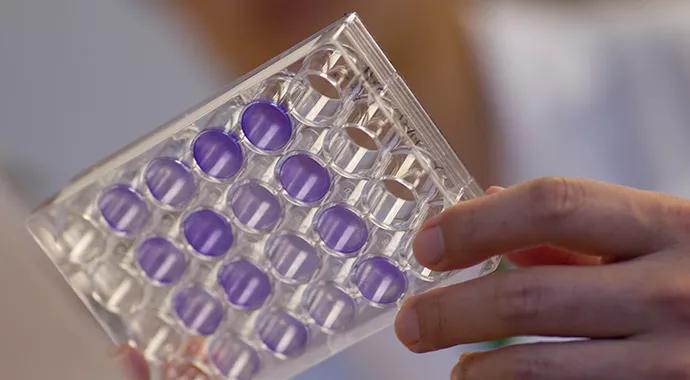
Image content: This image is available to view online.
View image online (https://assets.clevelandclinic.org/transform/816ae816-e870-4cb4-8490-e929e96bd11b/myloma-690x380_jpg)
myloma-690×380
Efforts in the lab have resulted in a range of new drugs available for the treatment of multiple myeloma, and clinical research is underway to define the best regimens for peak results.
Advertisement
Cleveland Clinic is a non-profit academic medical center. Advertising on our site helps support our mission. We do not endorse non-Cleveland Clinic products or services. Policy
“Many new agents have come out the last few years, and we’re working to figure out the best ways to combine and get the drugs to patients,” Mitchell Smith, MD, PhD, Director, Lymphoma and Myeloma Programs.
Cleveland Clinic offers active clinical trials for drugs at all stages, typically, offering standard of care plus different combinations of drugs and new agents. Cleveland Clinic sees more than 100 new multiple myeloma cases a year, and physicians specializing in the disease can work with referring physicians to evaluate patients for trial entry when standard treatments aren’t helping patients.
One study developed and offered only at Cleveland Clinic, combines low doses of azacitidine, a drug approved for leukemia, in combination with standard of care for relapsed multiple myeloma. Cleveland Clinic also has a study open for pomalidomide in patients with renal insufficiency, which is common with multiple myeloma. When kidney function is compromised, current drug treatment options are very limited. Additionally, multiple trials are open that include oral proteasome inhibitors for patients in various disease stages. For patients with newly diagnosed high-risk myeloma, there is a trial of 3 drugs combined with the promising new antibody elotuzumab.
In addition to trial access, the clinical program offers full patient support, with two dedicated nurse practitioners to provide patient education and a quarterly support group meeting for patients and their families. Cleveland Clinic Pain Management also is engaged to help patients manage chronic bone pain. Cleveland Clinic has an active bone marrow transplant program, and the multiple myeloma specialist physicians work closely with transplant physicians throughout the treatment decision-making process.
Advertisement
Cleveland Clinic also engages in translational drug development, working on new agents at the bench. “We foresee ongoing clinical trials developing from activities in the lab,” says Dr. Smith.
The Multiple Myeloma Program includes a special focus on amyloidosis, a related disorder that Dr. Smith says is extremely difficult to treat.
Amyloidosis generates a protein like multiple myeloma does, but instead of circulating in the blood, it deposits in tissue and commonly causes problems with the heart, liver, kidneys and nerves. Cleveland Clinic is uniquely poised to handle the resulting array of medical problems, with national experts in cardiology, neurology, and hematology on staff and working together. To help coordinate complex care, the Multiple Myeloma Program has an amyloidosis specialist on staff, Jason Valent, MD. He is currently running several amyloidosis clinical trials with plans to add additional studies.
The range of new drug agents and regimens under study today for amyloidosis and multiple myeloma likely will lead to new options and protocols in the coming years.
Advertisement
Advertisement
First-of-its-kind research investigates the viability of standard screening to reduce the burden of late-stage cancer diagnoses

Global R&D efforts expanding first-line and relapse therapy options for patients
Study demonstrates ability to reduce patients’ reliance on phlebotomies to stabilize hematocrit levels
A case study on the value of access to novel therapies through clinical trials

Findings highlight an association between obesity and an increased incidence of moderate-severe disease

Cleveland Clinic Cancer Institute takes multi-faceted approach to increasing clinical trial access 23456
Key learnings from DESTINY trials

Overall survival in patients treated since 2008 is nearly 20% higher than in earlier patients
 Search