Locations:





Focused therapy, minimal side effects
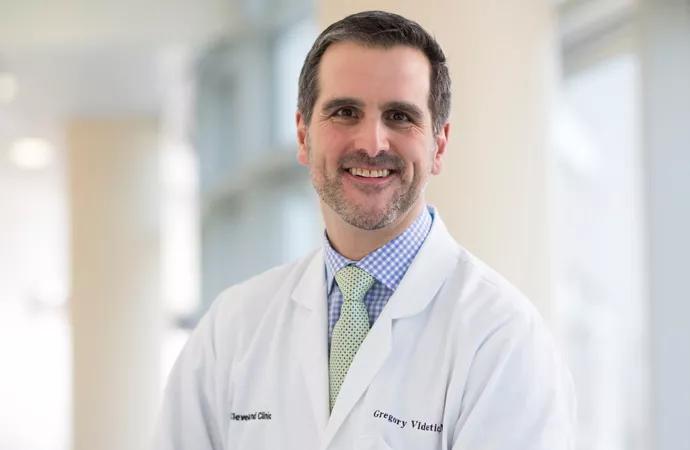
Image content: This image is available to view online.
View image online (https://assets.clevelandclinic.org/transform/a66f2f69-cd27-4f16-9617-8f19e01dc282/veditic_690x450_jpg)
veditic_690x450
Treating patients with stereotactic body radiation therapy (SBRT) has proven to be a good way to attack inoperable, early-stage lung cancer, according to a Cleveland Clinic study of results over the last 10 years presented at the recent Chicago Multidisciplinary Symposium in Thoracic Surgery.
Advertisement
Cleveland Clinic is a non-profit academic medical center. Advertising on our site helps support our mission. We do not endorse non-Cleveland Clinic products or services. Policy
“This treatment approach offered the potential for lung cancer cure in an otherwise frail patient population that previously had little or no options in the management of their disease,” says radiation oncologist Gregory Videtic, MD, Section Head for Thoracic Malignancies in the Department of Radiation Oncology at Cleveland Clinic.
Cleveland Clinic began its SBRT lung cancer program with a single schedule of treating potentially curable early-stage lung cancer in patients who were medically inoperable. When Cleveland Clinic installed the technology in 2003, SBRT was in its infancy as a treatment approach for lung cancer. SBRT delivers an extremely high dose per fraction of radiation to small targets in the body while minimizing side effects.
Over the past 10 years, Cleveland Clinic clinicians have prospectively collected data on the patients they have treated with SBRT. They looked at survival as well as early and late side effect rates. They have also written extensively on their evolving experience with SBRT as a treatment for lung cancer.
“We are one of only a few institutions with such a long period of experience with lung SBRT,” says Dr. Videtic. “After a decade of work, we have confirmed that this treatment offers a very good means of eradicating early cancer that has not spread outside the lung in a way that mimics surgery, but with minimal side effects. We have been privileged in demonstrating, along with other major academic institutions, that for medically inoperable patients with early-stage lung cancer, lung SBRT can now be considered the standard of care.”
Advertisement
Cleveland Clinic’s current study has helped to define the long-term safety of SBRT in that there were no unusual late complications from the treatment. The majority of toxicities (75-80 percent) were minor and resolved quickly.
As of this year, more than 1,000 lung cancer patients have been treated with SBRT at Cleveland Clinic. “A decade of experience coupled with rigorous and consistent follow-up and documentation of all our patients’ experiences has made us confident in offering hope, and the potential for a cure, to patients with early lung cancer who have medical conditions that historically would have prevented them from getting surgery and left them with otherwise few, if any, options,” Dr. Videtic says.
Cleveland Clinic is currently involved in studies to further refine the optimal form of lung SBRT schedules by participating in a randomized Phase II trial with Roswell Park Cancer institute. That trial will compare a single treatment session to the more current standard of three sessions over one week.
“We are also hoping to extend the potential uses of SBRT to operable patients by conducting clinical trials with other institutions,” says Dr. Videtic. “The data from our current project makes us feel safer about applying this option for fitter, operable patients, since there seem to be no unusual long-term side effects.”
Photo Credit © Russell Lee
Advertisement
Advertisement

First-of-its-kind research investigates the viability of standard screening to reduce the burden of late-stage cancer diagnoses

Global R&D efforts expanding first-line and relapse therapy options for patients

Study demonstrates ability to reduce patients’ reliance on phlebotomies to stabilize hematocrit levels
A case study on the value of access to novel therapies through clinical trials

Findings highlight an association between obesity and an increased incidence of moderate-severe disease

Cleveland Clinic Cancer Institute takes multi-faceted approach to increasing clinical trial access 23456
Key learnings from DESTINY trials

Overall survival in patients treated since 2008 is nearly 20% higher than in earlier patients
 Search