Locations:





Tumor cells push the body toward a procoagulant state
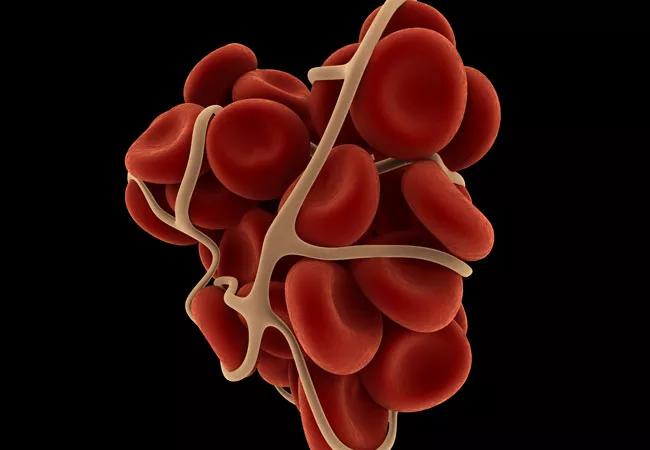
Image content: This image is available to view online.
View image online (https://assets.clevelandclinic.org/transform/a5bac5ef-d821-4bac-a321-a03d9eaf91a0/blood-clot_650x450-Copy_jpg)
blood-clot_650x450 – Copy
Venous thromboembolism (VTE), which includes deep venous thrombosis and pulmonary embolism, is a common but underestimated complication for cancer patients. Once patients develop VTE, even when treated with anticoagulation, they are at high risk for a recurrent episode.
Advertisement
Cleveland Clinic is a non-profit academic medical center. Advertising on our site helps support our mission. We do not endorse non-Cleveland Clinic products or services. Policy
Clinical guidelines recommend extended low-molecular-weight heparin (LMWH) monotherapy for up to six months, for instance, but studies have shown the chance of a second clot is still high — between 7 and 9 percent.
With this in mind, Alok A. Khorana, MD, Director of Cleveland Clinic Cancer Center’s Gastrointestinal Cancer Program, and colleagues decided to look for a biomarker that would identify patients at high risk for recurrent VTE. Their analysis, which was recently published in the Journal of Clinical Oncology, is the largest biomarker study of cancer-recurrent VTE to date.
“We tested for a number of biomarkers and found at least one and maybe two significantly associated with recurrent VTE,” says Dr. Khorana. “One that was definitely associated was high levels of circulating tissue factor (TF) at the time of initial thrombosis.”
To find biomarkers, Dr. Khorana and colleagues analyzed blood samples from 800 patients who were part of the Comparison of Acute Treatments in Cancer Hemostasis (CATCH) trial evaluating different anticoagulant treatments for cancer patients with VTE.
They found that higher levels of circulating TF at the time of the initial thrombosis were associated with a greater likelihood that patients would develop recurrent VTE. Tissue factor is a protein that plays a role in the process of blood clotting. They also found that C-reactive protein was borderline significant.
Tumor cells express TF and often activate the body’s coagulation system, says Dr. Khorana. “By increasing the level of circulating procoagulants and decreasing the level of anticoagulants, they change the body toward a more procoagulant state.”
Advertisement
Measuring TF is somewhat controversial. “We don’t quite know the best way to do it,” says Dr. Khorana. His team used the commercially available assay ELISA so their study could be more easily repeated.
There are ongoing trials to determine the best anticoagulation treatments, and Dr. Khorana and his team hope such investigations either confirm or refute their findings.
Pinpointing biomarkers for recurrent VTE is important because the condition can be deadly. Some researchers have proposed using the Ottawa score, a clinically based risk-assessment model, but studies have shown it is inconsistent in predicting recurrent VTE — thus the need for more definitive predictors or biomarkers.
“You want to patients at risk for recurrent VTE on a more intense anticoagulation treatment or a longer period of treatment,” he says. “If clots occur or recur they can be life-threatening, especially pulmonary embolism. Hence the need to manage this very carefully.”
Advertisement
Advertisement

First-of-its-kind research investigates the viability of standard screening to reduce the burden of late-stage cancer diagnoses

Global R&D efforts expanding first-line and relapse therapy options for patients

Study demonstrates ability to reduce patients’ reliance on phlebotomies to stabilize hematocrit levels

A case study on the value of access to novel therapies through clinical trials

Findings highlight an association between obesity and an increased incidence of moderate-severe disease

Cleveland Clinic Cancer Institute takes multi-faceted approach to increasing clinical trial access 23456
Key learnings from DESTINY trials

Overall survival in patients treated since 2008 is nearly 20% higher than in earlier patients
 Search