Locations:





A breast oncologist’s answer
Only if you love what you do, says Jame Abraham, MD, Director of the Breast Oncology Program at Cleveland Clinic Cancer Center (@jamecancerdoc). “Medical students ask me all the time why on Earth I would enjoy practicing oncology,” he says. “I tell them I am lucky to do what I love every day and happen to get paid for it.”
Advertisement
Cleveland Clinic is a non-profit academic medical center. Advertising on our site helps support our mission. We do not endorse non-Cleveland Clinic products or services. Policy
Enjoying medicine and enjoying your work environment are two different things, and Dr. Abraham argues that the latter matters at least as much as the former. “Physicians spend so much time at work that a healthy work environment is critically important. I view that as part of my job as a person in a position of leadership — do I foster and give priority to an environment that makes people happy to wake up and drive to work each morning? If not, the whole thing will fall apart.”
Dr. Abraham also argues that each physician must learn to build meaningful relationships with each patient, in spite of aspects of modern practice that may make that more difficult. “It doesn’t just help the patient,” he says. “It helps you find purpose in your job. I have the privilege of walking into the lives of thousands of women — mothers, sisters, daughters — at one of the most vulnerable times in their lives. I do not take that lightly.” To Dr. Abraham, remembering the purpose of medicine brings balance and meaning to his work.
What about life at home? How does family fit into the intensity of a career in academic medicine?
“Someone once told me, ‘You can love your work as much as you want, but your work is never going to love you back.’ I try to remember this when I feel pulled in many different directions with my clinical work, my research, my academic activities and my teenage sons and family.
“At the end of the day, I strive to live by example. If my son says ‘I want to be like you,’ that’s the best compliment I can receive. I stay conscious of this effort in every aspect of my life.”
Advertisement
An example to follow is one of the critical elements of a successful and balanced life, says Dr. Abraham. “I haven’t worked directly with my mentor in over 16 years, but we were just in touch this morning. Whenever I make major life decisions, I always reach out to him.” Finding and building a trusting mentor-mentee relationship helps physicians navigate through the complicated rigors of medical practice.
Dr. Abraham and his colleagues on the editorial board of ASCO Post have been working to create dialogue around maintaining a healthy work-life balance. “We decided that we’d honor the tradition in medicine of learning from each other,” he says. The resulting profiles of oncologists and their pursuits outside of medicine are fascinating. Dr. Abraham is guest editor of Living a Full Life, the column devoted to these insightful narratives.
Dr. Abraham hopes these narratives will highlight the need for healthy outlets to balance to the demands of a challenging field. For Dr. Abraham, it’s writing for the public in his native language, Malayalam, and listening to interesting audiobooks on his daily commute. For others, it’s oils and watercolors, fly fishing or cycling. Whatever the outlet, Dr. Abraham believes highlighting the accomplishments and interests of oncologists outside of oncology will remind colleagues that work-life balance is not only possible, but necessary, in this demanding field.
Photo Credit: ©Annie O’Neill
Advertisement
Advertisement
First-of-its-kind research investigates the viability of standard screening to reduce the burden of late-stage cancer diagnoses

Global R&D efforts expanding first-line and relapse therapy options for patients

Study demonstrates ability to reduce patients’ reliance on phlebotomies to stabilize hematocrit levels
A case study on the value of access to novel therapies through clinical trials

Findings highlight an association between obesity and an increased incidence of moderate-severe disease
Cleveland Clinic Cancer Institute takes multi-faceted approach to increasing clinical trial access 23456
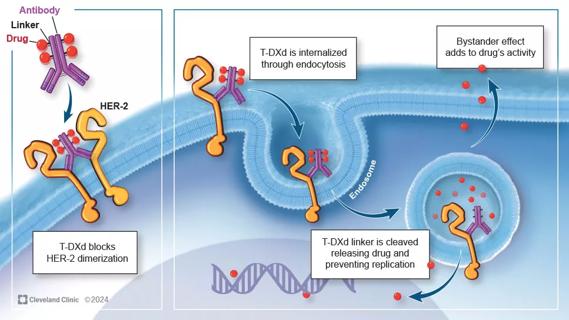
Key learnings from DESTINY trials

Overall survival in patients treated since 2008 is nearly 20% higher than in earlier patients
 Search