Locations:





Are there links to head and neck, breast and colon cancer?
Image content: This image is available to view online.
View image online (https://assets.clevelandclinic.org/transform/cfed7cf3-921a-4019-812f-24d952ea62c0/microbiome_650x450_jpg)
microbiome_650x450
Advertisement
Cleveland Clinic is a non-profit academic medical center. Advertising on our site helps support our mission. We do not endorse non-Cleveland Clinic products or services. Policy
When researchers discovered that Heliobacter pylori could lead not only to gastric ulcers but to gastric cancer, the medical community viewed this as an exception. However, recent technological advances such as genome sequencing and the ability to analyze big data may reveal that the role of bacteria and other nonhuman organisms in human cancer is broader than previously imagined.
The human metagenome represents the genomes of all nonhuman living organisms in and on the human body, including bacteria, viruses and fungi. The microbiome is the genomic footprint of the microbial (bacterial) community.
While gut microbiomic differences are well-characterized between obese and non-obese individuals, as well as between those with inflammatory bowel disease and those who are healthy, microbiomics in cancer is nascent.
Interdisciplinary members of Cleveland Clinic’s Taussig Cancer Institute and the Case Comprehensive Cancer Center are analyzing the microbiomes in several solid tumors, and are among only a handful of investigators doing so nationally and internationally. I am leading the team looking at the microbiome and mycobiome (fungal community) of head and neck squamous cell carcinomas (HNSCC).
Our pilot data reveal clear microbiomic differences between HNSCC and matched normal oral epithelium. Tantalizingly, the HNSCC microbiomic differences were associated with regional pathologic nodal status (pN2) and smoking, but not the presence or absence of human papillomavirus or alcohol consumption.
Advertisement
We are now analyzing a large independent series of HNSCC and their oral washes for the microbiome and mycobiome. Mycobiomic analyses are being performed by Mahmoud Ghannoum, PhD, FIDSA, Director of Medical Mycology at Case Western Reserve University School of Medicine and University Hospitals Case Medical Center. Head and neck oncologic surgeons led by Brian Burkey, MD, Vice Chair of Cleveland Clinic’s Head & Neck Institute, and anatomic pathologists led by Lisa Yerian, MD, Cleveland Clinic’s Medical Director of Continuous Improvement and former Section Head of Surgical Pathology, play vital roles in ensuring rigorous histologic accuracy and sterile sampling.
The oropharynx is typically colonized by microbes. But does an “occult” microbiome exist in organs such as the breast that are typically considered sterile? Stephen Grobmyer, MD, Cleveland Clinic’s Director of Breast Surgical Oncology and Co-Director of the Comprehensive Breast Cancer Program, and I co-lead a multidisciplinary team examining the microbiome in breast cancer. Other Cleveland Clinic members of this team include Holly Pederson, MD, Director of Medical Breast Services; Benjamin Calhoun, MD, PhD, Director of Breast Pathology; and Charles D. Sturgis, MD, a cytopathologist and staff member of the Department of Pathology.
The breast cancer microbiome team is interested in examining whether and how the microbiome plays a role in promoting, or preventing, breast cancer. They seek answers to such questions as whether microbiomic differences can help sort out prognosis in Oncotype DX® Breast Cancer Assay mid-scores and/or help the breast surgeon determine which breast lesions classed as BI-RADS 3 or 4 (mammographically indeterminate) should be biopsied.
Advertisement
David Serre, PhD, an associate staff member of Cleveland Clinic’s Genomic Medicine Institute, and collaborators at the Case Comprehensive Cancer Center are also interrogating the gut microbiome to see whether it can predict which colonic polyps progress to colon cancer.
If elements of the microbiome play key roles in carcinogenesis, then they can serve as novel biomarkers for progression and prognosis as well as novel targets for therapy. Probiotics or antibiotics could act as adjunctive treatment strategies or even as prevention.
Dr. Eng is the founding Chair of Cleveland Clinic’s Genomic Medicine Institute, Director of the Center for Personalized Genetic Healthcare, and a staff member of Taussig Cancer Institute’s Department of Hematology and Medical Oncology. She holds the Sondra J. and Stephen R. Hardis Endowed Chair of Cancer Genomic Medicine and is a Professor of Molecular Medicine at Cleveland Clinic Lerner College of Medicine. She can be reached at engc@ccf.org or 216.444.3440.
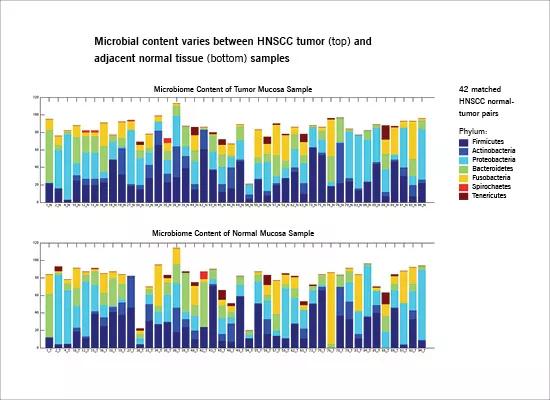
Image content: This image is available to view online.
View image online (https://assets.clevelandclinic.org/transform/922e43f8-b6be-4d83-8b78-d913f949e108/microbiome-chart_550x400_jpg)
Figure. Microbial subpopulational content at the phylum level of head and neck squamous cell carcinoma (HNSCC) and matched normal mucosa. Each bar represents a sample, and the bars are split to show the microbial content quantitatively of that sample at the phylum level.
From Bebek G, Bennett KL, Funchain P, Campbell R, Seth R, Scharpf J, Burkey B,
Eng C. Microbiomic subprofiles and MDR1 promoter methylation in head and neck
squamous cell carcinoma. Hum Mol Genet. 2012 Apr 1;21(7):1557-1565. Used with
permission from Oxford University Press.
Advertisement
Advertisement
First-of-its-kind research investigates the viability of standard screening to reduce the burden of late-stage cancer diagnoses

Global R&D efforts expanding first-line and relapse therapy options for patients
Study demonstrates ability to reduce patients’ reliance on phlebotomies to stabilize hematocrit levels
A case study on the value of access to novel therapies through clinical trials

Findings highlight an association between obesity and an increased incidence of moderate-severe disease

Cleveland Clinic Cancer Institute takes multi-faceted approach to increasing clinical trial access 23456
Key learnings from DESTINY trials

Overall survival in patients treated since 2008 is nearly 20% higher than in earlier patients
 Search