Locations:





Transplant-related mortality, relapse rates are low
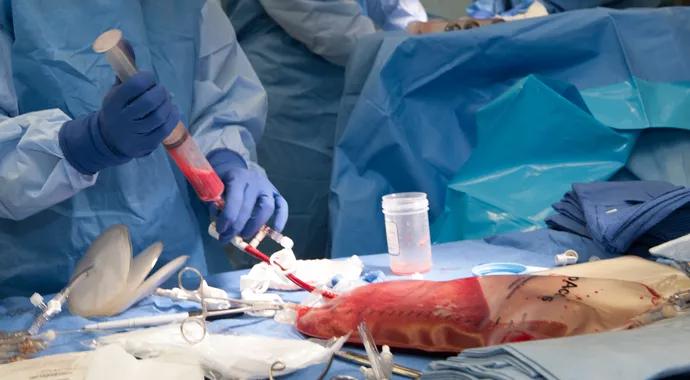
Image content: This image is available to view online.
View image online (https://assets.clevelandclinic.org/transform/39f58d04-033a-42bb-bbdb-fc2a45da8319/Hanna-BMT-Haplo_690x380_jpg)
Hanna BMT Haplo_690x380
The results from Cleveland Clinic’s haploidentical bone marrow transplant program, which was launched in 2014, have been so encouraging that the initiative is being expanded in 2015.
Advertisement
Cleveland Clinic is a non-profit academic medical center. Advertising on our site helps support our mission. We do not endorse non-Cleveland Clinic products or services. Policy
“Of the 18 adult and pediatric patients enrolled and treated since the start of the program, we had only two relapses and no deaths,” says Rabi Hanna, MD, director of the Pediatric Blood & Marrow Transplant Program. “I think the program has done exceptionally well. No deaths among 18 patients is an excellent outcome and indicates very low transplant-related mortality. The relapse rate so far is also very low.”
Graft-versus-host disease (GvHD) is also remarkably low, Dr. Hanna says. This complication, once common after mismatched haploidentical bone marrow transplants, is now observed in only a few patients.
“We see very little severe acute or chronic GvHD when we use the technique of post-transplant cyclophosphamide,” he says. The technique involves administering cyclophosphamide in the immediate days following transplantation to destroy alloreactive immune cells that mediate graft-versus-host and host-verus-graft reactions while sparing hematopoietic stem cells.
The haploidentical transplant program, begun by Cleveland Clinic in April 2014, was novel for many reasons, including its use of a reduced-intensity regimen or myeloablative regimen depending on patient’s co-morbidities and disease status while still using high dose cyclophosphamide shortly after transplant.
Using haploidentical donors, i.e., human leukocyte antigen (HLA) half-matched donors, greatly expands the availability of safe donors, in effect providing almost a universal access for patients needing this life-saving treatment, according to Dr. Hanna. An example of a haploidentical donor is a single biological parent donating to a child, or one sibling donating to another.
Advertisement
Cleveland Clinic is one of only a few centers in the nation conducting haploidentical research and transplantation.
Because of the first year’s success, the therapeutic horizon is widening in 2015.
“In the past we offered haploidentical bone marrow transplant for patients who had leukemia or malignant disorders,” says Dr. Hanna. “We then realized that the technique of transplant using post-transplant cyclophosphamide could be applicable to many disorders, malignant and non-malignant, including sickle cell disease and severe aplastic anemia”. In 2015, the program is expanding to include this as well.
This is especially significant because it is very difficult to find match-related or match-unrelated donors in the sickle cell patient population.
“By expanding the type of transplant to haplo transplant, we could conceivably offer every patient with sickle cell disease the potential to cure the disease with a haploidentical donor, with very low morbidity and good overall survival,” he says. One patient of the 2015 cohort has actually already been cured of sickle cell disease and myelodysplastic syndrome (MDS), Dr. Hanna says.
He says the results with sickle cell disease are also exciting by virtue of the reduced intensity of therapy and decreased transplant-related mortality.
“The sickle cell patient doesn’t stay in the hospital as long as the traditional patient undergoing myeloablative transplantation, because the conditioning regimen is of reduced intensity,” he says. “So the intensity and the hospitalization are less and the cost-effectiveness and value of the transplant become higher. This is good for the patient and for the overall healthcare system.”
Advertisement
Dr. Hanna says he envisions using haploidentical transplantation to treat other diseases as well, so every patient who may be potentially cured with hematopoietic stem cell transplant (HSCT) could have access to this transplant using this technique.
Advertisement
Advertisement
First-of-its-kind research investigates the viability of standard screening to reduce the burden of late-stage cancer diagnoses

Global R&D efforts expanding first-line and relapse therapy options for patients
Study demonstrates ability to reduce patients’ reliance on phlebotomies to stabilize hematocrit levels
A case study on the value of access to novel therapies through clinical trials

Findings highlight an association between obesity and an increased incidence of moderate-severe disease

Cleveland Clinic Cancer Institute takes multi-faceted approach to increasing clinical trial access 23456
Key learnings from DESTINY trials

Overall survival in patients treated since 2008 is nearly 20% higher than in earlier patients
 Search