Locations:





A comprehensive evaluation and multidisciplinary care are key to caring for patients with vestibular disorders
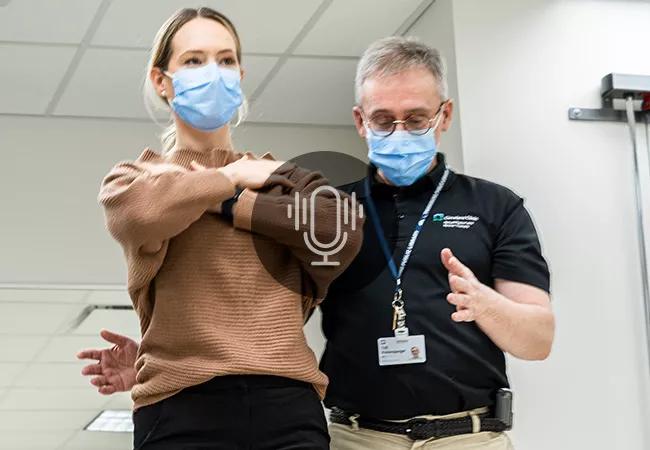
Image content: This image is available to view online.
View image online (https://assets.clevelandclinic.org/transform/8b756473-7eb9-4670-b1c9-3387257a3d6a/CQD-4397542-Vestibular-Testing-2_jpg)
Vestibular testing
Podcast content: This podcast is available to listen to online.
Listen to podcast online (https://www.buzzsprout.com/2241209/13504214)
Patients with vestibular disorders often describe feelings of dizziness, vertigo, imbalance or lightheadedness. A vestibular audiology evaluation can help discern the underlying cause.
Advertisement
Cleveland Clinic is a non-profit academic medical center. Advertising on our site helps support our mission. We do not endorse non-Cleveland Clinic products or services. Policy
“We are kind of the detectives for vestibular disorders to help decipher what could be a potential cause,” says Julie Honaker, PhD, Director of the Vestibular and Balance Disorders Program within Cleveland Clinic’s Head and Neck Institute. “It may not always be ear-related, but we’re going to spend a lot of time listening to the patients.”
In a recent episode of Cleveland Clinic’s Head and Neck Innovations podcast, Dr. Honaker discusses multidisciplinary care for patients with vestibular disorders and the latest treatments and rehabilitation tools. She covers:
Click the podcast player above to listen to the episode now, or read on for a short edited excerpt. Check out more Head and Neck Innovations episodes at clevelandclinic.org/podcasts/head-and-neck-innovations or wherever you get your podcasts.
Podcast host Paul Bryson, MD, MBA: What are some of the tools that your team has? What are some of the diagnostic maneuvers, equipment, things like that in your armamentarium for these patients?
Julie Honaker: Good question. Well, as I said, our main job is vestibular audiology, and I should say that we work very closely with our partners in rehab, so vestibular PT. We work together not in the same facility, but as a team to help with assessment and management for these patients.
Advertisement
But for our diagnostic patients, we really are able to get a good idea of function and physiology of all aspects of the vestibular system. So, much like the hearing system, we can perform an audiogram looking across frequency range for hearing. We can do the same for vestibular testing by integrating certain components of the vestibular system. In particular, looking at semicircular canal function, we can actually fill in gaps where a disorder may lie for somebody and whether or not it is a complete loss of function, just a mild loss of function, what’s spared within the system. And that will help with determining outcomes for rehab and help us better understand what we really need to focus on for our rehab efforts.
So, I would say with the advanced and modern technology that we have in our laboratories, we’re able to evaluate all five vestibular end organs across the frequency spectrum, and we can get a good idea of the function of that system, site of lesion, how a person’s compensating from loss of vestibular function, and whether or not there’s possibly some other contributors to a patient’s symptoms, such as central nervous system disorders.
Advertisement
Advertisement

With a wide scope of skills, comprehensive otolaryngologists care for patients of all ages in the community
Research on children with UHL explores the quality-of-life benefits and outcomes of cochlear implants
A look at how custom-fitted oral appliances work and when they’re a good fit for patients
Subtle information gleaned from clinical examinations prompted concern
A new single-port system well-suited for oropharyngeal cancer treatment
Challenging case requires outside-the-box approach
Collaborative and multidisciplinary approach necessary for treatment

The tri-vector gracilis procedure uses a thin muscle from the thigh to help create a natural mimetic smile
 Search