Locations:





Can exercise intervention reduce racial and socioeconomic disparities in health outcomes?
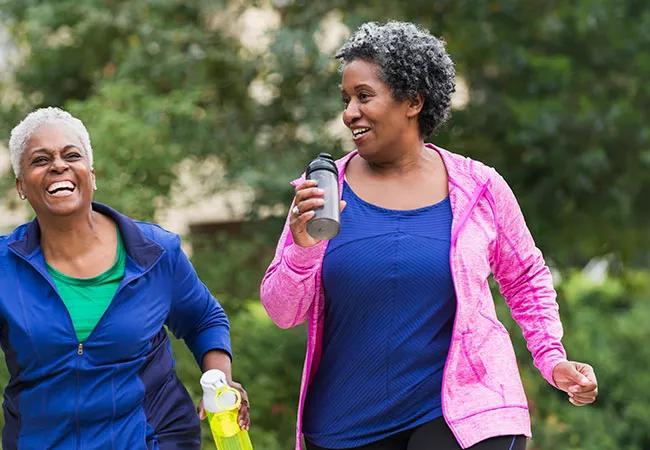
Image content: This image is available to view online.
View image online (https://assets.clevelandclinic.org/transform/5b3b5427-7e8f-4056-b984-750026905bc3/19-CNR-880-650x450-African-American-Woman-Moderate-Exercise_jpg)
endocrinology and geriatrics
Regular exercise of moderate intensity is associated with lower recurrence rates in women with invasive breast cancer. Three Cleveland-area hospitals are collaborating on ongoing research to learn more about the impact exercise has on physical performance, body composition and prognostic biomarkers in survivors of stage I-III breast cancer who are over age 65 and within five years of treatment. The IMPROVE study also seeks to discern whether race and socioeconomic status are determinants of physical performance capabilities and outcomes.
Advertisement
Cleveland Clinic is a non-profit academic medical center. Advertising on our site helps support our mission. We do not endorse non-Cleveland Clinic products or services. Policy
Cynthia Owusu, MD, MS, a medical oncologist at University Hospitals, is the study’s lead investigator, and Halle Moore, MD, staff physician in the Department of Solid Tumor Oncology at Cleveland Clinic, leads Cleveland Clinic’s cohorts. Paul Hergenroeder, MD, leads the MetroHealth Medical Center cohort. Dr. Owusu shared the IMPROVE study design during a poster presentation at the 2019 American Society of Clinical Oncology Annual Meeting.
The study is predicated, in part, on previous work showing that older women with non-metastatic breast cancer who are African American (vs. non-Hispanic white) and of lower socioeconomic status (vs. higher socioeconomic status) were four times more likely to develop functional disability following treatment.
“We want to learn whether targeted exercise interventions during the early breast cancer survivorship period may reduce racial and socioeconomic-related disparities in functional disability and, in the long-term, improve the functional and health status of these populations and all over-65 survivors,” says Dr. Moore.
A total of 320 study participants are being randomized to either a group that performs supervised exercise three times a week for 20 weeks in addition to a home walking program or a group that meets for the same period of time for education and monitoring. The exercise intervention includes moderate aerobic and resistance training tailored to individual ability.
At baseline and after 20 weeks, participants are tested and assigned physical performance and functional status scores. Body composition is analyzed, and blood biomarkers are measured.
Advertisement
“We want to determine the difference exercise makes in these individuals’ blood levels — in African American versus non-Hispanic white subgroups, for women of different socioeconomic status overall, and within the races,” says Dr. Moore. “Then we can see if the groups differ in the end, not only in their fitness, but also in these biomarkers that may relate to breast cancer recurrence.”
After 20 weeks, participants in the exercise group continue to exercise without supervision for an additional 32 weeks. The attention-controlled group continues to check in regularly. At the end of 52 weeks, the same data is obtained as at 20 weeks.
Enrollment is ongoing, with rolling participation in both groups. To date, about half the total participants have enrolled or completed the 52 weeks.
IMPROVE is an innovative study, given the paucity of research on these populations. “There are studies that looked at younger breast cancer survivors, but very few have addressed those over age 65, and even fewer have looked at African American and socioeconomic-disadvantaged survivors, who are extremely vulnerable to functional disability,” says Dr. Moore.
The stakes are high. The added cost of healthcare for older adults who cannot complete activities of daily living is around 10% of the total cost of personal healthcare for all people age 65 and older. Yet, according to the U.S. Department of Health and Human Services, adults who engage in 150 minutes of moderate-intensity aerobic exercise per week can substantially reduce their risk of functional limitation.
Advertisement
“One of the things we want to look at is what the barriers are to patients being able to complete the exercise program and what differences exist based on racial or socioeconomic factors,” says Dr. Moore. “If there are groups who have a higher rate of being sedentary or obese, or who have higher rates of cancer recurrence, we want to better understand what is causing this so we can address those factors.”
Advertisement
Advertisement

First-of-its-kind research investigates the viability of standard screening to reduce the burden of late-stage cancer diagnoses

Global R&D efforts expanding first-line and relapse therapy options for patients
Study demonstrates ability to reduce patients’ reliance on phlebotomies to stabilize hematocrit levels

A case study on the value of access to novel therapies through clinical trials

Findings highlight an association between obesity and an increased incidence of moderate-severe disease

Cleveland Clinic Cancer Institute takes multi-faceted approach to increasing clinical trial access 23456
Key learnings from DESTINY trials

Overall survival in patients treated since 2008 is nearly 20% higher than in earlier patients
 Search