Locations:





Cochlear implant design and insertion techniques advance
Image content: This image is available to view online.
View image online (https://assets.clevelandclinic.org/transform/b7f7b635-cd32-4d87-b692-c9d1812a0ace/14-ENT-2028-Sydlowski-Hero-Image-690x380pxl_jpg)
14-ENT-2028-Sydlowski-Hero-Image-690x380pxl
By Sarah A. Sydlowski, AuD, PhD
Advertisement
Cleveland Clinic is a non-profit academic medical center. Advertising on our site helps support our mission. We do not endorse non-Cleveland Clinic products or services. Policy
Advancements in cochlear implant (CI) design and insertion techniques have allowed surgeons to preserve cochlear structures in patients with usable low frequency hearing. Hearing preservation is affected by many factors, including the insertion technique (round window or cochleostomy), insertion depth (short or full-length array), type of electrode (straight, perimodiolar or mid-scala) and insertion force.
Several standard-length (“cochlear coverage”) arrays already on the market have been successfully used during hearing preservation procedures. However, the recent FDA approval of the Cochlear Americas Hybrid™ CI device has further improved the opportunity to preserve and utilize residual hearing, and it has expanded the candidacy criteria such that patients with substantial residual hearing are now candidates for CI technology. With the approval of this new CI design, clinicians have the opportunity to utilize an acoustic component that can be placed in the implanted ear of patients with postoperative residual hearing.
Research has shown that this electric-acoustic configuration gives the recipient many hearing advantages, including improved music appreciation, improved perception of speech quality and better understanding of speech in noise. Because successful hearing preservation can influence CI programming and outcomes, it is critical that programming clinicians are aware of the patient’s level of acoustic hearing when completing CI programming.
To accommodate our changing population of CI recipients, we have adapted our postoperative protocol to include audiometric evaluation (including air- and bone-conduction thresholds, speech recognition thresholds, word recognition scores and tympanometry).
Advertisement
Hearing preservation is routinely measured and reported in the literature as serial assessments of pure-tone air-conduction thresholds in the implanted ear. A limitation of this methodology is that the exclusion of bone-conduction thresholds can mask the introduction of an air-bone gap that develops as a result of hemotympanum. Evaluation is conducted before activation and then again at each post activation programming appointment until the hemotympanum has resolved. Residual hearing is periodically reevaluated for changes that may impact programming decisions.
Our early experience suggests that at least partial preservation of low-frequency (< 1500 Hz) acoustic hearing after cochlear implantation is possible for most patients (see example results in Figure), even with full insertion of a standard-length array.
Dr. Sydlowski is Audiology Director of the Head & Neck Institute’s Hearing Implant Program.
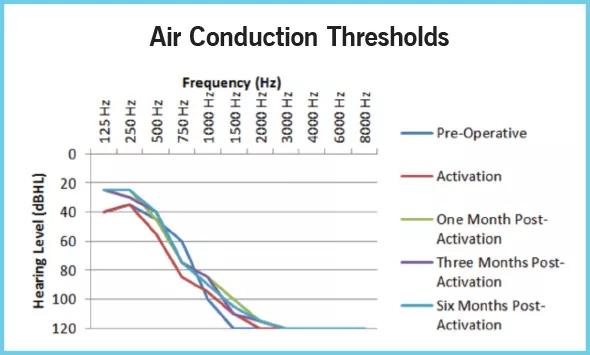
Image content: This image is available to view online.
View image online (https://assets.clevelandclinic.org/transform/6a101870-5660-4563-9f6d-6093447a647f/14-ENT-2028-Sydlowski-Inset-Image-Graph-590pxl-width_jpg)
Figure. Pre- and postoperative serial audiograms in a recently implanted ear.
Advertisement
Advertisement

With a wide scope of skills, comprehensive otolaryngologists care for patients of all ages in the community
Research on children with UHL explores the quality-of-life benefits and outcomes of cochlear implants
A look at how custom-fitted oral appliances work and when they’re a good fit for patients
Subtle information gleaned from clinical examinations prompted concern
A new single-port system well-suited for oropharyngeal cancer treatment
Challenging case requires outside-the-box approach
Collaborative and multidisciplinary approach necessary for treatment

The tri-vector gracilis procedure uses a thin muscle from the thigh to help create a natural mimetic smile
 Search