Locations:





New drug among the most potent antibody-drug conjugates in development
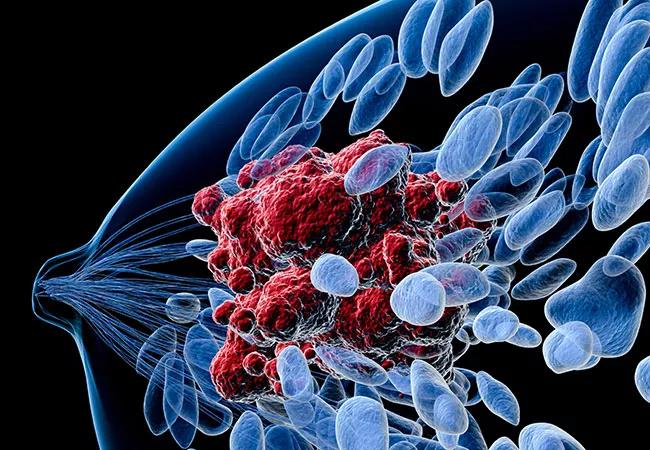
Image content: This image is available to view online.
View image online (https://assets.clevelandclinic.org/transform/4cb5052a-38df-4773-b16f-e4c73534595a/650x450-Breast-Cancer_jpg)
650×450-Breast-Cancer
HER2+ breast cancers are among the most aggressive forms of breast cancer, with an increased chance of recurrence and relapse and decreased overall survival. Now a global phase 3 clinical trial will investigate a novel drug in the post neoadjuvant setting that researchers hope will be a significant improvement over the current standard of care.
Advertisement
Cleveland Clinic is a non-profit academic medical center. Advertising on our site helps support our mission. We do not endorse non-Cleveland Clinic products or services. Policy
Around 15% to 20% of breast cancer patients have HER2 overexpression. In the KATHERINE trial, T-DM1 (trastuzumab emtansine), substantially improved disease-free survival for patients who had residual disease after neoadjuvant taxane-based chemotherapy and HER2 targeted agents (trastuzumab +/- pertuzumab).
“This was great news for many patients, but a subset of high-risk patients maintain a high chance of relapse,” says Jame Abraham, MD, Chair of the Department of Hematology and Medical Oncology at Cleveland Clinic Cancer Center, who is leading the trial. “The current trial is looking at trastuzumab deruxtecan [T-DXd; DS-8201a] versus T-DM1 in the post neoadjuvant setting for patients with residual disease and at a higher risk of recurrence,”
This trial (NSABP B 60/DESTINY-Breast 05) will enroll HER2+ patients who were treated with taxane-based chemotherapy and trastuzumab (+/- pertuzumab), had residual disease after surgery, and are at high risk of recurrence, which includes patients with large, inoperable tumors at presentation or who are node positive after preoperative therapy. Patients will be randomized to either T-DXd every three weeks for 14 cycles or T-DM1 every three weeks for 14 cycles. The primary endpoint is invasive disease-free survival.
“The question is: Can we do better than T-DM1 in these high-risk patients?” says Dr. Abraham.
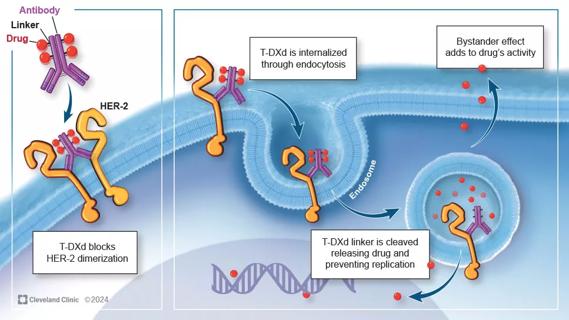
Both medications are antibody-drug conjugates, but T-DXd is highly potent, with a drug-to-antibody ratio of 8. Its payload also has a shorter half-life, reducing systemic exposure, and is membrane permeable, which allows for elimination of both HER2-targeted tumor cells as well as surrounding tumor cells. It features a tumor-selective cleavable linker.
Advertisement
“It’s probably one of the most active antibody-drug conjugates in development,” Dr. Abraham says.
A phase 2 trial of T-DXd found significant response in HER2+ metastatic breast cancer patients who had previously been treated with T-DM1, with an objective response rate of 60.9%, and median progression-free survival of 16.4 months.
One of the potential side effects identified in previous trials is an increased risk of interstitial lung disease (ILD), which is exacerbated further in patients who have received radiation. “That is a concern, and we need to make sure that we’re able to manage ILD and that patients don’t have too high a risk of developing it,” he says. “A robust monitoring and management plan is in place,” he adds.
Some 1,600 patients will be enrolled in this new global trial, which involves as many as 400 sites across 31 countries. The study is planned to launch in November and will last approximately seven years.
To learn more about this trial, listen to the Cancer Advances podcast.
Advertisement
Advertisement

First-of-its-kind research investigates the viability of standard screening to reduce the burden of late-stage cancer diagnoses

Global R&D efforts expanding first-line and relapse therapy options for patients

Study demonstrates ability to reduce patients’ reliance on phlebotomies to stabilize hematocrit levels

A case study on the value of access to novel therapies through clinical trials

Findings highlight an association between obesity and an increased incidence of moderate-severe disease

Cleveland Clinic Cancer Institute takes multi-faceted approach to increasing clinical trial access 23456
Key learnings from DESTINY trials

Overall survival in patients treated since 2008 is nearly 20% higher than in earlier patients
 Search