Locations:





Gene expression analysis uncovers clues
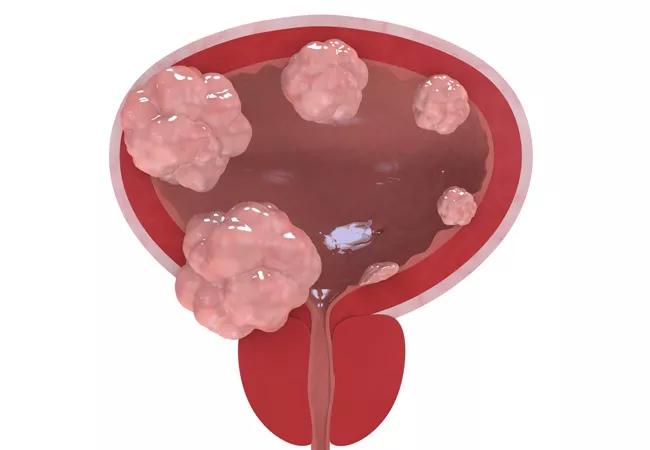
Image content: This image is available to view online.
View image online (https://assets.clevelandclinic.org/transform/4def328b-5624-4ab4-b2ac-79a2041e6c5a/bladder-cancer_650x450_jpg)
bladder-cancer_650x450
Cleveland Clinic researchers recently conducted a retrospective study to gain a better understanding of small cell bladder cancer (SCBC), a rare, often deadly, and poorly understood form of bladder cancer. SCBC is difficult to diagnose and treat as it often progresses quickly, and patients tend not to respond well to current treatment method drawn from urothelial and small cell lung cancer protocols.
Advertisement
Cleveland Clinic is a non-profit academic medical center. Advertising on our site helps support our mission. We do not endorse non-Cleveland Clinic products or services. Policy
The biology of SCBC is poorly understood, but its clinical behavior shares similarities with small cell and neuroendocrine tumors of other primary sites, such as small cell lung cancer. Thus, the investigators used an institutional cohort to test the hypothesis that SCBC tumors would express genes common to other small cell cancers, including small cell carcinoma of the lung.
Using pathology records, Omar Mian, MD, PhD, associate staff in the departments of Radiation Oncology and Translational Hematology and Oncology Research, and his colleagues identified 63 patients with SCBC who were treated at Cleveland Clinic between 1993 and 2016. Data included fixed and archived tissue from about 40 tumors. Additionally, six cases had matched pairs of tumor and adjacent normal tissue, and one case included a sample from a metastatic lesion.
“That’s powerful,” Dr. Mian says, “because we were able to make comparisons in the same individual between their normal bladder gene expression and the tumor-related activation and suppression of genes.”
The researchers found that not all of the 63 tumors were purely SCBC histologically. Some contained a mix of SCBC cells and other bladder cancer cells such as urothelial cancer cells. “It varied anywhere from a small component of the bladder cancer to the entire tumor being small cell,” says Dr. Mian.
Median overall survival (OS) was 22.8 months, and median progression free survival (PFS) was 13.7 months. The team also discovered several independent prognostic factors. For instance, tumors with DLL3 protein expression of greater than 10 percent were associated with shorter OS and PFS from diagnosis and shorter OS from cystectomy.
Advertisement
Dr. Mian and colleagues also performed differential gene expression analysis on the six matched pairs of tumor and adjacent normal tissue, finding a total of 583 differentially expressed genes. After gene set enrichment analysis, they uncovered that the top differentially expressed genes are significantly enriched in pathways related to biological regulation, protein binding and metabolic processes, including stimulus response.
The research team analyzed differentially expressed genes based on small cell component of the tumor and performed correlations with immunostaining for known pathologic biomarkers associated with small cell cancers. This analysis generated a novel gene signature for SCBC, which the research team believes will allow distinction of SCBC from other bladder cancer variants based on molecular profiling.
External validation of this gene signature in larger cohorts at Cleveland Clinic and collaborating institutions is planned. If validated, the signature may, for the first time, provide a reliable molecular pattern for distinguishing this rare subtype of bladder cancer with potential utility in selecting patients for tailored treatments.
The Cleveland Clinic research team included lead authors Petros Grivas, MD, PhD, hematology and medical oncology and Vadim Koshkin, MD, fellow in solid tumor oncology; Ming Hu, PhD, quantitative health sciences; Byron Lee, MD, PhD, and other surgeons from the Glickman Urologic and Kidney Institute; and pathologists, led by Cristina Magi-Galluzzi, MD, PhD, Director of Genitourinary Pathology.
Advertisement
Advertisement

First-of-its-kind research investigates the viability of standard screening to reduce the burden of late-stage cancer diagnoses

Global R&D efforts expanding first-line and relapse therapy options for patients

Study demonstrates ability to reduce patients’ reliance on phlebotomies to stabilize hematocrit levels

A case study on the value of access to novel therapies through clinical trials

Findings highlight an association between obesity and an increased incidence of moderate-severe disease

Cleveland Clinic Cancer Institute takes multi-faceted approach to increasing clinical trial access 23456
Key learnings from DESTINY trials

Overall survival in patients treated since 2008 is nearly 20% higher than in earlier patients
 Search