Locations:





Cancer Center Chairman discusses leading through change

Image content: This image is available to view online.
View image online (https://assets.clevelandclinic.org/transform/00ead1f4-b2fa-4060-8525-5f96297505ba/bolwell_650x450_jpg)
bolwell_650x450
Dr. Bolwell is Chair of Physician Leadership and Development and former Chair of Taussig Cancer Institute. He can be reached at bolwelb@ccf.org or 216.444.6922. On Twitter: @BrianBolwellMD
Advertisement
Cleveland Clinic is a non-profit academic medical center. Advertising on our site helps support our mission. We do not endorse non-Cleveland Clinic products or services. Policy
Q: The U.S. Department of Health and Human Services Agency for Healthcare Research and Quality has over 2000 metrics for clinical quality. How do you address so many metrics at one time?
A: When you sit in front of a patient and try to help them, it’s hard to imagine there are actually 2000 things to measure. But I do think many of the metrics make sense, especially those dealing with quality, like the incidence of deep venous thrombosis after surgery.
As a leader, I focus on how to get a team of people to go from point A to point B. I think if you tell a team they need to meet 55 different metric goals that tends to be rather overwhelming. There’s a finite number of things on which I can ask them to focus, and if we do those very well, it’s likely that many other things will follow.
I think of the analogy of a golf swing. It’s actually very difficult to swing well. I remember someone telling me years ago that if you finish a swing in balance and you’re pointing to the target you’ve probably made a pretty good swing. Similarly, I think if we can focus on a handful of things and do them well, it’s pretty likely that we’re doing a whole bunch of other things well, too.
Q: What metrics does Cleveland Clinic Cancer Center prioritize and why?
A: We focus on three priorities that I think are fundamental. Quality and safety is number one. Number two is treating people well, and number three is access.
You have to lead with quality and safety. Very early in my career, I was running the bone marrow transplant program, and we heard about a couple of catastrophic events that happened at another center in which patients received fatal doses of chemotherapy. It turned that organization on its head, and it certainly changed the way we order chemotherapy here. When I began leading this center, our goal was to eliminate harm events from chemotherapy, and by working together with our nursing colleagues, we’ve actually lowered our chemotherapy harm events to zero for the past five years.
Advertisement
The second thing is treating people well, and that starts with our own work family. I think if we ensure that everyone in our work environment is treating the entire team with respect, then it’s highly likely we’ll treat patients and their families well.
Finally, we are incredibly focused on access. I think the time it takes for a person to receive their first therapy after diagnosis is a surrogate marker for the amount of empathy in a culture. It’s a cultural thing. People need to be seen; we get them in and see them. We know they’re anxious and scared and respect that with prompt access. I’m happy with the progress we’ve made on time to treat metrics thus far. I think improving access cascades to many other measures.
Q: Reimbursement tied to specific metrics is just one example of the tumultuous changes occurring in healthcare in general and in oncology in particular. As a leader, how do you promote the well-being of your colleagues in such an environment?
A: The whole field of oncology is changing very, very rapidly. I think that for most of us, simply keeping up is a challenge. I think step one is to communicate with staff. Be transparent about what is going on in the organization and outside of the organization. People need to know why we’re being asked to do whatever the task at hand might be.
Another focus is teamwork. I think the shift to value-based care has caused disruptive change, but the emphasis on integrated teams has been a particularly helpful change. That’s the whole key to value-based care. But by nature, most physicians are pretty independent. Teamwork was not a qualification to get into medical school or residency, and it’s not something with which everyone is comfortable.
Advertisement
Our care paths are a good example of a response to value-based care that has fostered teamwork. To analyze what treatments work best, what should be the standard of care, we involved team members from different institutes, different locations, in different positions. The goal was to adopt a standard of care, but we also created a sense of teamwork that fosters collaboration and gets people working together on a task, which is important to creating an environment in which people feel comfortable and fulfilled in their daily work.
Q: What enables you to lead through this time of change?
A: A while ago I was fortunate to undergo formal leadership training, which included an extensive report of my colleagues’ perceptions of me and my leadership style. It was basically a 20-page report in which they told me everything I did wrong, but it was incredibly useful. Openness to constructive criticism is key. It was eye opening; I learned and changed a lot.
I’ve read about 40 books on the topic of leadership, and I’ve gravitated to something called serving leadership, which just makes sense to me. It means that I have three goals: set a clear vision, which is harder than it sounds. Hire wonderful people and enable them to succeed. And then remove the barriers. I think that’s a big part of how I can contribute to the team’s well-being. Anytime you work in a large organization there are barriers, political or otherwise. My job is to remove those and let people do their jobs.
As a leader, if I can focus on those three things, and if as a Cancer Center, we can focus on quality and safety, respect for one another and access, then no matter how the external environment demands change, we will succeed.
Advertisement
Advertisement
First-of-its-kind research investigates the viability of standard screening to reduce the burden of late-stage cancer diagnoses

Global R&D efforts expanding first-line and relapse therapy options for patients

Study demonstrates ability to reduce patients’ reliance on phlebotomies to stabilize hematocrit levels
A case study on the value of access to novel therapies through clinical trials

Findings highlight an association between obesity and an increased incidence of moderate-severe disease
Cleveland Clinic Cancer Institute takes multi-faceted approach to increasing clinical trial access 23456
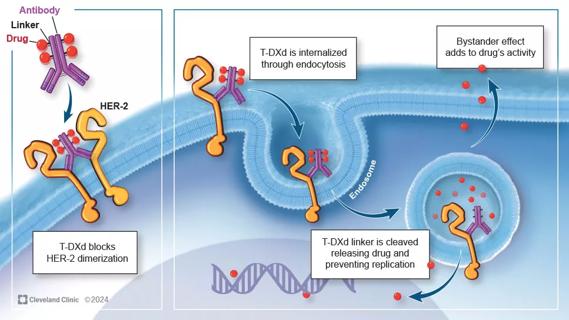
Key learnings from DESTINY trials

Overall survival in patients treated since 2008 is nearly 20% higher than in earlier patients
 Search