Locations:





Low-strength electrical current identifies at-risk patients with greater accuracy than tape measurement
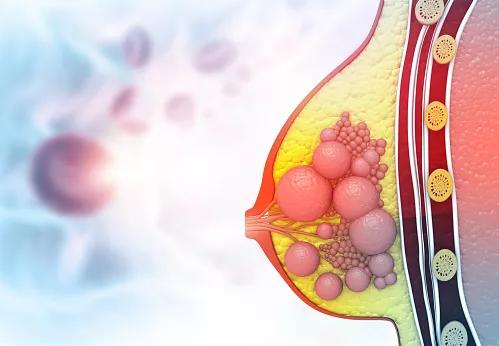
Image content: This image is available to view online.
View image online (https://assets.clevelandclinic.org/transform/c0a8badf-2dea-43e6-a07b-f8af60a5f5ca/gettyimages-1272058199-170667a_jpg)
Cross section of human breast cross section. 3d illustration
Bioimpedance spectroscopy (BIS) coupled with early compression treatment appears to be more effective than tape measure-triggered compression for preventing lymphedema after breast cancer surgery. According to a recent international, multicenter study, BIS can identify patients who are likely to benefit from early compression intervention with greater precision than tape measurement (TM) alone. In addition, BIS is associated with a significant absolute reduction in chronic lymphedema in women with breast cancer.
Advertisement
Cleveland Clinic is a non-profit academic medical center. Advertising on our site helps support our mission. We do not endorse non-Cleveland Clinic products or services. Policy
“The primary end point of the trial was the rate of chronic lymphedema using complex decongestive physiotherapy as a surrogate,” explains Cleveland Clinic radiation oncologist Chirag Shah, MD, a co-author of the randomized study. “Our data showed that there was a statistically significant reduction in chronic lymphedema when we used BIS to conduct prospective surveillance. Historically, approximately 20% of patients developed chronic lymphedema based on their need for complex decongestive physiotherapy, but BIS reduced that rate to only 7.9%.”
In explaining the rationale behind this research, he emphasizes that lymphedema is a major potential side effect of breast cancer treatment that can have a profound impact on patients’ quality of life.
“Unfortunately, lymphedema is relatively common in patients with breast cancer, particularly in those with more advanced disease who require lymph node dissection, radiation therapy, and/or chemotherapy,” says Dr. Shah, Director of Clinical Research in the Department of Radiation Oncology at Taussig Cancer Institute. “Because the condition is associated with significant morbidity and quality-of-life-altering complications, we feel it is worthy of continuing research.”
According to Dr. Shah, the major driver of lymphedema is the amount of local/regional therapy that a patient receives for their breast cancer.
“There are several driving factors that increase the risk of lymphedema more than the patient’s age or the type of breast cancer itself,” he explains. “For example, women who require axillary lymph node dissection compared to sentinel lymph node biopsy suffer from higher rates of lymphedema, as do patients who require regional lymph node radiation. In addition, some forms of chemotherapy — such as taxane-based chemotherapy — are associated with a higher incidence of lymphedema.”
Advertisement
The multicenter, international trial enrolled 1,200 patients with newly diagnosed breast cancer between June 24, 2014 and September 11, 2018. All patients had undergone surgery for their cancer. Study subjects were randomized 1:1 to prospective surveillance by BIS (n=482) or tape measurement (n=442) and screened for lymphedema development at regular intervals for three years after breast cancer surgery. The rate of progression to chronic breast cancer-related lymphedema, following an intervention for subclinical lymphedema using a compression garment, served as the primary end point.
Dr. Shah notes that this is the first randomized trial to compare BIS to tape measurement as a method of breast cancer surveillance. In addition, it appears to be the largest study of early treatment for breast cancer-related lymphedema. “I don’t think there has ever been a similar study close to this size,” he says.
Approximately 14% of study participants progressed to chronic lymphedema after intervention with a compression garment; however, only 8% of patients in the BIS arm developed this complication compared to 19.2% in the tape-measurement group. Interestingly, the patients monitored with BIS also required fewer interventions/triggers than those in the tape-measurement group (20% vs. 28%).
These findings amount to an absolute reduction of 11.3% in the propensity to progress to chronic lymphedema with the use of BIS surveillance coupled with early intervention with a compression garment.
“These results imply that breast cancer patients who are at risk of developing lymphedema should undergo prospective lymphedema surveillance with BIS coupled with the early use of a compression garment,” Dr. Shah says, adding that the trial has shown BIS to be a far superior breast cancer-related lymphedema diagnostic technique as compared to tape measurement.
Advertisement
Advertisement

First-of-its-kind research investigates the viability of standard screening to reduce the burden of late-stage cancer diagnoses

Global R&D efforts expanding first-line and relapse therapy options for patients

Study demonstrates ability to reduce patients’ reliance on phlebotomies to stabilize hematocrit levels

A case study on the value of access to novel therapies through clinical trials

Findings highlight an association between obesity and an increased incidence of moderate-severe disease

Cleveland Clinic Cancer Institute takes multi-faceted approach to increasing clinical trial access 23456
Key learnings from DESTINY trials

Overall survival in patients treated since 2008 is nearly 20% higher than in earlier patients
 Search