Locations:





Full treatment in five fractions
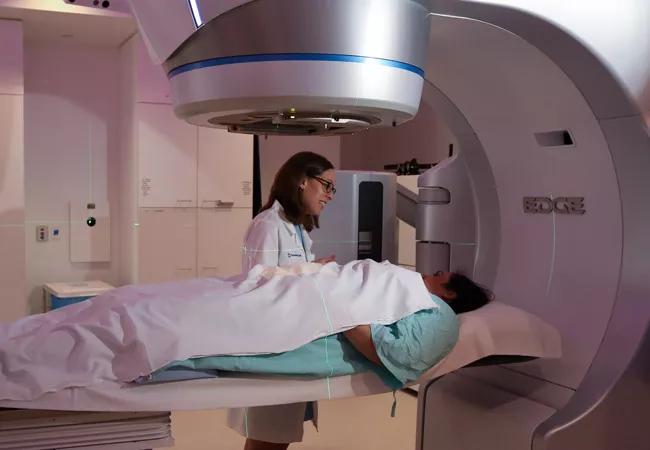
Image content: This image is available to view online.
View image online (https://assets.clevelandclinic.org/transform/2880b873-8ee3-4d37-abd2-c50b31698b5a/Dr_MurphyEDGE_650x450_jpg)
Dr.Murphy&EDGE_650x450
When Chirag Shah, MD, became a radiation oncologist in 2007, almost all breast cancer patients had one option: five to six weeks of daily, whole-breast/chest-wall radiation, regardless of surgical type (mastectomy or lumpectomy). A mere decade later, thanks to advances in the field in part refined at Cleveland Clinic Cancer Center, patients can choose among several options for radiotherapy, many of which are safer and shorter without compromising efficacy. Dr. Shah is directing Cleveland Clinic Cancer Center’s adoption of new techniques to significantly reduce the duration of radiation therapy treatments for appropriately selected patients, from three to four weeks to just five treatments.
Advertisement
Cleveland Clinic is a non-profit academic medical center. Advertising on our site helps support our mission. We do not endorse non-Cleveland Clinic products or services. Policy
Accelerated partial-breast irradiation (APBI) allows appropriately selected patients with early-stage breast cancer to complete adjuvant radiation in two weeks or less following breast-conserving surgery. To date, multiple randomized trials have demonstrated no difference in rates of recurrence or survival with APBI delivered using brachytherapy or external beam radiation techniques.
For patients with ductal carcinoma in situ (DCIS) and early-stage invasive breast cancer, APBI has been shown to be an alternative to standard whole-breast irradiation, allowing for a reduction in the duration of radiation therapy. The technique, by reducing the amount of normal, healthy breast tissue treated with radiation, may also reduce side effects of treatment and improve cosmetic outcomes. It is also considered a cardiac and pulmonary dose-sparing technique.
One method of delivering APBI is intensity-modulated radiation therapy (IMRT), a highly precise form of radiotherapy. Cleveland Clinic Cancer Center employs a team of highly trained specialists that utilize the Edge® (Varian Medical Systems Inc.) radiosurgical suite. The Edge is a state-of-the-art linear accelerator coupled with real-time motion management to ensure fast, precise delivery of treatment. The six-degree freedom couch, which accounts for motion in multiple directions, allows for accurate patient positioning while a CT scan attached to the machine allows accurate targeting of the area at risk.
”Combining active breathing control (ABC) with IMRT reduces cardiac dosing even further,” says Dr. Shah, Director of Clinical Research and Breast Radiation in the Department of Radiation Oncology. “We can usually line this up with an accuracy of within a few millimeters.”
Advertisement
IMRT is commonly used to treat prostate, head and neck and central nervous system cancers. Dr. Shah’s team is refining its use in breast cancer to deliver partial breast irradiation. IMRT can deliver higher doses with fewer side effects and reduced treatment toxicity, but it does require more planning than other traditional methods. “Still, we’ve submitted a study showing that our five-fraction treatment reduces costs for patients and health systems. Although it uses more advanced technology, it saves money because of fewer treatments, less time in treatment, less missed work and reduced overall expenses.”
With a variety of innovations and radiation technique trials available to patients, Dr. Shah is optimistic about the ability of breast radiation oncology to increase its impact on patient survival and quality of life. “In the short years I’ve been practicing, the field has exploded with better options for patients, and I believe we’ve only just begun.”
Photo Credit: Annie O’Neill
Advertisement
Advertisement

First-of-its-kind research investigates the viability of standard screening to reduce the burden of late-stage cancer diagnoses

Global R&D efforts expanding first-line and relapse therapy options for patients

Study demonstrates ability to reduce patients’ reliance on phlebotomies to stabilize hematocrit levels

A case study on the value of access to novel therapies through clinical trials

Findings highlight an association between obesity and an increased incidence of moderate-severe disease

Cleveland Clinic Cancer Institute takes multi-faceted approach to increasing clinical trial access 23456
Key learnings from DESTINY trials

Overall survival in patients treated since 2008 is nearly 20% higher than in earlier patients
 Search