Locations:





Oncologist leads new Center for Clinical Artificial Intelligence
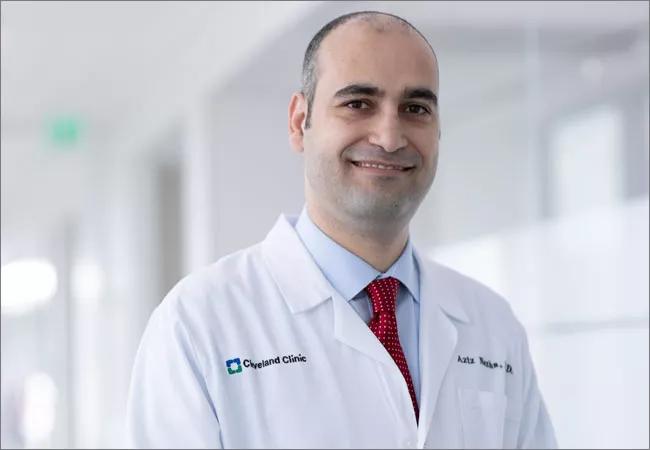
Image content: This image is available to view online.
View image online (https://assets.clevelandclinic.org/transform/68846968-2875-4a9e-b354-cfcbed33e870/DrNazha_650x450_jpg)
DrNazha_650x450
Researchers and clinicians are using concepts rooted in artificial intelligence (AI) to improve healthcare delivery in areas such as diagnostics, disease prediction and treatment planning. AI projects across several institutes at Cleveland Clinic have been underway for quite some time, but a new Center for Clinical Artificial Intelligence will concentrate these efforts, bringing together specialists from several departments including pathology, imaging, information technology, oncology, genomics and quantitative health sciences.
Advertisement
Cleveland Clinic is a non-profit academic medical center. Advertising on our site helps support our mission. We do not endorse non-Cleveland Clinic products or services. Policy
The center will serve as a platform for collaboration and communication between physicians and data scientists; provide programmatic and technology support for AI initiatives; and conduct research in several areas of medicine that can solve clinical problems using machine learning, deep learning and other AI technologies.
Aziz Nazha, MD, hematologist and medical oncologist at Cleveland Clinic Cancer Center, has been appointed director of the new center and Associate Medical Director for AI. The center will be a hub of collaboration between physicians, researchers, computer scientists and statisticians across the United States and globally to advance the application of AI in healthcare. The center will also facilitate collaboration between academia and industry.
Researchers in the center are building machine learning models for several projects that use AI technologies in diagnostics, prognosis, treatment decision-making and patient outcomes. Projects already underway include building machine learning models to identify patients with high risk of death within 48-72 hours of admission; predict inpatient length of stay; and predict readmission risk, all with a higher degree of accuracy than existing models.
Additionally, several cancer-focused projects are ongoing. Dr. Nazha has led projects to improve prognostic scoring systems and hematopoietic stem cell transplantation (HCT) outcomes in patients with myelodysplastic syndromes (MDS). Machine learning and other AI concepts helped him address the lack of precision in prognostic scoring systems for the disease.
Advertisement
The International Prognostic Scoring System (IPSS-R) categorizes patients into one of five groups, from very low risk to very high risk, based on risk of mortality and transformation to acute myeloid leukemia (AML). But, says Dr. Nazha, “We often found a significant gap between what we predicted in terms of survival for our patients, based on those models, and what actually happened to our patients.”
“So that triggered us to think, ‘Can we do a better job predicting the actual survival of the patient?’ Because prognosis in oncology, I would argue, is the most important part of our job. All oncology patients want to know how long they are going to live.”
Dr. Nahza and colleagues decided to create a new system that incorporates individual patient genomic and clinical data using a machine-learning algorithm to better predict an individual patient’s outcome. Their system outperformed other models for overall survival (OS) and acute myeloid leukemia (AML) transformation. They also created a system that successfully predicted outcomes in patients with MDS who undergo HCT.
Application of various AI concepts made both of these projects possible, and with the infrastructure and resources of the new center, many more projects of this nature will benefit research, education and patient care.
Photo credit: Russell Lee
Advertisement
Advertisement
First-of-its-kind research investigates the viability of standard screening to reduce the burden of late-stage cancer diagnoses

Global R&D efforts expanding first-line and relapse therapy options for patients

Study demonstrates ability to reduce patients’ reliance on phlebotomies to stabilize hematocrit levels
A case study on the value of access to novel therapies through clinical trials

Findings highlight an association between obesity and an increased incidence of moderate-severe disease

Cleveland Clinic Cancer Institute takes multi-faceted approach to increasing clinical trial access 23456
Key learnings from DESTINY trials

Overall survival in patients treated since 2008 is nearly 20% higher than in earlier patients
 Search