Locations:





Cleveland Clinic one of few centers to offer procedure
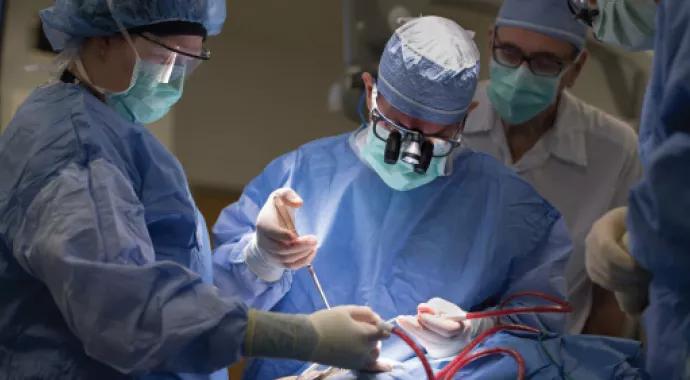
Image content: This image is available to view online.
View image online (https://assets.clevelandclinic.org/transform/0d88c741-11ec-4f6d-9cd1-d23ee0522aa3/14-ENT-2026-Haberkamp-Hero-Image-690x380pxl_jpg)
14-ENT-2026-Haberkamp-Hero-Image-690x380pxl
Advertisement
Cleveland Clinic is a non-profit academic medical center. Advertising on our site helps support our mission. We do not endorse non-Cleveland Clinic products or services. Policy
Auditory brainstem implant (ABI) surgery is now available in Cleveland Clinic’s Head & Neck Institute, thanks to a joint effort by the Section of Otology-Neurotology and the Section of Rhinology, Sinus and Skull Base Surgery. Our first such surgery was performed in June 2014. The addition of ABI surgery to our range of services will benefit patients in the Midwest, since only a handful of centers in the U.S. offer this procedure.
The purpose of ABI surgery is to restore hearing in patients who have experienced damage to the auditory nerve. This procedure was developed in 1979 at the House Ear Institute in Los Angeles. The first implant was performed by placing two ball electrodes on the surface of the cochlear nucleus. Multichannel devices were introduced in 1992 and have been used ever since.
The ABI device was initially conceived for use in patients with neurofibromatosis type 2 (NF2). Most patients with NF2 develop neurofibromas on both auditory nerves. Affected patients experience profound bilateral deafness due to the disease itself or to tumor complications. Unfortunately, surgical removal of these tumors can lead to hearing loss as well, since surgery often compromises the auditory nerve.
Traditional cochlear implants may not help in these cases because of the damage to the nerve. In such cases, implantation of the ABI electrodes allows the surgeon to circumvent the damaged nerve so that acoustic signals are delivered from the ear canal directly to the brainstem.
In most cases, the ABI is placed during the same operation in which one of the acoustic neuromas is removed. Not all patients experience restoration of auditory perception following the first procedure, but another attempt can be made (1) when the surgery on the second side is performed or (2) as a separate surgery if both tumors have been removed already.
Advertisement
Hearing outcomes in post-ABI patients with NF2 have been good, although not as good as those generally achieved with cochlear implantation (which, as mentioned, is not helpful in these cases). We believe ABI surgery is sometimes unsuccessful because the tumor causes a degeneration or alteration within the hearing centers of the brain.
Even so, about 85 percent of patients experience auditory sensations, and 93 percent experience better sentence understanding with lip reading and sound recognition three to six months postoperatively. Sound recognition and perception gradually improve for up to eight years following implantation. While open-set speech discrimination is usually not achieved, it is still possible, occurring in 10 to 20 percent of cases.
ABIs were approved by the FDA in October 2000 for use in patients with NF2 who are age 13 or older, are proficient in language and psychologically sound, and who have no medical contraindications to surgery.
There are no hearing criteria for ABI candidacy, since NF2 eventually causes profound bilateral hearing loss in everyone who has it.
New uses for ABIs are on the horizon. In the U.S., a clinical trial has been approved for ABI use in children born without an inner ear; the first two patients received their implants last year. Also, European studies in similar patients without NF2 have shown that hearing results more closely approximate those of cochlear implant surgery, as approximately 62 percent of patients have achieved that level of performance.
Advertisement
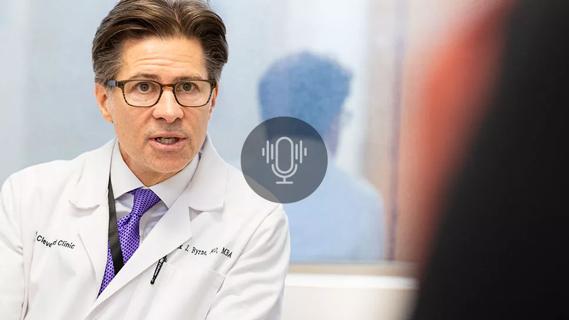
Dr. Haberkamp is Section Head of Otology-Neurotology.
Advertisement
Advertisement
With a wide scope of skills, comprehensive otolaryngologists care for patients of all ages in the community
Research on children with UHL explores the quality-of-life benefits and outcomes of cochlear implants
A look at how custom-fitted oral appliances work and when they’re a good fit for patients
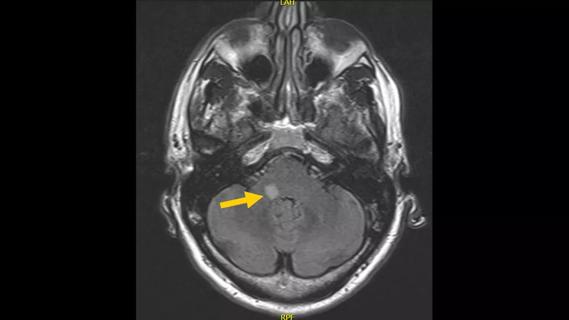
Subtle information gleaned from clinical examinations prompted concern
A new single-port system well-suited for oropharyngeal cancer treatment
Challenging case requires outside-the-box approach
Collaborative and multidisciplinary approach necessary for treatment
The tri-vector gracilis procedure uses a thin muscle from the thigh to help create a natural mimetic smile
 Search