Locations:





Patients at risk for speech, language delays
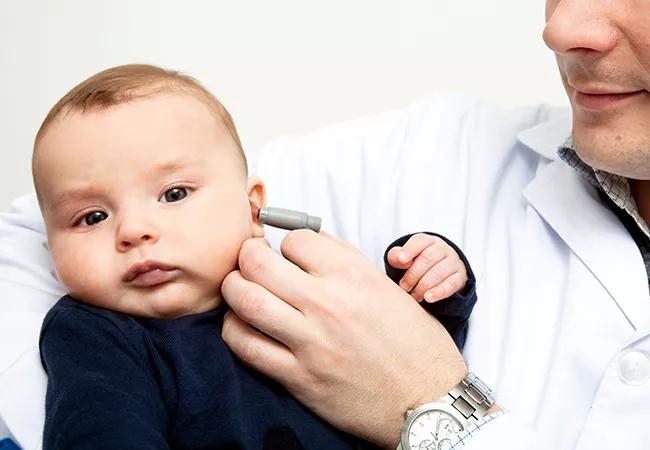
Image content: This image is available to view online.
View image online (https://assets.clevelandclinic.org/transform/56e95c8c-9073-4646-821d-5e8d7b481f91/650x450-Hearing_jpg)
650×450-Hearing
Unilateral hearing loss in pediatric patients is common – with a prevalence of 3 percent to 6 percent in school-aged children – and there is increasing evidence that it should be treated with amplification and/or assistive devices.
Advertisement
Cleveland Clinic is a non-profit academic medical center. Advertising on our site helps support our mission. We do not endorse non-Cleveland Clinic products or services. Policy
Samantha Anne, MD, Section Head of Pediatric Otolaryngology and Medical Director of Pediatric Ear and Hearing Disorders in Cleveland Clinic Children’s Hospital Head and Neck Institute, says the concern with unilateral hearing loss (UHL) is that in the past, children with normal hearing in one ear were not treated. The problem, she says, is studies show these children are exhibiting speech and language delays and are at risk for education problems, including an increased rate of failing a grade, the need for educational assistance in the classroom, and perceived behavioral issues.
“We wanted to see what literature is out there, so we did a survey of the literature on speech and language consequences and how amplification and assistive devices are helping when they have unilateral hearing loss,” Dr. Anne says.
The study “Auditory Outcomes with Hearing Rehabilitation in Children with Unilateral Hearing Loss: A Systemic Review,” published in Otolaryngology-Head and Neck Surgery, suggests a trend toward improvement in speech perception with hearing aids, with frequency-modulating (FM) systems showing the most benefit for speech recognition in noise. For severe to profound hearing loss, bone-conduction hearing devices showed improved pure-tone averages, speech recognition thresholds, and sound localization in implanted patients
A second study, “Speech and Language Consequences of Unilateral Hearing Loss: A Systematic Review,“ published in Otolaryngology-Head and Neck Surgery, found evidence that there may be a small effect on speech and language measures in mild or moderate UHL, while poorer speech and language testing results are clearly evident with severe to profound unilateral sensorineural hearing loss.
Advertisement
The studies found no uniformity on testing methods or the severity of hearing loss tested, as well as a lack of consensus on what degree of UHL should be treated or which amplification method is best.
Options for managing UHL in children include conventional hearing aids, FM systems, bone-conduction hearing devices, and contralateral rerouting of signal (CROS) aids.
“We definitely need more studies to see the direct impact of unilateral hearing loss in these children,” she says. “In terms of are we doing enough to help children, the literature shows using the hearing aids does help.”
While most of the literature examined the use of bone-anchored devices for severe to profound hearing loss, even conventional hearing aids showed evidence of improvement with speech recognition and noise in less severe hearing loss.
“We need further studies and clarification of the severity of hearing loss, how much it’s affecting speech and language, and whether using a hearing aid is helping with these children,” Dr. Anne says, adding that she hopes future studies will break down the different severities to evaluate the impact more thoroughly – mild vs. moderate to severe vs. severe to profound.
Dr. Anne says the literature solidified her belief that hearing aids provide a benefit to children with any degree of hearing loss.
“It was what I suspected and confirmed my belief that if a child has hearing loss, I don’t see the harm in using hearing aids,” she says. “These studies solidified we need to evaluate these children for amplification despite the severity of hearing loss.”
Advertisement
She sees all levels of patients in her practice, from infants identified at newborn screenings and preschoolers identified during pre-kindergarten screenings, to adolescents identified after testing when they present with subjective hearing loss. Patients and families who end up in her office go through a diagnostic workup to determine the cause of the hearing loss. Management depends on the severity and child’s age.
She says unilateral hearing loss is common, and screenings are improving and identifying children earlier, which allows for earlier intervention.
Advertisement
Advertisement

With a wide scope of skills, comprehensive otolaryngologists care for patients of all ages in the community
Research on children with UHL explores the quality-of-life benefits and outcomes of cochlear implants
A look at how custom-fitted oral appliances work and when they’re a good fit for patients
Subtle information gleaned from clinical examinations prompted concern
A new single-port system well-suited for oropharyngeal cancer treatment
Challenging case requires outside-the-box approach
Collaborative and multidisciplinary approach necessary for treatment

The tri-vector gracilis procedure uses a thin muscle from the thigh to help create a natural mimetic smile
 Search