Locations:





Case details, patient outcomes and lessons learned
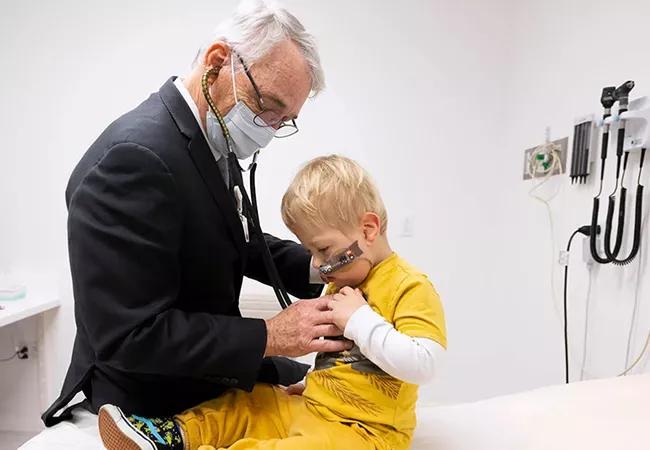
Image content: This image is available to view online.
View image online (https://assets.clevelandclinic.org/transform/4439b730-3287-4a41-9747-1f49f583a234/23-CHP-3548760-CQD-Boyle-Najm-Jude-Heart-Defect_jpg)
23-CHP-3548760 CQD Boyle Najm – Jude Heart Defect
A 23-month-old boy on a ventilator was transferred to Cleveland Clinic Children’s for management of heart failure. He was born with a severely stenosed pulmonary valve and multiple ventricular septal defects (VSDs). At the age of 18 months, attempts to open the valve with a balloon catheter and close the largest defect with an occluder failed, and the repairs were subsequently made surgically.
Advertisement
Cleveland Clinic is a non-profit academic medical center. Advertising on our site helps support our mission. We do not endorse non-Cleveland Clinic products or services. Policy
Nearly one month later, the patient developed atrioventricular dissociation (heart block), and a pacemaker was placed in an attempt to regulate his heart rhythm. Then, four months later, in February 2022, an echocardiogram revealed that he had developed pacing-induced dilated cardiomyopathy, and he was readmitted to the hospital. Soon after, he was transferred to Cleveland Clinic for assistance in managing his heart failure.
Pediatric cardiologist Gerard Boyle, MD, admitted the patient. In an attempt to stabilize his blood pressure, his medications and pacemaker were continually adjusted. After four weeks, all medical management options had been exhausted, and a decision was made to list the child for transplantation.
A PEDI Mag temporary left ventricular device (LVAD) was placed and switched out for a durable Berlin heart one week later. When a donor heart became available, pediatric and congenital heart surgeon Hani Najm, MD, performed the transplant. The surgery was uneventful. Three weeks later, a right-heart catheterization and biopsy showed no signs of rejection, and the child was transferred to Cleveland Clinic Children’s Hospital for Rehabilitation (CCCHR). Six weeks later, he was discharged home.
Although it’s not well understood, pacing-induced cardiomyopathy may be caused by electromechanical dyssynchrony of ventricular contractility. Unfortunately, we have no clear way of identifying which patients will develop this complication. As such, we watch all our pacemaker patients closely to ensure their ventricular function remains intact.
Advertisement
In this patient, the heart block may have been a complication of surgery in such a small heart, since it does not take much manipulation to interfere with conduction tissue.
The patient arrived on a medical regimen consisting of milrinone, amlodipine and diuretics. We added norepinephrine, nitroprusside and an anticoagulant and made continual adjustments to his pacemaker in an effort to stabilize his blood pressure and transition him to oral medications. Yet, he continued to lose ground. We listed him for transplant knowing that he would need a Berlin Heart left ventricular assist device (LVAD) to get him to transplant.
When a patient requires it, a Berlin Heart is ordered. To help manage the patient and prepare for this LVAD, our surgeons placed Berlin Heart cannulae and attached it to a PEDI Mag temporary LVAD. This magnetically driven continuous flow pump can be adjusted to help determine the optimal blood flow necessary to maintain blood pressure and blood gas levels. One week later, we exchanged the PEDI Mag for a Berlin Heart.
After transitioning to the Berlin Heart, his cardiac output improved, and we were able to begin weaning his sedation. He awakened enough to breathe on his own and soon began taking food by mouth and participating in physical therapy. By the time a suitable donor heart was identified five months later, the child was stronger and better able to withstand the transplant. His hospital recovery and transfer to CCCHR went smoothly.
CCCHR is an ideal location for recovery. Patients and their families spend most of each day participating in physical, occupational and recreational therapy. Children learn or relearn how to walk and play and are able to be outdoors. After weeks of enteral feeding, they learn how to eat normal food.
Advertisement
A parent may room in with their child and are expected to be involved in all aspects of rehabilitation. They are taught how to care for their child’s specific needs and continue his or her rehabilitation at home. This is important training for parents who may have long relied on medical personnel to meet their child’s needs.
Both parents were dedicated to their child, highly attentive to his needs and exceptionally compliant. They understood the problems he faced and were eager to understand and participate in his rehabilitation plan.
This child sees me regularly for checkups. His growth and development have caught up to that of his peers. He is healthy, active and behaving like a typical 3-year-old.
Children will surprise you, if you give them a chance at life. That’s why I continue to do what I do, and we never give up.
Advertisement
Advertisement

Try these moves to relieve butt pain and numbness
Systemic change needed to improve health outcomes for parents and children, say researchers
Rare genetic variant protected siblings against seizures and severe hypoglycemia

Movie has more positive impact than expected, says Head of Adolescent Medicine
Genetic changes are similar between some vascular anomalies and cancers
Expert panel advises a two-tier structure for surgical centers
Our new head of pediatric general and thoracic surgery shares his passion and vision
Basic understanding of condition and treatment is lacking
 Search