Locations:





How Cleveland Clinic’s Center for Connected Care is innovating in the post-acute care space
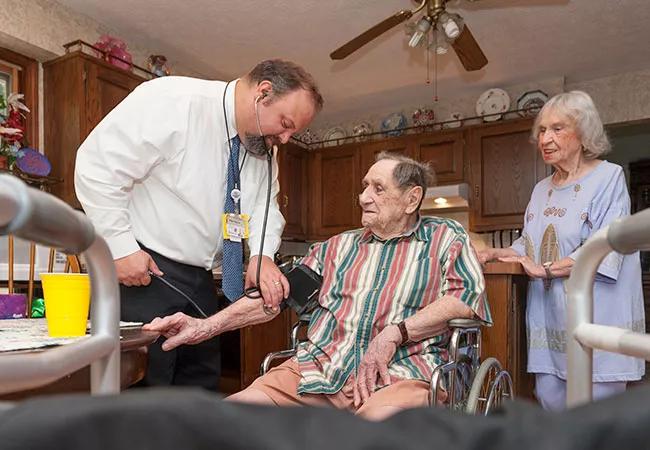
Image content: This image is available to view online.
View image online (https://assets.clevelandclinic.org/transform/a0f6a1c6-475f-4692-b5d6-65bbc29aab21/16-GER-2155-Zafirau-650x450_jpg)
16-ger-2155-zafirau-650×450
As healthcare providers, our job isn’t over when patients leave the hospital. Helping people successfully transition from hospital to home or a post-acute care facility is a key part of the care continuum. With the move to value-based care — which emphasizes outcomes and prioritizes patient experience — it’s more important than ever to make sure patients have the services they need, when they need them.
Advertisement
Cleveland Clinic is a non-profit academic medical center. Advertising on our site helps support our mission. We do not endorse non-Cleveland Clinic products or services. Policy
That’s why Cleveland Clinic’s Center for Connected Care exists. “One way to look at it is that we provide all of the services that aren’t in the hospital or in a medical office,” says William Zafirau, MD, the Medical Director of the Center for Connected Care. The Center is comprised of about 500 caregivers from home and transitional care who provide care to about 3,500 patients.
The center’s team includes home care, hospice, mobile primary-care physician group practice, home infusion pharmacy, home respiratory therapy, skilled nursing facilities (SNF), home palliative medicine and emerging transitional care programs. “Ninety percent of our employee caregivers are out in the community, taking care of people,” Dr. Zafirau says. “Through our services, we are trying to improve quality of care, keep people at home and reduce hospital readmissions.”
Specifically, the center is trying to close care gaps, better manage chronic illnesses, and educate and engage patients and families regarding their care plan. These are not simple tasks, but Dr. Zafirau and his staff are working diligently to figure out the best way to go about meeting these goals.
Dr. Zafirau is often called upon to speak at conferences about the work the Center is doing. In late October, he’ll be speaking at the 2018 Advanced Payment Summit. The theme is, “Disruption: Driving value in a risk-based world.” One of the topics Dr. Zafirau will be talking about is how the Center for Connected Care manages its post-acute partnerships.
Advertisement
“We are changing how we work with providers to try to better align the care and improve the quality for patients,” he says. For example, one of the initiatives is to provide better transitional care for patients who are at-risk for re-entering the hospital. “Even if we are not their primary care physician, we will continue to follow up with them, and send a nurse practitioner or a paramedic to visit them for 30 days after discharge.”
The center is also re-evaluating its partnerships with skilled nursing facilities. “We’re utilizing both internal data and publicly reported data to see who should be in the network, and making agreements based on quality and outcomes,” Dr. Zafirau says. Along with that, the center is working to better educate family members about quality and help them make better decisions about providers and home health agencies. “We are encouraging them to look at things like re-admission rates, and how often a patient improves function and then returns back to the community.”
“In the post-acute space, there is so much variance in quality and variance in how much things cost,” Dr. Zafirau says. With the center’s work, the team is are trying to reduce that variance by working collaboratively. The Advanced Payment Summit is a chance to bring clinicians and administrators together. “We need clinicians to be involved and engaged, to learn where things are going and how they can help lead, and we need administrators to increase their breadth of knowledge on the different models of care and what other organizations are doing,” he says.
Advertisement
The intense focus on population health, outcome metrics and value-based care is a big change, and it’s happening more rapidly than changes in healthcare tend to happen. “As we shift models of care, it puts more demand on providers, and patients who used to be in the hospital are going home or to a nursing home. We need people who are well trained to provide the care. Recruitment, training, and retention is a big challenge in the post-acute space,” Dr. Zafirau explains. We want people with the brightest minds and the passion to provide care thinking about this challenge and how to meet it.
This is the central mission of the Center for Connected Care, and it needs as many voices to join the conversation and work on solutions as possible. “We’re all looking forward to continuing the conversation on how we can do things differently and innovate with each other,” Dr. Zafirau says.
Advertisement
Advertisement
Pilot study confirms feasibility of conducting additional research on the novel treatment

Longer hospitalization does not mean a safer, faster recovery for patients age 70+

Structured data helps identify older adults at risk for poor outcomes, defines patients who require more comprehensive assessments


Self-administered tool can be completed in 10 minutes in waiting room

Social prescribing turns leisure activities into good “medicine”
A large geriatric study aims to find the answers

Analysis underscores how telehealth can help pinpoint elder abuse
 Search