Locations:





 Search
Developing the score, evaluating its performance and exploring what’s next
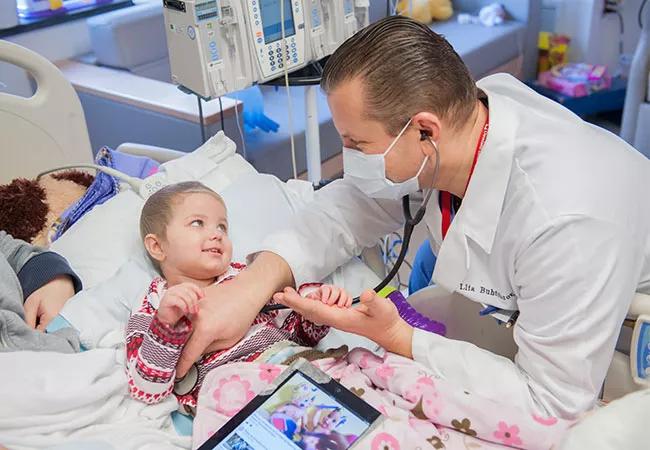
Image content: This image is available to view online.
View image online (https://assets.clevelandclinic.org/transform/1cc617f4-6bce-4020-af12-112dbd5a775f/21-CHP-2227858-Hero-650x450-1_jpg)
21-CHP-2227858-Hero-650×450
Critical care pediatricians at Cleveland Clinic Children’s are piloting a novel algorithm that evaluates patients’ risk of cardiac arrest in the intensive care unit using readily available electronic health data and alerting providers in real-time when a patient’s clinical status is declining.
Advertisement
Cleveland Clinic is a non-profit academic medical center. Advertising on our site helps support our mission. We do not endorse non-Cleveland Clinic products or services. Policy
The team behind this innovation presented their early data at the 16th Annual International Meeting of the Pediatric Cardiac Intensive Care Society in late 2020.
Orkun Baloglu, MD, the first author of the study, says the situational awareness scoring system was designed to flag patients who are showing signs of clinical deterioration and increased risk for cardiac arrest.
“In a very busy ICU with 30 to 40 patients, it can be challenging to identify those who need urgent attention. With this scoring system, when the caregiver sees that the patient has a high score, they know to immediately evaluate the patient and provide intervention,” he says.
“It also works the other way,” he says. “If a patient had a high score and received an intervention, then the score is expected to go down if the intervention was appropriate.”
The range of individual patient scores is determined by various clinical abnormalities. While the team is still investigating thresholds, Dr. Baloglu explains that “as the score increases, the risk for cardiac arrest does as well.” These thresholds are likely to differ among patient populations.
The researchers evaluated the effectiveness of the score in a retrospective study. They looked at two patient cohorts in the PCICU from January 2014 to December 2018: those who experienced cardiac arrest and those who did not. A total of 28 cardiac arrest events were analyzed in 462 PCICU admissions from 267 patients.
The researchers calculated the score in two, four, six and eight-hour intervals from the time of the cardiac arrest or, in the cases of no cardiac arrest, from the time the patient was discharged from the unit.
Advertisement
Dr. Baloglu explains that the team used a cross-validated discrete time logistic regression model in their statistical analysis. Findings showed that the score achieved its best discriminatory performance with area under the curve (AUC) of 0.91 (95% Confidence Interval (CI): 0.86-0.96) within the four-hour time interval before the cardiac arrest. Furthermore, odds ratio for cardiac arrest was 1.32 [95% CI: 1.26-1.39] for every 10 unit increase in the score.
While the data for this study are not yet published, the team was pleased with the strength of this model based on preliminary data — particularly given its relative simplicity.
“The perception is that ICU patients’ clinical trajectories cannot be adequately predicted based only on vital signs and routinely used lab tests with relatively simple mathematics.”
He says the team is now doing rigorous testing to determine associations between the calculated number and adverse patient outcomes in the adult cardiovascular ICU. They plan to integrate the algorithm into clinical application to pilot in the PCICU by early 2022.
The adaptability of the scoring system makes it transferable to diverse patient populations in the intensive care setting, “from a newborn to a 90-year-old patient,” he says. Eventually, they hope to expand outside of pediatric and adult cardiac ICUs and test the model’s utility in adult medical/surgical ICUs.
Cleveland Clinic Children’s recently launched a Center for Artificial Intelligence to help facilitate research efforts like this and develop machine learning tools that will improve clinical care.
Advertisement
“It’s clear that mathematics and computer program coding are extremely valuable tools for current and next-generation physicians. The more we can make these tools available and train other providers to use them, the better service we can provide to our patients,” he says.
Samir Latifi, MD, Chair of Cleveland Clinic’s Department of Pediatric Critical Care, Kristopher Kormos (Cleveland Clinic Children’s Center for Artificial Intelligence) and Sarah Worley (Lerner Research Institute, Department of Quantitative Health Sciences, Cleveland Clinic) are co-investigators on this project.
Advertisement
Advertisement

Try these moves to relieve butt pain and numbness

Systemic change needed to improve health outcomes for parents and children, say researchers
Rare genetic variant protected siblings against seizures and severe hypoglycemia

Movie has more positive impact than expected, says Head of Adolescent Medicine

Genetic changes are similar between some vascular anomalies and cancers
Expert panel advises a two-tier structure for surgical centers
Our new head of pediatric general and thoracic surgery shares his passion and vision
Basic understanding of condition and treatment is lacking