Locations:





 Search
Goal is to avoid dreaded vessel rupture
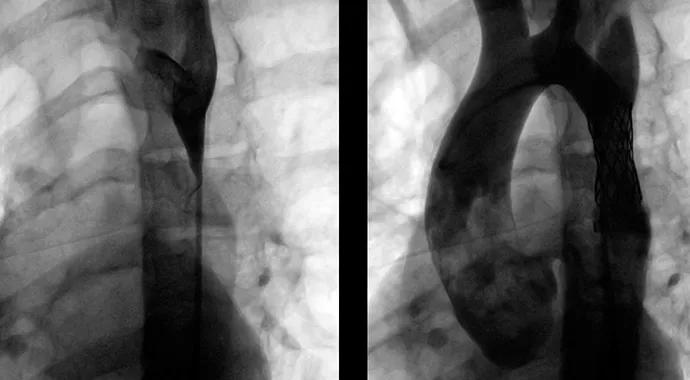
Image content: This image is available to view online.
View image online (https://assets.clevelandclinic.org/transform/1c552a05-8e47-44b4-a203-9eb1f041f9c9/690x380-Prieto-Stents_jpg)
690×380-Prieto-Stents
Advertisement
Cleveland Clinic is a non-profit academic medical center. Advertising on our site helps support our mission. We do not endorse non-Cleveland Clinic products or services. Policy
Therapeutic interventions for congenital cardiac lesions are becoming increasingly complex at the same time that larger numbers of patients can be treated via transcatheter techniques instead of open heart surgery. As these new technologies enter the clinical realm, they must compare well against surgical interventions in both efficacy and safety. For every new procedure performed in the catheterization laboratory, the ability to treat potential complications is just as important as the ability to perform the procedure itself.
One of the most dreaded complications of transcatheter therapeutic interventions is vessel rupture. Occurrence of a rupture in a great vessel, such as the aorta or the pulmonary artery, can be lethal if not treated within a very short time frame.
Balloon-expandable covered stents large enough to treat such complications are not yet approved by the FDA but are currently being evaluated in the United States in multi-institutional trials. Cleveland Clinic Children’s is one of the participating institutions, which enables us to contribute to the data necessary for eventual approval and, importantly, to use the covered stents in our patients when needed. We profile two of these ongoing trials below.
The Coarctation of the Aorta Stent Trial (COAST) allows use of the Cheatham-Platinum stent covered with an expandable fluoropolymer sleeve (Covered CP Stent™, NuMED, Hopkinton, N.Y.) in two different scenarios for patients with coarctation (congenital narrowing) of the aorta:
Advertisement
These groups include patients with extremely severe aortic narrowing, in whom the minimal diameter is 3 mm or less, and those with conditions that confer a higher risk of rupture, including:
To date, Cleveland Clinic has enrolled six patients in COAST: two due to acute rupture, three for severe narrowing (≤ 3 mm) and one for age greater than 65. Both patients with rupture had their aortic tear successfully treated by the covered stent and had no neurologic or other sequelae. All six patients have had excellent relief of their coarctation and have required no further procedures.
Ours is one of 29 institutions participating in COAST nationwide, and we are hopeful that approval of this potentially lifesaving device will make it available to all pediatric catheterization labs in the near future.
The Pulmonary Artery Repair with Covered Stents (PARCS) trial allows use of the same Covered CP Stent in two groups of patients:
To date, we have implanted 47 Melody valves at Cleveland Clinic Children’s and have been fortunate not to have yet encountered a conduit injury requiring use of the covered stent. We do, however, ensure that every patient taken to the catheterization lab for Melody valve implantation undergoes informed consent for potential use of the covered stent should it become necessary.
Advertisement
In the near term, the availability of these covered stents allows us to sleep better the night before a case. In the longer term, if these studies continue to produce reassuring results, they should soon make it possible for many more patients to undergo safer percutaneous correction of congenital heart anomalies.
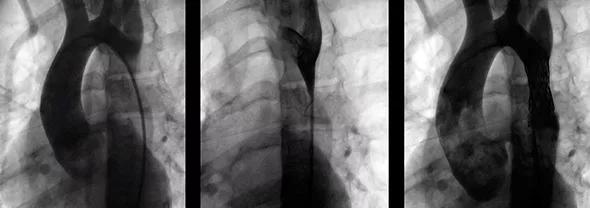
Image content: This image is available to view online.
View image online (https://assets.clevelandclinic.org/transform/81fbfd12-2a0a-4ba2-9d03-f40d53a2f2e4/590x-Inset-Prieto-Stents_jpg)
Left. Ascending aorta angiogram demonstrates a severe aortic coarctation with no contrast visible in the descending aorta. Middle. Descending aorta angiogram just above the coarctation shows a minimal amount of flow around the 6-French catheter, demonstrating that the minimal diameter is just about 2 mm. Right. Ascending aorta angiogram after placement of a covered stent shows excellent relief of the coarctation with no residual obstruction and no aortic wall complications.
Dr. Prieto directs the pediatric catheterization laboratory in the Cleveland Clinic Children’s Center for Pediatric and Congenital Heart Disease
Advertisement
Advertisement

Try these moves to relieve butt pain and numbness

Systemic change needed to improve health outcomes for parents and children, say researchers
Rare genetic variant protected siblings against seizures and severe hypoglycemia

Movie has more positive impact than expected, says Head of Adolescent Medicine
Genetic changes are similar between some vascular anomalies and cancers
Expert panel advises a two-tier structure for surgical centers
Our new head of pediatric general and thoracic surgery shares his passion and vision

Basic understanding of condition and treatment is lacking