Locations:





Patients who pass SEP-1 in hospital less often

Image content: This image is available to view online.
View image online (https://assets.clevelandclinic.org/transform/51747ab2-ae55-4f72-afdf-73c04e6a713d/18-PUL-195-SCCM-Hero-Image-650x450pxl_jpg)
18-PUL-195-SCCM-Hero-Image-650x450pxl
By Anita Reddy, MD, and Seth Bauer, PharmD
Advertisement
Cleveland Clinic is a non-profit academic medical center. Advertising on our site helps support our mission. We do not endorse non-Cleveland Clinic products or services. Policy
The Severe Sepsis and Septic Shock Early Management Bundle (SEP-1) is one of several efforts from the U.S. Centers for Medicare and Medicaid Services to combat the prevalence and mortality of sepsis as well as mitigate the cost burden upon the healthcare system. Sepsis is the leading cause of hospital readmission, a major factor in patient mortality and healthcare cost. To date, we have no evidence-based methods of reducing readmissions after a sepsis episode.
Our study, presented at the Society of Critical Care Medicine (SCCM) Annual Congress in February 2018, sought to determine if SEP-1 bundle compliance is associated with hospital readmission. We evaluated for SEP-1 eligibility patients admitted to a health system from October 2015 – May 2017 with administrative coding for sepsis during index hospital admission. We then analyzed whether patients passed or failed SEP-1 and the individual bundle element that lead to failure. We also looked at 30-day readmission. Note: the numbers below reflect the data as presented at SCCM. Updated analysis is forthcoming.
Of 1729 patients identified in the SEP-1 measure population, 34.5 percent passed SEP-1, and 90.3 percent survived index hospitalization. Hospital survival was 94.8 percent in patients who passed SEP-1 compared with 87.9 percent for those who failed (P < 0.01). Of the surviving patients, whose who passed SEP-1 had fewer readmissions than those who failed SEP-1.
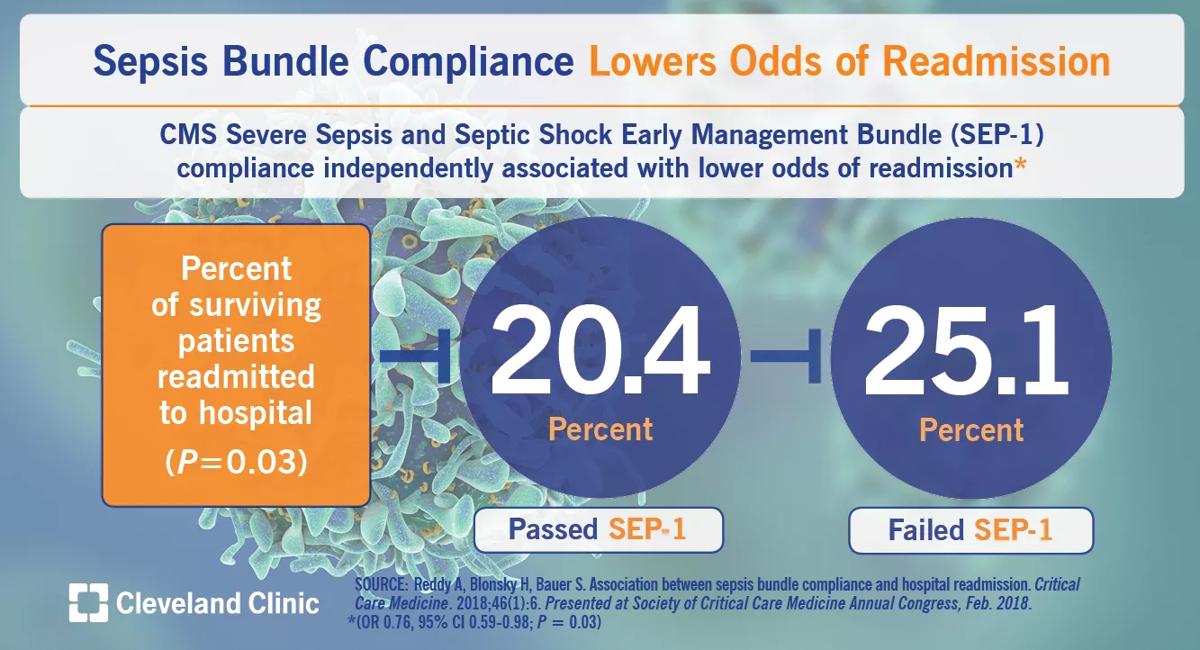
Image content: This image is available to view online.
View image online (https://assets.clevelandclinic.org/transform/5205c699-fa93-491e-8e00-980ec2096de1/18-PUL-234-SCCM-Visual-Abstract-1200x650pxl_02_jpg)
We analyzed individual elements of the SEP-1 bundle leading to failure, and none were associated with readmission. Using multivariate logistic regression, we found that SEP-1 compliance lowered odds of readmission (OR 0.76, 95% CI 0.59-0.98; P = 0.03).
Advertisement
As we search for interventions across the spectrum of sepsis prevention, treatment and mortality, compliance with the SEP-1 bundle may offer a targeted intervention that reduces admissions and decreases overall healthcare costs and sepsis disease burden beyond initial hospital admission.
Dr. Reddy is Quality Officer in the medical intensive care unit and Co-Chair of the Enterprise Sepsis Steering Committee at Cleveland Clinic. Dr. Bauer is a clinical pharmacist in the medical intensive care unit and a member of the Enterprise Sepsis Steering Committee at Cleveland Clinic.
Advertisement
Advertisement

Volatile organic compounds have potential in heart failure diagnostics

Caregivers are provided with real-time bronchoscopy patient findings
Insights for diagnosing, assessing and treating
A Cleveland Clinic pulmonologist highlights several factors to be aware of when treating patients

New program sets out to better support underserved patient populations
Cleveland Clinic pulmonologists aim to further lower waitlist times and patient mortality

Lessons learned from cohorting patients and standardizing care
New tools and protocols to improve care
 Search