Locations:





 Search
Technological advances give robotic surgery the edge
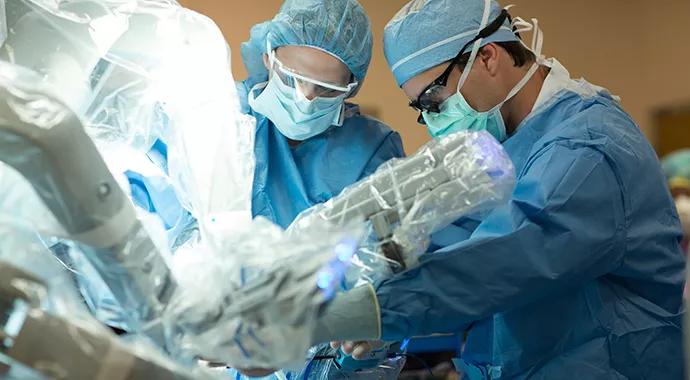
Image content: This image is available to view online.
View image online (https://assets.clevelandclinic.org/transform/813ca165-cd30-4dfa-976a-e12998483970/690-x-380-Seifarth_jpg)
690-x-380-Seifarth
Advanced instrumentation and visualization bring exquisite precision to selected procedures in small bodies.
Advertisement
Cleveland Clinic is a non-profit academic medical center. Advertising on our site helps support our mission. We do not endorse non-Cleveland Clinic products or services. Policy
“Robotic surgery offers a solution to current challenges of minimally invasive surgery in children, particularly for delicate procedures requiring surgical dexterity within a small workspace,” says pediatric general surgeon Federico Seifarth, MD.
Dr. Seifarth currently uses the robot in pediatric patients undergoing the following procedures:
• Nissen fundoplication
• Choledochal cyst excision
• Adrenalectomy
• Complex abdominal surgeries such as removal of abdominal masses
• Reconstructive surgeries such as repair of congenital diaphragmatic hernia
The primary benefits of robot-assisted minimally invasive surgery are realized through the improved dexterity enabled by articulating instruments, better visualization and reduction of hand tremor. Whereas Dr. Seifarth likens the use of laparoscopic instruments to “operating with chopsticks,” he says robotic instruments move like hands. This flexibility enables him to reach behind a structure such as the esophagus — rather than moving it aside — and ensures finer dissection and more precise placement of sutures.
“There’s no question that the robot enables higher-quality stitch placement and repair,” he says. “The operation is not subject to technical limitations.”
A high degree of magnification and a 3-D view on the monitor allow the surgeon to visualize the anatomy in sharp detail and with depth perception. “The robot improves surgical outcome by enhancing the surgeon’s skills with technology that allows better visualization and tremor suppression,” Dr. Seifarth explains.
Advertisement
Robots have been used in adult urology and gynecology since 2005 and are increasingly embraced by other specialties. At Cleveland Clinic, a large number of surgeons in multiple disciplines keep five robots and two training robots in daily use. Dr. Seifarth takes advantage of the abundance of expertise among his adultcare colleagues to hone his skills, resulting in an enviable level of experience.
“Through collaboration with the adult robotics team, we’ve identified selected indications where we can use the robot to perform operations we’d normally do laparoscopically or with traditional open surgery,” he says. “We can get the same or better quality of operation, but with less pain and without a big scar.”
Although scar size may seem trivial in the context of a serious medical condition, he says it looms large for many children and parents. “Why should any child carry a big scar for life if he or she doesn’t have to?”
One of the procedures most commonly performed with robotic assistance at Cleveland Clinic Children’s is Nissen fundoplication, for which the robot offers clear advantages over laparoscopic instrumentation, especially in complex cases such as reoperations.
Dr. Seifarth also finds the robot particularly valuable for choledochal cyst excision, an operation for which a minimally invasive approach is not always routine, due to the challenge of meticulous dissection in babies using laparoscopic instruments. “Any bile duct anomaly is very demanding to operate on in a minimally invasive way, but the dexterity of the robot offers a significant advantage,” he observes.
Advertisement
Since minimal invasiveness is a guiding principle across Cleveland Clinic Children’s surgical services, Dr. Seifarth plans to apply robotic surgery to a number of new uses, including splenectomy, bowel resection and reconstruction, and various gynecologic and oncologic procedures.
“Robotic technology has evolved greatly in the past decade,” he notes. “Recent efforts succeeded in developing smaller, more flexible and more affordable instruments to benefit a wide range of pediatric patients. Robotic surgery is ready to be applied in children, and I hope other pediatric specialists follow us to develop its full potential for the most delicate patients.”
Advertisement
Advertisement

Try these moves to relieve butt pain and numbness

Systemic change needed to improve health outcomes for parents and children, say researchers

Rare genetic variant protected siblings against seizures and severe hypoglycemia

Movie has more positive impact than expected, says Head of Adolescent Medicine

Genetic changes are similar between some vascular anomalies and cancers
Expert panel advises a two-tier structure for surgical centers
Our new head of pediatric general and thoracic surgery shares his passion and vision

Basic understanding of condition and treatment is lacking