Locations:





New research finds unique pattern of brain abnormalities, cognitive deficits

Image content: This image is available to view online.
View image online (https://assets.clevelandclinic.org/transform/cd18cf2a-669f-4669-9bad-edaf87b4bc5f/690x380-Frazier_jpg)
690×380-Frazier
By Thomas W. Frazier, PhD
Advertisement
Cleveland Clinic is a non-profit academic medical center. Advertising on our site helps support our mission. We do not endorse non-Cleveland Clinic products or services. Policy
New research out of Cleveland Clinic Children’s Center for Autism has focused on a genetic subgroup of children with autism spectrum disorder (ASD) — those with mutations of the PTEN gene — to identify a unique pattern of brain abnormalities and cognitive deficits. We are now building on these insights with new investigations that promise greater understanding of the biological mechanisms causing autism — and that ultimately may lead to individualized treatments.
Disorders along the autism spectrum are frequently debilitating and lead to lifelong impairments in social interaction coupled with inflexible behavior. Research has identified a strong genetic component to autism, but identifying effective treatments has been difficult due to high variability in the underlying biology.
One approach to this problem is to study genetic subgroups of autism. Our group applied this strategy to individuals with PTEN mutations who also have autism (PTEN-ASD). The PTEN gene was identified as a tumor suppressor gene by Charis Eng, MD, PhD, Chair of Cleveland Clinic’s Genomic Medicine Institute and my close colleague and scientific mentor. Dr. Eng also noticed that parents with mutations in the PTEN gene were having a disproportionately high number of children with autism and very large heads, a feature consistent with brain overgrowth.
Together, Dr. Eng and I led a group that recruited 17 children with PTEN-ASD (mean age, 11.5 years) and compared them to patients with autism with no known genetic cause and to healthy controls. The primary goal was to identify specific patterns of brain abnormalities and thinking skills unique to PTEN-ASD. The secondary goal was to determine whether these patterns are linked to the molecular effects of PTEN mutations.
Advertisement
Our study found that patients with PTEN-ASD had overgrowth of the white matter connections as well as spots where white matter development was clearly abnormal (Figure 1). These brain changes correlated with cognitive problems, such as reductions in information processing speed and memory, and motor difficulties in the PTEN-ASD group relative to both other study groups. These findings enabled us to determine that reduction in the PTEN protein drives brain overgrowth and white matter abnormalities that, in turn, drive these patients’ cognitive and behavioral impairment (Figure 2).
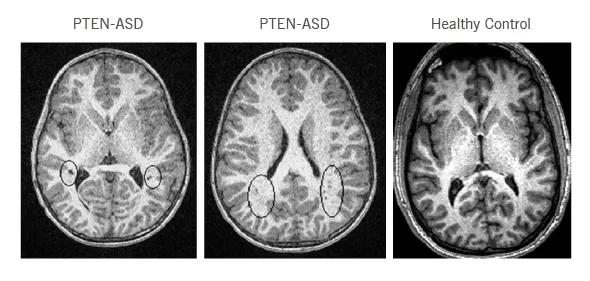
Image content: This image is available to view online.
View image online (https://assets.clevelandclinic.org/transform/c5851156-1f45-472c-9559-895e629c1799/590x-Inset-1-Frazier_jpg)
Figure 1. Brain scans showing white matter abnormalities in PTEN-ASD subjects but not in healthy controls. These types of imaging findings from our study suggest that reduced PTEN protein (strongly observed in PTEN-ASD subjects) seems to drive white matter abnormalities that, in turn, lead to IQ reductions.
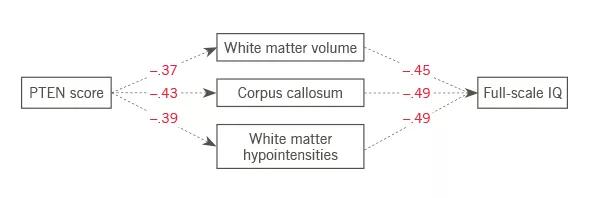
Image content: This image is available to view online.
View image online (https://assets.clevelandclinic.org/transform/b715a82c-d695-4dd4-85c5-df4c84b8d281/590x-Inset-2-Frazier_jpg)
Figure 2. Mediational models displaying how PTEN protein levels drive white matter abnormalities that then drive cognitive deficits in patients with PTEN-ASD. Adapted from Frazier et al, ©2014 Macmillan Publishers Limited.
At a practical level, these data suggest that any child presenting with large head size and developmental or cognitive delays should receive genetic counseling and possible testing for a PTEN mutation. Such testing is particularly important because individuals with PTEN-ASD may have increased cancer risks due to the role of PTEN as a tumor suppressor and regulator of cell growth and proliferation.
Advertisement
Our findings also suggest that therapists treating patients with PTEN-ASD should speak slowly and clearly, with frequent repetition and attention questions, to ensure that children understand the information being communicated. Given the high rate of motor difficulties seen in patients with PTEN-ASD, patients also should be regularly referred for occupational and, in many cases, physical therapy.
Interestingly, we did not find that other proteins related to PTEN were abnormal, suggesting that PTEN mutations cause reductions in PTEN protein levels but do not seem to cause changes in the typical PTEN biological pathways. This may indicate that reductions in PTEN protein levels are working through other mechanisms, such as interactions with mitochondrial or metabolic pathways or other noncanonical biological routes.
Future research is needed to pin down the exact molecular effects of PTEN protein loss and develop additional treatment targets. However, based on the low PTEN protein levels observed in this study, Dr. Eng and I have received funding as part of a consortium examining rare genetic causes of autism to longitudinally follow patients with PTEN-ASD over two years and begin a medication trial. The latter is especially exciting because it was designed based on knowledge of PTEN and associated pathways and would represent one of the first attempts to develop an individualized gene-based treatment approach for children with autism.
We hope to build on the findings reported here by using processing speed, memory and brain white matter changes as outcomes to provide treatment targets that are more sensitive than those used in typical medication trials focused on autism symptoms or other behavioral aspects that often require long periods for changes to be detectable.
Advertisement
Ultimately, we believe this study and the planned follow-up research we are just beginning represent a new paradigm for autism research: Find the gene or set of genes causing autism, comprehensively study and follow patients with those genetic changes, and use the knowledge gained to develop individualized treatments.
Dr. Frazier is Director of Cleveland Clinic Children’s Center for Autism.
Advertisement
Advertisement

Try these moves to relieve butt pain and numbness

Systemic change needed to improve health outcomes for parents and children, say researchers

Rare genetic variant protected siblings against seizures and severe hypoglycemia

Movie has more positive impact than expected, says Head of Adolescent Medicine

Genetic changes are similar between some vascular anomalies and cancers

Expert panel advises a two-tier structure for surgical centers

Our new head of pediatric general and thoracic surgery shares his passion and vision

Basic understanding of condition and treatment is lacking
 Search