Locations:





 Search
Interactive Metronome® and therapeutic listening are a testament to therapy refinement
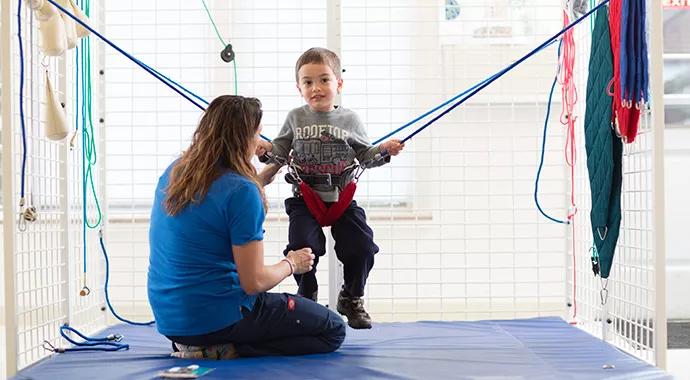
Image content: This image is available to view online.
View image online (https://assets.clevelandclinic.org/transform/099ef985-2142-4347-8a1d-a00ca0c5379c/690x380-Therapy-Cage_jpg)
690×380-Therapy-Cage
Specialized pediatric therapy services are constantly evolving to expand and complement the treatment mix for young people striving to overcome chronic medical challenges.
Advertisement
Cleveland Clinic is a non-profit academic medical center. Advertising on our site helps support our mission. We do not endorse non-Cleveland Clinic products or services. Policy
The rehabilitation specialists with Cleveland Clinic Children’s Therapy Services recently introduced two innovative therapy services that they believe are worthy of greater awareness and consideration for appropriate pediatric patients. The fact that both happen to involve auditory interventions speaks to how refined and specialized the proliferation of new offerings has made the discipline of pediatric therapy services in recent years.
Interactive Metronome® is a research-based training program designed to help children and adults overcome limitations in attention, memory and coordination.
This computer-based intervention directs patients to perform 13 different repetitive hand and foot movements to a rhythmic beat. Audible tones provide immediate feedback on how well each movement is in sync with the rhythm. These efforts to keep the beat train the brain to plan, sequence and process more effectively. The aim is to improve timing, attention and coordination in children with impairments in:
Treatment typically requires at least 12 to 15 one-hour sessions with an occupational therapist over several weeks.
Therapeutic listening is an evidence-based auditory intervention to support individuals who face challenges with sensory processing dysfunction, listening, attention and communication.
The approach uses music and rhythmic sound patterns to stimulate brain regions used in listening and processing sensory information. These techniques are combined with movement and core-strengthening exercises to help patients improve:
Advertisement
Music and sounds are customized to each child’s individual needs with input from parents/guardians. Treatment is administered by occupational therapists over a period from eight weeks to several months.
Beyond these spotlighted offerings, the more than 125 therapists (occupational, physical, speech-language and recreational) who make up Cleveland Clinic Children’s Therapy Services offer dozens of other interventions to patients from infancy through age 21.
The services are provided at six locations across Northeast Ohio for patients with serious injuries, developmental delays, learning difficulties, challenges with ADLs, and other chronic or acute conditions that affect development. A team of specialists evaluates each patient and custom-designs treatment to help increase the child’s functional abilities and independence.
Among the therapists’ other notable service offerings:
Advertisement
A fuller range of interventions offered by Cleveland Clinic Children’s Therapy Services is detailed at clevelandclinicchildrens.org/therapyservices.
Advertisement
Advertisement

Try these moves to relieve butt pain and numbness

Systemic change needed to improve health outcomes for parents and children, say researchers
Rare genetic variant protected siblings against seizures and severe hypoglycemia

Movie has more positive impact than expected, says Head of Adolescent Medicine
Genetic changes are similar between some vascular anomalies and cancers
Expert panel advises a two-tier structure for surgical centers
Our new head of pediatric general and thoracic surgery shares his passion and vision

Basic understanding of condition and treatment is lacking