Locations:





Understanding applications, tracking outcomes and creating standards for use
Image content: This image is available to view online.
View image online (https://assets.clevelandclinic.org/transform/1b63383d-074d-45c0-af8e-fef1a7b9fb04/17-OR-1164-King-Hero-Image-650x450pxl_jpg)
17-OR-1164-King-Hero-Image-650x450pxl
By Dominic King, DO; Jason Genin, DO; George F. Muschler, MD; and Nicolas Piuzzi, MD
Advertisement
Cleveland Clinic is a non-profit academic medical center. Advertising on our site helps support our mission. We do not endorse non-Cleveland Clinic products or services. Policy
For the uninitiated, the term orthobiologics refers to all treatments that utilize molecules, cells or tissues to aid in the healing and reparative process of a musculoskeletal injury or chronic orthopaedic condition. This includes cell-based therapies and platelet rich plasma (PRP), about which orthopaedists are hearing increasingly more from colleagues and answering many questions from patients.
Several studies on the use of cell-based therapies and PRPs have demonstrated marked heterogeneity between preparations, appropriate uses and patient-reported outcomes. This lack of standardization undermines the ability to reliably reproduce studies. Consequently, there is a glaring lack of large-scale, high-quality research.
Recognizing the powerful potential applications of these treatments, Cleveland Clinic has undertaken a proactive approach to developing solid standards that we hope will guide our and other teams’ use of these new therapies. This effort is an important component of the newly established Cleveland Clinic Joint Preservation Center.
Our approach to developing these standards started with the creation of a reliable tracking mechanism. We developed a specific orthobiologic module within Cleveland Clinic’s OrthoMiDaS Episode of Care system, in collaboration with Kurt Spindler, MD. The module ensures standardization of injection protocols and tracks longitudinal safety, efficacy and outcomes for every orthobiologic treatment performed at our institution.
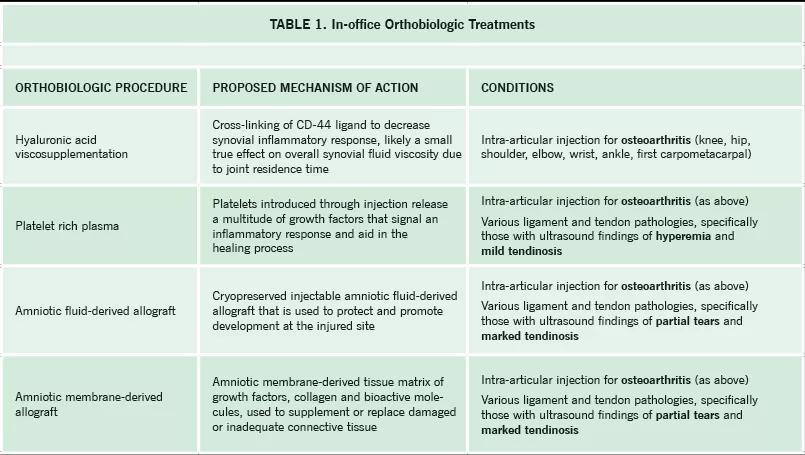
Image content: This image is available to view online.
View image online (https://assets.clevelandclinic.org/transform/600e01c7-f735-481e-beae-cc6ea05f8b5f/17-ORT-11164-King-Insert-Table-01-805pxl-width_jpg)
Each of these treatments is just beginning to be understood in detail, and clinical efficacy is still to be proven. Therefore, insurance coverage is minimal and patients must usually pay out of pocket. We offer these treatments as part of a comprehensive, multimodal program combined with physical therapy, bracing and activity modification in a safe, controlled environment.
Advertisement
We have also collaborated with George F. Muschler, MD, who has been a referral source in orthopaedic regenerative medicine research. He and his team have optimized surgical techniques for bone marrow aspiration to improve the yield of stem and progenitor cells (connective tissue progenitors or CTPs), designed standards to measure cell-based therapies, and improved understanding of the complexity of multiple orthobiologic treatments.
The lack of consistency in orthobiologic use, specifically in the treatment of tendinopathies, is fundamentally related to the lack of a reliable tendon damage classification system. Ultrasound findings, such as tendon thickening, hypoechogenic tendinosis, neovascularization denoted by power Doppler-flow-enhanced hyperemia and intrasubstance partial tearing, all may result in different outcomes after the same orthobiologic injection. Yet these are lumped into a single general category of “tendinopathy” in most research articles. Recognizing the lack of a standard classification system, we are also developing our own tendinopathy classification system at Cleveland Clinic.
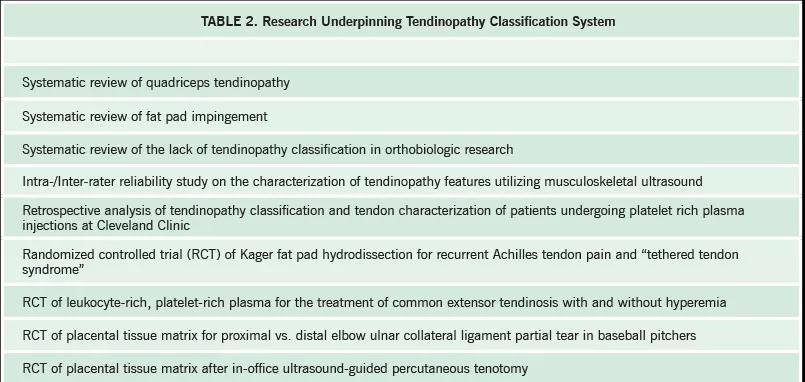
Image content: This image is available to view online.
View image online (https://assets.clevelandclinic.org/transform/06ada20e-a37a-40e0-acd6-f00af35e5b1b/17-OR-1164-King-Insert-Table-02-805pxl-width_jpg)
There has been a paucity of high-quality, reproducible research for orthobiologics. Instead, we have mostly relied on trial-and-error approaches. To rectify this situation, we are laying the foundation to build standards that will help ensure excellent outcomes for patients.
This includes a transparent, controlled, evidence-based effort to understand pathologies underlying the maladies we treat and the mechanisms of action of orthobiologic products and, most importantly, to set reproducible standards in orthobiologic care. Data we collect will help guide our research directives and establish national guidelines for orthobiologic research.
Advertisement
We look forward to sharing our evidence and having ongoing discussions with colleagues about our approach and findings, and we welcome your feedback.
Dr. King and Dr. Genin are staff physicians in Sports Medicine and Medical Orthopaedics in the Sports Health Center and Joint Preservation Center. Dr. Muschler is a Professor of Orthopaedic Surgery, specializing in all aspects of knee and hip replacements. He is Director of the Regenerative Medicine Laboratory, where he conducts research on bone and cartilage tissue regeneration. Dr. Piuzzi is a clinical scholar in Orthopaedic Regenerative Medicine and Cellular Therapies.
Advertisement
Advertisement
Biologic approaches, growing implants and more
Study reports zero infections in nearly 300 patients
How to diagnose and treat crystalline arthropathy after knee replacement
Study finds that fracture and infection are rare
Center will coordinate, interpret and archive imaging data for all multicenter trials conducted by the foundation’s Osteoarthritis Clinical Trial Network
Reduced narcotic use is the latest on the list of robotic surgery advantages
Cleveland Clinic specialists offer annual refresher on upper extremity fundamentals
Cleveland Clinic orthopaedic surgeons share their best tips, most challenging cases and biggest misperceptions
 Search