Locations:





An overview of case reports and management
Advertisement
Cleveland Clinic is a non-profit academic medical center. Advertising on our site helps support our mission. We do not endorse non-Cleveland Clinic products or services. Policy
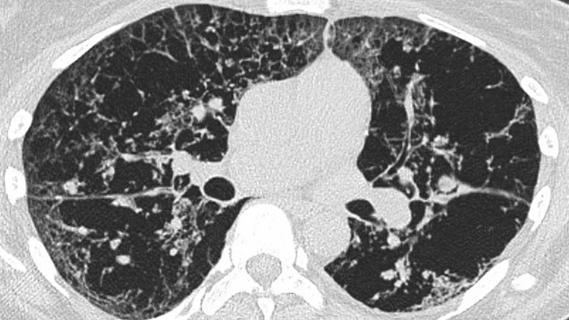
Nonthrombotic pulmonary embolism (NTPE) is uncommon and can be difficult to diagnose. My colleagues and I recently reviewed this complete or partial occlusion of the pulmonary vasculature resulting from inorganic particulate matter and foreign bodies in Chest. The below images demonstrate accidental embolization from talc granulomatosis.
Talc granulomatosis is now a bit of a misnomer, as it was named when talc was a common filler material for pills. Filler materials for drugs intended for oral use are now mostly microcrystalline cellulose and crospovidone. Talc granulomatosis occurs when drugs intended for oral use are injected intravenously, such as opioids and amphetamines. Filler materials become trapped in pulmonary capillaries and extrude into the interstitium, forming granulomas. It can progress to pulmonary hypertension or fibrosis and eventually panacinar emphysema.
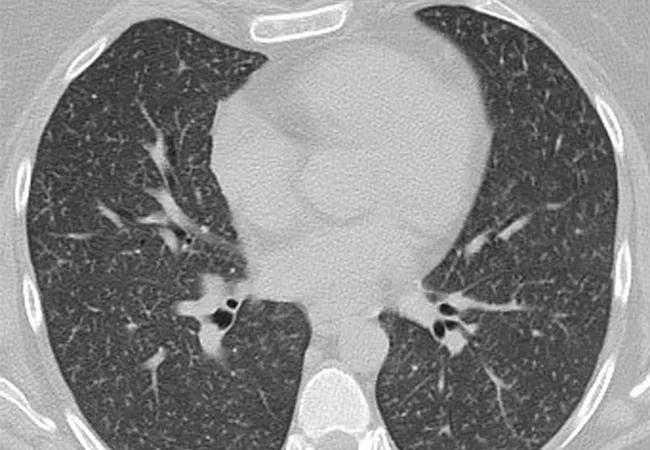
Image content: This image is available to view online.
View image online (https://assets.clevelandclinic.org/transform/a6b756f2-878a-4ba1-acbc-9be78c72684b/Mehta-4796-Inset-01_jpg)
An axial CT chest (lung window) like above will show diffuse tiny branching centrilobular opacities in both lungs. The patient above presented to the emergency department with dyspnea and a history of IV drug abuse. In many patients, NTPE due to talc granulomatosis can be progressive and fatal. Most cases are confirmed at autopsy. However, transbronchial lung biopsy can reveal diagnostic features.
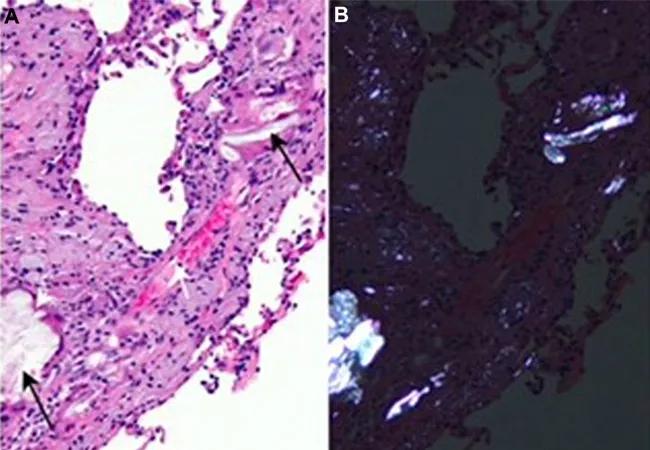
Image content: This image is available to view online.
View image online (https://assets.clevelandclinic.org/transform/1398c070-d998-4c3b-8ab7-70c25429f2c1/Mehta-4796-Inset-02_jpg)
The figures above show typical features, including extruded microcrystalline cellulose particles (black arrows) in the interstitium adjacent to a small blood vessel (white arrow), surrounded by multinucleated giant cells (arrowheads) (A). Image B shows the benefits of examination under polarized light, as microcrystalline cellulose is strongly birefringent.
Advertisement
A thorough history focusing on opioid and stimulant use can reveal clinical clues such as a history of chronic pain, a carousel of medical providers, needle tracks and infective endocarditis. Management is mainly nonstandardized and supportive.
NTPE due to talc granulomatosis is quite rare but quite dangerous. Accurate diagnosis requires extensive knowledge of imaging modalities and post-processing tools. Other posts review macroscopic emboli like catheter tips and guidewires, polymethylmethacrylate cement and brachytherapy seeds and microscopic emboli like ethiodized oil and silicone.
Cleveland Clinic coauthors include Sanjay Mukhopadhyay, MD, staff, Department of Anatomic Pathology, Derick Asah, DO, resident, and Subha Ghosh, MD, staff, Department of Diagnostic Radiology.
Dr. Mehta is staff in the Department of Pulmonary Medicine.
Images and text republished with permissions from Elsevier. Originally published in Chest.
Advertisement
Advertisement
Volatile organic compounds have potential in heart failure diagnostics

Caregivers are provided with real-time bronchoscopy patient findings
Insights for diagnosing, assessing and treating
A Cleveland Clinic pulmonologist highlights several factors to be aware of when treating patients

New program sets out to better support underserved patient populations
Cleveland Clinic pulmonologists aim to further lower waitlist times and patient mortality

Lessons learned from cohorting patients and standardizing care
New tools and protocols to improve care
 Search