Locations:





Early reductions require rapid intervention

Image content: This image is available to view online.
View image online (https://assets.clevelandclinic.org/transform/7604bac1-6e3a-4ae9-9598-52f997a748b0/650x450-Frazier_jpg)
650×450-Frazier
Advertisement
Cleveland Clinic is a non-profit academic medical center. Advertising on our site helps support our mission. We do not endorse non-Cleveland Clinic products or services. Policy
A recent study out of Cleveland Clinic Children’s Center for Autism has identified reductions in family quality of life even before a child is diagnosed with autism. This finding — made possible by the validated Child and Family Quality of Life questionnaire developed here — highlights the need to collect information about the functioning of the whole family, not just the child. When problems in family life are identified early in the child’s life, broad intervention strategies that include the whole family may lead to better outcomes for the child, parents and siblings.
For some time, researchers have known that quality of life is reduced over time in families affected by autism spectrum disorders (ASD).1 The chronic, severe nature of ASD — which typically involves impairments in one of the most central elements of human life, social interactions — can wear on a family. Tension between parents is common, as new parenting strategies have to be learned and faithfully implemented. Other siblings can be affected when the parents have to devote most of their energy to their child with ASD. Children with ASD also frequently exhibit challenging behaviors, including aggression, self-injury and elopement, which can further impair family relationships and functioning.2
Despite these well-documented factors, family quality of life is typically not a focus of initial diagnostic evaluations. As a result, most recommendations are focused on the needs of the child identified with autism and not the remaining family members.
Advertisement
To better understand how early quality of life is impacted in families affected by ASD, we developed a measure — the Child and Family Quality of Life questionnaire (CFQL) — that can be used to assess quality of life of the child, parent, family and external support network.3 The CFQL includes seven scales to assess quality of life in the following domains:
Each scale is anchored to determine whether quality of life is low, moderate or high, and the content was developed to be linked to specific actions. For example, low quality of life in the partner relationship domain would signal a possible need for referral to individual or couples counseling.
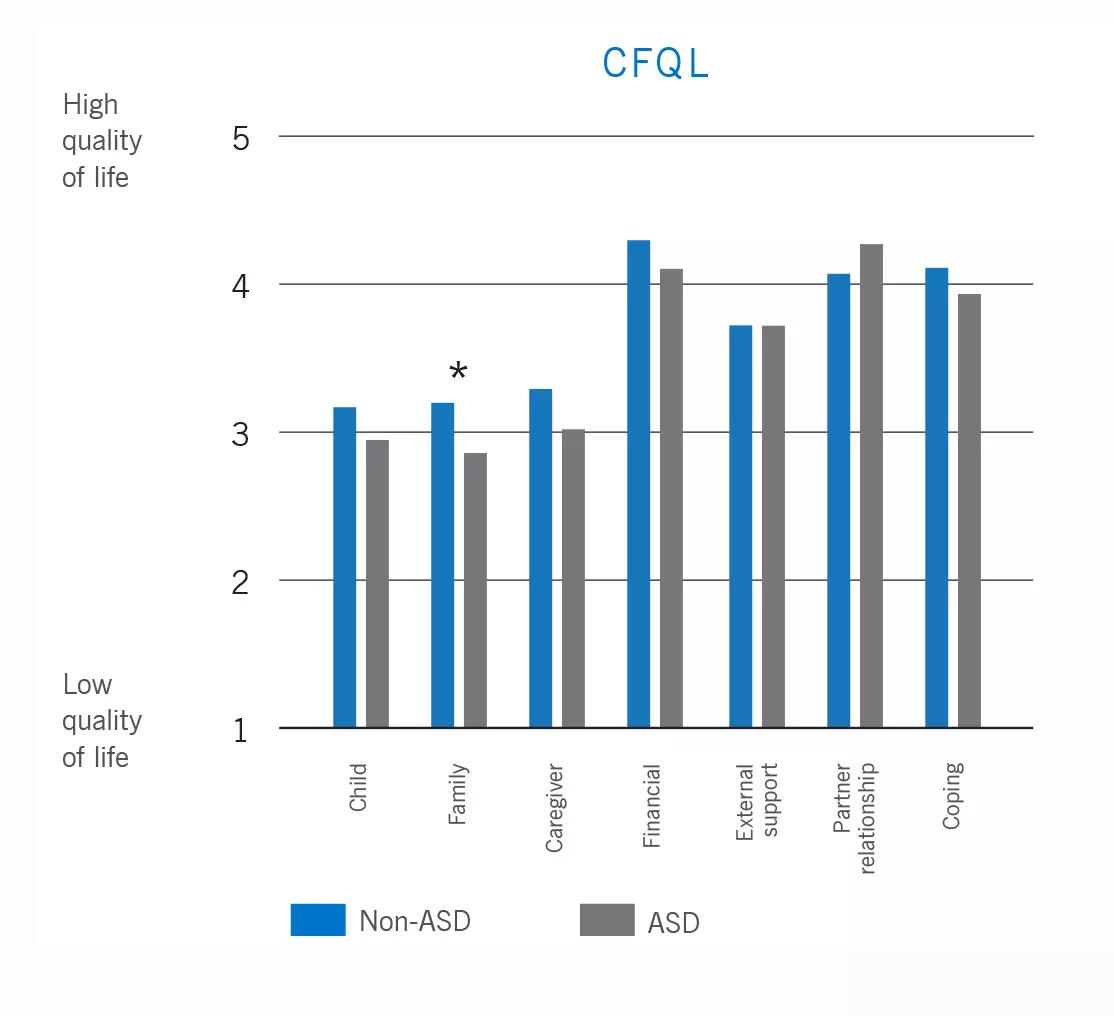
Image content: This image is available to view online.
View image online (https://assets.clevelandclinic.org/transform/819f17af-ffec-46d0-b042-cfb7474a5fd4/Inset-1-1_jpg)
Figure 1. Mean quality-of-life scores across the various CFQL scales in families with and without children diagnosed with ASD. The reduction in the family scale score for ASD-affected families was statistically significant (*P < .05). Reprinted from Markowitz et al3 as originally published in Autism.
To test the value of the measure and validate it for everyday clinical practice, we administered the CFQL to parents of 212 children suspected of having ASD before their first diagnostic evaluation visit. Of these children, 121 were diagnosed with ASD (mean age, 3.5; range, 1.2-7.2) and 91 were diagnosed with other developmental problems or had no diagnosis (mean age, 3.7; range, 1.1-6.6).
Results showed that the CFQL scales were highly reliable and demonstrated moderate relationships with one another but were unrelated to autism symptom levels or cognitive abilities. Thus, we demonstrated that the CFQL provides a nonredundant, broader measure that can be collected prior to diagnostic evaluation appointments to generate treatment recommendations for the whole family.
Advertisement
Next we demonstrated that parents of children with ASD reported significantly lower family quality of life than did parents of children without ASD (Figure 1). With the exception of external support and partner relationship, there were trends toward lower quality of life for the other CFQL scales in ASD-affected families. This suggests that quality of life is broadly impaired early in the lives of families of children with ASD, even before the children are diagnosed.
Finally, this research revealed three main patterns of quality of life in families of children at risk for ASD (Figure 2):
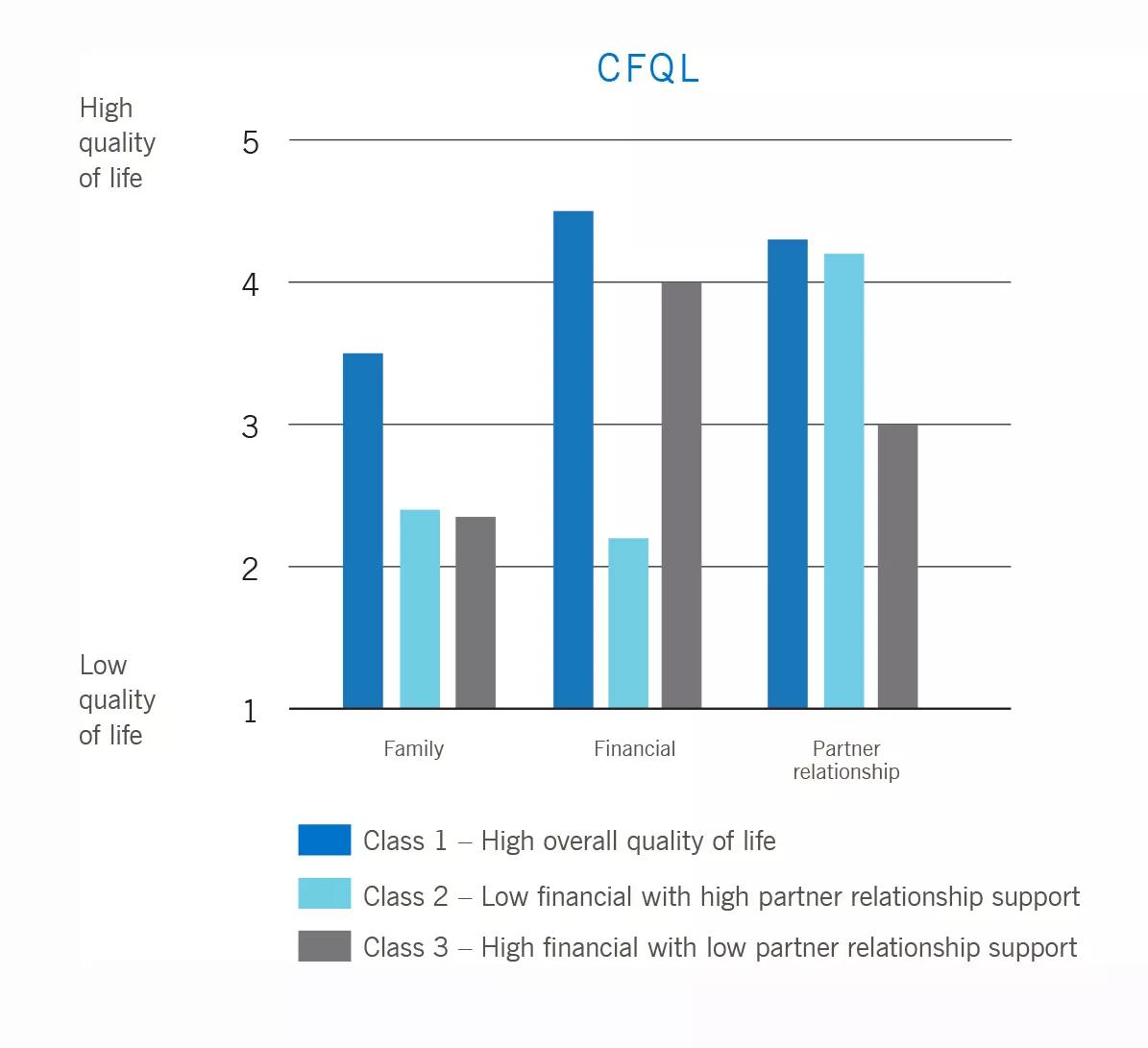
Image content: This image is available to view online.
View image online (https://assets.clevelandclinic.org/transform/6d7a8648-0df8-4a10-904a-30d232dac9c5/Inset-2-1_jpg)
Figure 2. The study revealed three main patterns of quality of life in families of individuals at risk for ASD, as reflected in the three classes detailed in the graph. Reprinted from Markowitz et al3 as originally published in Autism
The latter two patterns suggest that clinicians should be aware of the types of quality-of life impairments exhibited in families and develop recommendations that emphasize the strengths while addressing weaknesses. For example, in families with strong partner relationships but weaker financial support, it may make sense to encourage both parents to participate in behavior therapy training and refer them to low-cost government- or insurance-supported treatment programs.
Our future research will further validate and develop norms for the CFQL to enhance its use in evaluations of individuals with or at risk for ASD.
Advertisement
Dr. Frazier is Director of the Center for Autism.
Advertisement
Advertisement

Try these moves to relieve butt pain and numbness

Systemic change needed to improve health outcomes for parents and children, say researchers
Rare genetic variant protected siblings against seizures and severe hypoglycemia

Movie has more positive impact than expected, says Head of Adolescent Medicine

Genetic changes are similar between some vascular anomalies and cancers

Expert panel advises a two-tier structure for surgical centers

Our new head of pediatric general and thoracic surgery shares his passion and vision

Basic understanding of condition and treatment is lacking
 Search