Locations:





Integrating geriatrics principles in the MICU
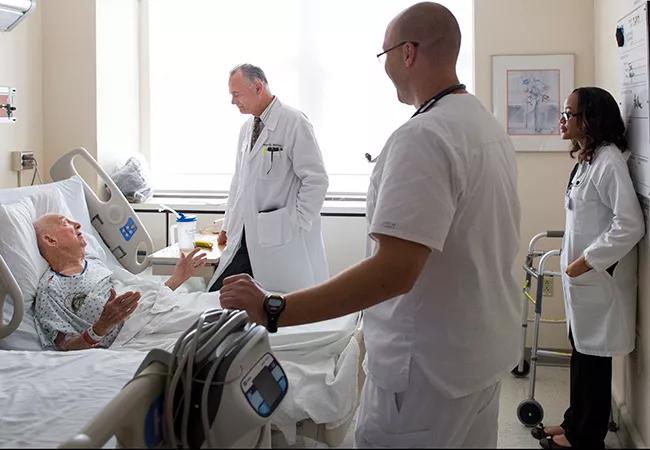
Image content: This image is available to view online.
View image online (https://assets.clevelandclinic.org/transform/613c9b45-2186-4d25-875c-5a9eddc16e30/19-GER-5540-Hero-Image2_CQD_650x450_jpg)
19-GER-5540-Hero-Image(2)_CQD_650x450
A demographic shift in aging indicates that more than 20% of patients admitted to U.S. intensive care units today are the “oldest old,” age 85 and older. That percentage likely will increase as America’s “oldest old” population grows to an estimated 18 million by 2050, according to the U.S. Census Bureau.
Advertisement
Cleveland Clinic is a non-profit academic medical center. Advertising on our site helps support our mission. We do not endorse non-Cleveland Clinic products or services. Policy
These patients — a combination of a hospital’s sickest and most vulnerable — require a comprehensive model of care that integrates geriatrics principles with critical care, says Gowrishankar Gnanasekaran, MD, MPH, CMD, of Cleveland Clinic’s Center for Geriatric Medicine.
It’s a novel concept for medical intensive care units (MICUs), he says. Currently, MICU protocols do not have standard geriatrics assessments integrated in clinical care of elderly patients. However, orthogeriatric and geriatric cardiology programs around the country have shown promise in reducing hospital-acquired complications and length of stay. And geriatric trauma services are gaining popularity, improving a multidisciplinary approach to care.
Dr. Gnanasekaran is among the leading few to develop a geriatric ICU program, embedding geriatric specialists in a critical care unit. He introduced the concept in the MICU at Cleveland Clinic in September 2018.
Now one year later, he shares what’s working and what’s still to come.
Dr. Gnanasekaran: Our program is a comanagement model. Geriatricians work alongside the patient’s critical care physician to improve outcomes in high-risk elderly patients. Furthermore, we follow along with patients on their transition from the MICU to a regular floor, providing an additional layer of care for a smoother, safer transition.
I spend much of my time in the MICU, and another geriatrician covers for me when I’m not there. A nurse practitioner is joining our geriatrics team and also will assist with coverage needs.
Advertisement
We also have started adding geriatric resource nurses (GRNs) to the MICU to do weekly rounds on high-risk geriatric patients. GRNs are clinical nurses who are experts in recognizing the special needs of older adults and educating other caregivers on best practices in geriatric nursing.
Once a month, we have interdisciplinary rounds to discuss our high-risk elderly patients. It’s a quality check for our team, GRNs and nurses. We review care, determine outcomes and discuss what we’d do differently in the future.
Dr. Gnanasekaran: We evaluate the complexity and vulnerability factors of our senior patients. Vulnerability factors — such as frailty, multimorbidity, sensory losses and cognitive losses — typically are not part of the equation in standard critical care. But we take them into account to better prognosticate outcomes, which can help ICU teams and families make informed treatment decisions.
We follow the Institute for Healthcare Improvement’s 4M Framework for Age-Friendly Health Systems:
We use a variety of tools to assess cognition (including delirium, cognitive deficits, depression and neurodegenerative conditions), polypharmacy issues, functionality and frailty.
We consider how a patient’s functionality might change after their care in the MICU. Will their cognition be affected? What about their nutritional status? We discuss options and resources available to families in caring for their loved ones once discharged.
Advertisement
Dr. Gnanasekaran: Considering the unique needs of older adults can help critical care physicians and family members make more informed treatment decisions.
For example, it’s common to intubate a critically ill patient who isn’t breathing well. But if that patient is 94-years-old and severely frail, his likelihood of success in weaning off the ventilator might be lower because of his poor functionality.
Our assessment tools help us better predict patients’ outcomes after treatment so we can begin to discuss next steps and discharge planning earlier. For example, a family has more time to select a skilled nursing facility when they know sooner that a patient will require rehabilitation before returning home.
Dr. Gnanasekaran: In our first year, we observed more aging patients with cognitive impairment, frailty and polypharmacy burdens that may have impacted their MICU care. These preliminary findings were just observational.
Now beginning our second year, with IRB approval, we plan to measure outcomes quantitatively. We intend to study the data to see how we can improve critical care for geriatric patients. This would help identify value in strategically disseminating our care model systemwide.
Advertisement
Advertisement
Pilot study confirms feasibility of conducting additional research on the novel treatment

Longer hospitalization does not mean a safer, faster recovery for patients age 70+
Structured data helps identify older adults at risk for poor outcomes, defines patients who require more comprehensive assessments


Self-administered tool can be completed in 10 minutes in waiting room

Social prescribing turns leisure activities into good “medicine”
A large geriatric study aims to find the answers

Analysis underscores how telehealth can help pinpoint elder abuse
 Search