Locations:





 Search
Study findings don’t support current AAP recommendations
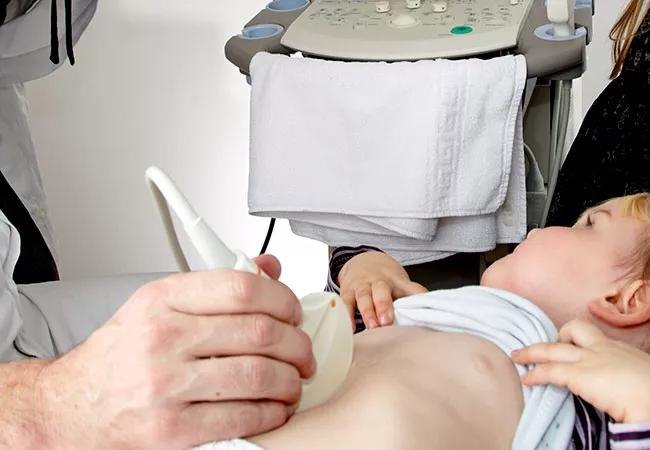
Image content: This image is available to view online.
View image online (https://assets.clevelandclinic.org/transform/17df1f2d-8b1a-4d9b-ba5b-643d35865ff7/650x450-Ultrasound_jpg)
650×450-Ultrasound
By Prabi Rajbhandari, MD, and Raed Bou Matar, MD
Advertisement
Cleveland Clinic is a non-profit academic medical center. Advertising on our site helps support our mission. We do not endorse non-Cleveland Clinic products or services. Policy
Urinary tract infection (UTI) is one of the most commonly encountered diagnoses for urgent care and emergency room visits. In 2011, the American Academy of Pediatrics (AAP) revised its guidelines for the evaluation and treatment of UTI in infants ages 2 to 24 months. A renal and bladder ultrasound (RBUS) was recommended as the initial screening modality in infants who present with their first febrile UTI.
In this context, RBUS aims to detect anatomic abnormalities requiring further intervention. The guidelines also recommend delaying RBUS until after the acute infection has subsided. The latter recommendation was primarily based on expert opinion, with the aim of minimizing the likelihood of detecting transient dilation of the collecting system caused by bacterial endotoxins. According to two animal studies performed during the 1960s and 1970s, bacterial endotoxins released during an acute UTI induce transient ureteral smooth muscle relaxation that, in turn, results in ureteral dysfunction and transient hydronephrosis.1,2 No similar experimental data are available in humans. Moreover, no clinical studies to date have systematically examined the value of delaying renal imaging in infants with UTI.
In day-to-day practice, planning for RBUS later during the course of the illness carries a potential risk of this valuable study being delayed weeks to months or not done at all, particularly in less compliant families or those who, for any reason, are lost to subsequent follow-up.
The primary objective of this study was to investigate whether, in children ages 2 to 24 months presenting with their first febrile UTI, obtaining RBUS early (< 10 days from presentation) versus late (≥ 10 days from presentation) is associated with an altered rate of persistent, minor anatomic abnormalities on repeat imaging. In addition, minor abnormalities detected on RBUS were correlated with the presence of vesicoureteral reflux (VUR) on voiding cystourethrogram (VCUG), and such correlation was also compared between the early versus late groups.
Advertisement
To answer this question, researchers performed a retrospective chart review of all patients 2 to 24 months of age who presented to Cleveland Clinic outpatient clinics between January 2009 and December 2013 with their first febrile UTI. Febrile UTI was defined by a temperature of ≥ 100.4°F, with an abnormal urinalysis plus growth of > 50,000 colonies of a known uropathogen on urine culture. Patients were grouped based on timing of their first RBUS: early and late (< 10 versus ≥ 10 days). The two groups were then compared based on clinical variables, including RBUS and VCUG results.
RBUS results were available for 201 patients who were included in the study. Initial RBUS was abnormal in 77 infants (38.3 percent), which included minor abnormalities (pyelectasis/pyelocaliectasis/mild hydronephrosis) in 49 patients (24 percent). Twenty-five infants with minor abnormalities (51 percent) underwent a repeat RBUS, of which 13 (27 percent) had persistent findings on repeat imaging. VCUG was done in 144 infants (71 percent), of which 65 (32 percent) had ≥ grade II VUR. Among patients with minor abnormalities, 24 (49 percent) had ≥ grade II VUR. The two groups did not differ in terms of persistent minor abnormalities on repeat RBUS (42 percent versus 33 percent, P = 0.99) or VUR detection rate on VCUG (53 percent versus 41 percent, P = 0.49).
The findings of this study suggest that in infants presenting with their first febrile UTI, minor abnormalities seen on RBUS obtained early versus late during the course of the illness carried a similar likelihood for being persistent on repeat imaging and for associated VUR. As this was a retrospective study, additional research is needed to better delineate the optimal timing of RBUS during the course of a febrile UTI in infants. However, findings did not support the current AAP recommendations to delay RBUS in infants with febrile UTI until the acute illness has subsided.
Advertisement
REFERENCES
Advertisement
Advertisement

Try these moves to relieve butt pain and numbness

Systemic change needed to improve health outcomes for parents and children, say researchers
Rare genetic variant protected siblings against seizures and severe hypoglycemia

Movie has more positive impact than expected, says Head of Adolescent Medicine
Genetic changes are similar between some vascular anomalies and cancers
Expert panel advises a two-tier structure for surgical centers
Our new head of pediatric general and thoracic surgery shares his passion and vision
Basic understanding of condition and treatment is lacking