Locations:





Helping children return to school and daily activities

Image content: This image is available to view online.
View image online (https://assets.clevelandclinic.org/transform/08160d24-1acf-4eb6-9767-081505dd8665/650x450-Pain-Rehab-GettyImages-590279936_jpg)
650×450-Pain-Rehab-GettyImages-590279936
By Ethan Benore, PhD; Gerard Banez, PhD; and Jenny Evans, PhD
Advertisement
Cleveland Clinic is a non-profit academic medical center. Advertising on our site helps support our mission. We do not endorse non-Cleveland Clinic products or services. Policy
Chronic pain in children is a tremendous problem across the United States. Due to the constant sensation of pain, children develop additional struggles with school attendance, peer relationships and activities of daily living — all of which reduce their quality of life. There is a significant financial burden of pediatric chronic pain as well. These children undergo extensive medical or rehabilitative treatments — in addition, parents often miss work to help provide this care. Current estimates are that chronic pain in children costs $19.5 billion annually in the United States.1
Despite the burden and cost of pediatric chronic pain, there is hope. Multiple treatment centers have published outcomes supporting the clinical effectiveness of intensive interdisciplinary pain management.2 These programs typically occur over several weeks, either within a hospital setting or in a day hospital or outpatient process.
The Pediatric Pain Rehabilitation Program at Cleveland Clinic Children’s is one such program that has demonstrated successful management of chronic pain, extending out two to four years.3 The program typically occurs over three weeks (two weeks inpatient, one weekday hospital treatment). On average, patients receive three hours of physical/occupational therapy (PT/OT) each day (> 15 hours/week), as well as recreational and art therapies (six hours/week), psychology (> six hours/week), parent psychoeducation/support group (three hours/week), and school (> 7 hours/week). The treatment approach also provides interdisciplinary collaboration and cotreatment. The program’s primary goal is to enhance daily functioning (i.e., return to school and activities) despite the presence of chronic pain.
Advertisement
These clinical outcomes do not come without their own cost. The added cost of intensive rehabilitation for pediatric pain in our own program is approximately $31,720 (on average). Based on the current healthcare environment and the struggle for affordable care, the financial value of intensive rehabilitation for pediatric chronic pain has yet to be determined. Our research sought to demonstrate the value of our program from a financial standpoint.4
To evaluate the cost-effectiveness of our program, we used the 2011 household component event files from the Medical Expenditure Panel Survey. Data were used to estimate the healthcare costs of our patients, including lost revenue from missed work. Using patient and family reports of missed school and work and access to medical care, we then computed estimated annual costs for all medical care related to chronic pain in the year prior to admission. We reassessed patients one year following discharge from our program using these same variables.
The table displays the significant change in healthcare utilization following intensive pain rehabilitation. All measures significantly improved at P < .05, with the exception of ED visits, which were minimal at baseline. The number 1 in the “1-Year Post-Discharge” Median column represents the estimated annual cost of healthcare related to these services for pediatric chronic pain, as well as costs for the following year (including for our intensive program. Annual expenditures dropped from $74,217 to $15,378
Advertisement
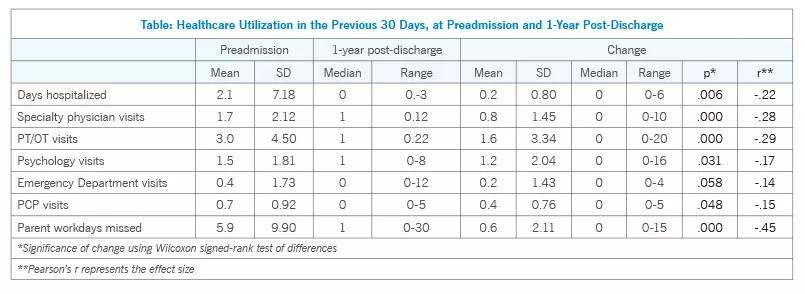
Image content: This image is available to view online.
View image online (https://assets.clevelandclinic.org/transform/02506e99-4dbe-4392-927c-2fb903c6236c/Inset-table_jpg)
(see figure). The cost savings over the first year are estimated at $27,118, but importantly, these reduced expenditures indicate how or on what basis?3
The value of healthcare services is based not only on clinical outcomes, but on the financial “value added” of these services. Our study demonstrates one method for assessing the financial value of our services. While there are limitations in the method,2 we believe that patients, insurers and healthcare providers benefit from a process to assess cost-effectiveness of clinical programs. In the current climate that emphasizes affordability and transparency, analysis of cost-effectiveness should be an objective of all those working to improve the quality of children’s healthcare.
REFERENCES
Advertisement
Advertisement
Advertisement

Try these moves to relieve butt pain and numbness

Systemic change needed to improve health outcomes for parents and children, say researchers
Rare genetic variant protected siblings against seizures and severe hypoglycemia

Movie has more positive impact than expected, says Head of Adolescent Medicine

Genetic changes are similar between some vascular anomalies and cancers
Expert panel advises a two-tier structure for surgical centers
Our new head of pediatric general and thoracic surgery shares his passion and vision
Basic understanding of condition and treatment is lacking
 Search