Locations:





Discuss gaming as a potential trigger with families of at-risk patients
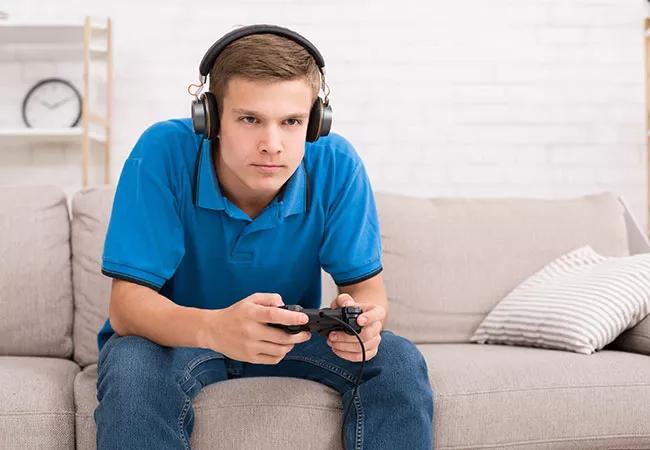
Image content: This image is available to view online.
View image online (https://assets.clevelandclinic.org/transform/7fe8d0f2-81fc-40df-8519-2ebbb4e2e2ce/650x450-Teen-Video-Games_jpg)
Teenager playing video games
Electronic gaming can trigger syncope in at-risk children, a recent letter published in the New England Journal of Medicine confirms. This is not surprising to Cleveland Clinic Children’s cardiologist Peter Aziz, MD, who says that while “sports carry risk, there are activities outside of sports that can also be risky. When we counsel families about risk factors in children at high-risk for cardiac arrest, I think including gaming as a risk factor is important.”
Advertisement
Cleveland Clinic is a non-profit academic medical center. Advertising on our site helps support our mission. We do not endorse non-Cleveland Clinic products or services. Policy
The independent nature of gaming adds an additional layer of complexity, as there may be no witness to cardiac events. “At sporting events there are a lot of people around. If a child passes out during play, the event is likely witnessed, and people oftentimes know what to do. The playground, the competitive field and the arena are probably safer places to have a life-threatening arrhythmia event than behind closed doors, in the basement, when you’re all alone playing video games,” Dr. Aziz adds.
Although rare, these instances of syncope during physical or emotional intensity can be serious. If a child has a heart condition that elevates their risk, Aziz and colleagues “always discuss triggers with families,” he adds.
In the NEJM letter, Clare M. Lawley, MBBS, of the University of Sydney in Australia and colleagues describe four instances of syncope associated with ventricular arrhythmia or ventricular fibrillation occurring in three patients.
A 10-year-old boy experienced syncope after winning an electronic war game. He spontaneously regained consciousness, but later had a cardiac arrest due to ventricular fibrillation while at school. He was subsequently diagnosed with catecholaminergic polymorphic ventricular tachycardia.
A second patient experienced ventricular tachycardia twice. This 15-year-old boy had a history of a ventral septal defect, which was treated with a Rastelli procedure to transpose the great arteries. Then one day, while sitting on his bed, he suddenly experienced presyncope when winning an electronic game. He was rushed to the emergency department, diagnosed with rapid monomorphic ventricular tachycardia and was cardioverted. Two months after placement of an implantable cardioverter defibrillator (ICD), he experienced another episode when he was about to win the same game. This time, however, he was successfully cardioverted by his ICD.
Advertisement
The third patient was an 11-year-old boy who experienced palpitations while excitedly playing an electronic war game with a friend and collapsed. He regained consciousness spontaneously. He and several family members subsequently were diagnosed with long QT syndrome.
Dr. Aziz says experience at Cleveland Clinic Children’s is “pretty similar to the NEJM letter. We’ve seen this in the context of patients who are predisposed — people losing consciousness during a heated part of a video game or passing out while watching sports.”
“We had a patient who collapsed after [watching] a winning touchdown play during the Super Bowl,” he adds.
Many parents manage risk by keeping their child out of competitive sports, Dr. Aziz says. However, pulling them out of competitive sports might increase the amount of time they spend playing video games. Furthermore, children who are gaming and not outside being physically active are at greater overall risk for cardiovascular disease from lack of exercise.
Given the relative rarity of life-threatening ventricular arrhythmia events during gaming, the message is not prohibiting video game playing in the larger population, Aziz notes.
Whenever we hear about a child who dies suddenly on the soccer field, we don’t as a community say, ‘nobody should be playing soccer.’
Most arrhythmia syndromes in the pediatric population are channelopathies — disruptions in the way ion channels form and perform inside heart muscle cells. Channelopathy-related arrhythmias typically occur during high catecholamine states.
Advertisement
When catecholamines are elevated, “your heart rate is up, you’re driven, you’re wired and you’re active – whether emotionally, physically or otherwise. Your heart rate goes up and your blood pressure increases, which are normal fight or flight responses,” Dr. Aziz says.
“We should also rethink how legislation like Ohio’s Lindsay’s Law might apply to patients with syncope during gaming,” notes Dr. Aziz. According to the legislation, anyone 19 years old or younger who passes out while playing sports must be evaluated and cleared by a healthcare professional before returning to play.
“At Cleveland Clinic, counseling patients with life threatening disorders includes sports restriction and triggers at large,” Dr. Aziz says. “We understand that restricting someone from sports can have unintended consequences, and allowing children play video games all day can have unintended consequences as well.”
Advertisement
Advertisement

Try these moves to relieve butt pain and numbness

Systemic change needed to improve health outcomes for parents and children, say researchers
Rare genetic variant protected siblings against seizures and severe hypoglycemia

Movie has more positive impact than expected, says Head of Adolescent Medicine

Genetic changes are similar between some vascular anomalies and cancers

Expert panel advises a two-tier structure for surgical centers

Our new head of pediatric general and thoracic surgery shares his passion and vision

Basic understanding of condition and treatment is lacking
 Search